Hello, everyone.
This is Enta.
"Why are you digging 3.1 meters when the design calls for 3 meters?" I was asked. That's a good question. I used to wonder the same thing myself, lol.
But that's beside the point.
This time, we'll be discussing "over-drilling" in the drilling process.
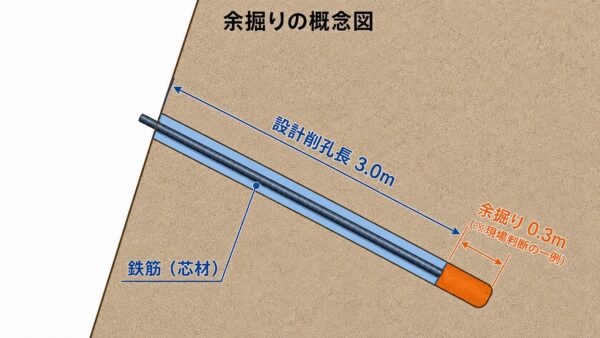
It refers to that practice of drilling slightly deeper than the designed hole depth when drilling for rebar insertion (rock bolt installation) or anchor installation.
Even though there's no mention of "over-excavation allowance" anywhere in the drawings, it's done as a matter of course on-site.
Sometimes, the design specifications also include details such as the excess length of the drilled hole.
And they won't even give me any money, lol
What is "extra digging"?
"Over-drilling" refers to the practice of intentionally drilling a hole deeper than the length specified in the design.
For example, if the design length for a rebar insertion job is 3.0 meters, the general idea is to dig a hole about 3.1 to 3.3 meters deep at the job site.
Incidentally, there is no explicit provision in the standards manual stating, “Dig X cm deeper.”
This is used to assess the condition of the natural ground at the job site, and is merely a guideline specific to our company.
Of course, if there are specific requirements in the client’s special specifications, those take precedence.
As an aside, the term “yohori” itself appears in various books.
The Guidelines for Cut Work and Slope Stabilization in Road Earthworks state that, for lateral boring works to prevent landslides, the aquifer and the slip surface should be cut through, and the excavation should be extended by approximately 10 meters beyond that.
In the world of drainage drilling, they dig extra in 10-meter increments. That’s on a whole different scale, lol.
I know, you're probably thinking, "Seriously?!", but it's written on page 434 and onward, lol.
Why Is Over-Digging Necessary? | The Culprit Is a Slime
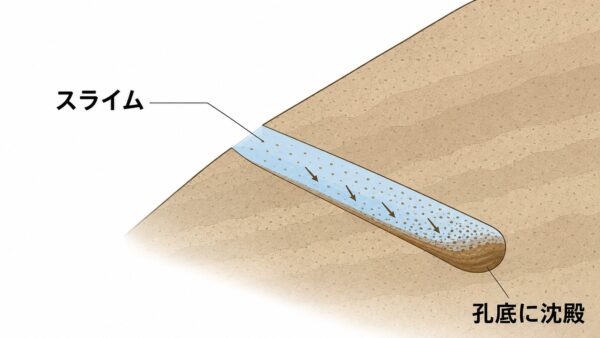
To cut to the chase, the culprit is the slime (Kuriko).
The chips and slurry produced during drilling are blown out of the hole using air or water, but some inevitably remain inside the hole.
And once the drilling is finished and the rod is pulled out, the slime inside the hole slowly trickles down to the bottom of the hole.
In other words, if you drill exactly to the design depth, the hole will end up being shallower by the amount of slime that has accumulated at the bottom of the hole.
This is also carefully noted in the standards; the manual for ground reinforcement states that if slurry remains in the borehole,
It states that slurry must be completely removed after drilling, as failure to do so may interfere with the insertion of the core material or cause defects that significantly reduce the bond strength between the ground and the reinforcement.
The design and construction standards for ground anchors also stipulate that, after drilling is complete, the borehole must be flushed with clean water or air, and that tendon insertion and grouting must be carried out promptly as a continuous process.
Thoroughly cleaning the borehole is the most important thing. On top of that, over-drilling serves as a safety measure to account for any material that remains or settles.
Field Case Study | The Last 10 cm Won't Fit
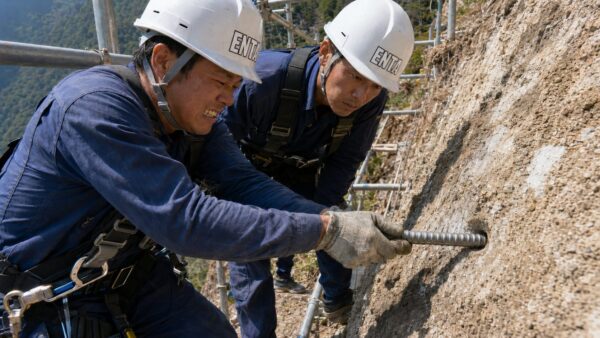
Here’s an example from our own experience. At a cliff drilling site, we drilled the hole exactly to the chief designer’s specifications and thoroughly cleaned the borehole, but when we went to insert the rebar, it stopped dead about 10 cm from the end and wouldn’t go any further.
Slime had accumulated at the bottom of the hole, so the effective hole length was insufficient. Since the rock drill causes the hole walls to crumble easily, the slime that wasn’t completely flushed out during cleaning, combined with the crumbling of the hole walls, caused the bottom of the hole to fill up in no time.
At this point, I guess I'll either clean it again or drill a hole in it, lol.
We'll pull out the rebar, reinsert the rod, re-drill the hole, and start the cleaning process all over again.
A loss of a few tens of minutes per bottle. If that happens a few times in a row, the day’s target number of bottles goes out the window in a flash lol.
This is a story about how nothing would have happened if they had simply dug 10 to 20 centimeters deeper from the start and cleaned the area.
Ideally, I’d be able to gauge the mountain’s tendency to collapse from the first few sections, but mountains aren’t that straightforward...
Depending on the hill, sometimes I’ll dig about 1 meter too deep, and other times I’ll hit the perfect spot, so the view is completely different each time. It’s all part of the experience, though ^^
Another concern is “leaving the anchor in place after drilling.” According to anchor standards, in soft rocks prone to slaking—such as mudstone or tuff—leaving the anchor in place after drilling may result in the anchor failing to achieve the required circumferential friction resistance.
The holes you’ve dug are still fresh. It’s absolutely out of the question to just leave them alone until the next day, thinking you’re safe because you dug a little extra.
Be careful not to dig too deep
So, does that mean you’ll be safe if you just dig deep? Not necessarily.
First, the amount of grout increases by the amount of excess excavation.
Since the grout is injected while displacing the material from the tip of the borehole toward the mouth, the grout also fills the space created by over-excavation.
Even if the cost per piece is minimal, when you’re dealing with a site that requires hundreds of them, the material costs add up significantly.
Next, the drilling time will also be extended by the amount of over-drilling.
If you dig 50 cm deeper than necessary into hard bedrock, the drill bit will wear down that much more, and it’ll take up extra time.
Also, be careful with anchors at angles that are close to horizontal.
According to anchor standards, setting the inclination angle within the range of −5° to +5° should be avoided, as residual slurry or grout bleeding may significantly affect the anchor’s load-bearing capacity.
Holes that are nearly horizontal are hard for slime to escape from in the first place. So, this isn't something you can just get away with by digging a little extra, lol.
Occasionally, when we inspect a hole that was dug deeper than planned, we are told that it is “deeper than the design specifications = over-excavated.”
If you let the supervisor know in advance by saying, “We’re digging a little extra to prevent the slime from collapsing,” the inspection will go more smoothly for both of us.
Also, be careful not to dig too deep—you might end up with too many anchors and not be able to pull them out, lol.
See you later.