

Hello.
This is Enta.
The other day, I thought I had posted it, but it hadn't gone up.
My apologies.
I’d like to introduce a product that I found to be quite good while testing out various crack-preventing materials.
I think Nafuroku is something everyone uses quite often.
That's the one used in the simplified method, right? It's a very expensive product—a real headache for directors.
Also, I think that when used in spray applications, it often forms clumps that can cause clogs, but,
I want to prevent cracks, but it's hard to find a good product.
As a condition,
1. Mix well.
2. It doesn't form a ball.
3. It's cheap.
4. No cracks form.
5. It's even better if it's registered with NETIS.
6. It doesn't prick your hand when you grip it.
There are probably more, but I guess these are the kinds of criteria I use.
The product used this time is from a store in Osaka,Tezac Co., Ltd. A company called “Toughlight RG" a product.
I tried using this.

Here's what the packaging looks like.
This one contains 20 kg.
The ingredients are
It appears to range from 0.91 kg (standard) to 1.82 kg per cubic meter.
I bought it as part of my creative experimentation and to try mixing it in, so I used 0.91 kg.
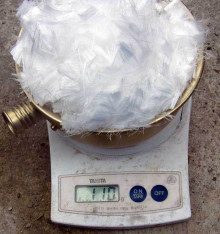
It’s roughly a heaping handful, weighing about 0.1 kg. (0.11 kg per BT)
I didn't use a mixer or anything like that when adding the ingredients; I just roughly mixed them in by hand.
Nothing like a thorn pricking my hand happened.
So I tried playing it, and surprisingly, it didn't get too sticky (though it did get a little sticky), and I was able to use it comfortably.

It's mixed thoroughly.
I was wondering if it might end up being a bit more round, but this is actually pretty easy to use.
The unit price is 1,700 yen per kg. (Estimated price)(I think the unit price varies depending on the supplier.)
20 kg for 1,700 yen = 34,000 yen (This is just a rough estimate!)
Assuming 0.91 kg per cubic meter, there is enough for approximately 18 cubic meters.
I think it falls well within the scope of what can be considered creative ingenuity.
What's more, if no cracks form, there will be no need for touch-ups, so it might actually be a better deal when you consider the total cost.
If it were a little cheaper, I'd use it more... lol
I haven't yet seen how much this reduces the crack occurrence rate, so I'll write about that in a follow-up post.
By the way, since there’s mortar inside the frame, I’d like to conduct experiments using both 0.91 kg and 1.82 kg.
I'll also check the difference between that and the test piece lol
See you later.