Hello, everyone.
This is Enta.
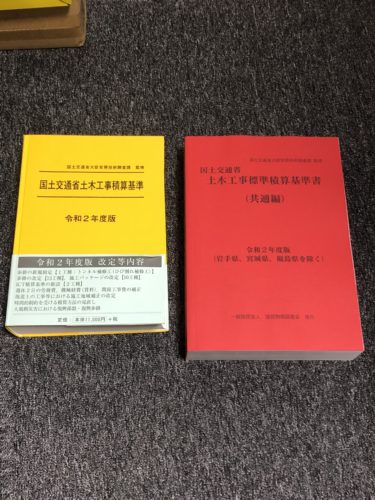 I finally bought it!
Estimation Standards!! lol
I did have it in fiscal year Heisei 22.
However, since there was one small thing I didn't understand, I figured I had no choice but to buy it, so I went ahead and made the purchase.
While this isn't particularly relevant for those who only perform on-site construction work, it's an essential tool for site supervisors who manage construction projects.
Well, it's not like I use it all the time, but it's always good to have one on hand.
These days, we can generally figure out the detailed construction methods using cost estimation software (we use Gaia), but there are times when the information just won’t come up, and there are often cases where it’s simply not available.
That's exactly when you need this book, isn't it?

For those who aren't familiar with it, this book explains how to calculate design costs for public works projects.
By analyzing this, you can understand how public works projects are designed (calculated) and how the construction costs are determined.
That's why this book is so important.
We also use this book to perform calculations during the bidding process.
As a firm specializing in subcontracting, we use this because it helps us handle design changes when we’re a first-tier subcontractor, and because accurately calculating the costs for specialized work in the general contractor’s bid can affect the outcome of that bid.
If the general contractor wins the bid, the work might come our way. (Or maybe not? lol)
It is also used for purposes such as conducting economic comparisons during the design phase.
Please consider this book to be the cornerstone of public works projects.
It is absolutely essential for understanding everything about public works funding.
Recently, there are even specifications—known as “construction packages” (SP)—where it’s not entirely clear what they entail, but you can simply enter the quantities to generate a cost estimate.
Well, I can't deny that I feel like I'm being taken advantage of and getting a raw deal.
It's a little tricky, but once you've done it once, it's actually surprisingly easy.
I think it's important to have a solid understanding of financial matters, even if you're a subcontractor.
Why is the bid amount what it is? What are labor costs? How are they calculated?
I think that by learning this, your company’s quotes will change, and in some cases, you may even be able to aim to become a general contractor.
I think that if you have a solid understanding of financial matters, negotiations with the general contractor will go more smoothly.
People often say that subcontractors get cheated, but in reality, they weren’t cheated—they simply lacked the necessary knowledge.
If I’d known, it wouldn’t have turned out that way.
As the saying goes, ignorance is no excuse
Let's get started with cost estimation, even as a subcontractor!
(If you really want to know, I'll tell you lol—if I have some free time.)
See you later.