

Hello, everyone.
This is Enta.
The other day, I ran into a totally baseless accusation, and I'm still a little shaken up lol
People who don't make any sense—whether online or in real life—are scary.

But that's beside the point.
The other day, I was watching a recorded episode of a show called “The Unknown Gulliver.”
It's a program that introduces various major Japanese corporations, and most of these companies have grown by leveraging their proprietary technologies.
It seems that the major companies today, in particular, have been constantly pursuing new technologies since the early Showa era—or even earlier—and have continued to do so up to the present day.
And we continue to work on developing new technologies to this day.
It is thanks to these benefits that we are able to enjoy our comfortable lives.
In such a development environment, it takes an enormous amount of time to gradually turn the project into a finished product.
The same applies to slope construction; we contractors are able to carry out this work after paying patent royalties and licensing fees.
Since the product patents have already expired, these products are now available from any manufacturer.
Back then, we used to buy materials for an astronomical amount (I think it was about five times what it is now), and looking back, it was quite an era.
But when I think about how our current work exists only because there are people who developed those products, I can’t help but feel grateful.
In the past, anchor manufacturers held patents on their materials, so there was a time when construction simply couldn’t proceed without purchasing those materials. (The same applied to legal frameworks.)
Back then, even if you could drill holes, only major companies that paid licensing fees could purchase the material, so in a sense, it was a monopoly.
The common factor here is patents, but another is the presence of a director.
The people who provide guidance on these patent-based construction methods are generally construction supervisors.
It was a time when construction simply couldn't be carried out without a supervisor.
I suspect that for those of us in the industry who are in our 40s and older, this is the dawn of the technologies currently being used for slope stabilization.
Thanks to that, when I was younger, I was able to attend many construction review meetings and trial construction sessions regarding specialized construction methods for which the company paid patent royalties.
I’m not very familiar with construction methods that have just recently been introduced, but back then, there were a lot of pilot projects.
There were also many construction methods that are not widely used today.
In other words, the construction supervisors from that era are now at a level where they can teach construction techniques to construction companies.
In the past, there were so many supervisors like that, so there were often cases where contractors couldn't carry out the work.
A construction supervisor who teaches them everything from scratch.
Looking back now, I realize what an amazing time that was.
Nowadays, anyone can do it as a matter of course.
Any new construction method is standardized to some extent, so after about a week of on-site work, you’ll generally be able to do it yourself.
Lately, when I think about that, I realize that precisely because this is the kind of work anyone can do, I want to make sure I do it right.
Even with our specialized, patented construction methods, pretty much anyone can do the work in about a week.
Regardless of how fast or slow you are, it's designed so that anyone can do it.
That’s exactly why I think it’s better to make an effort to do it thoroughly and reliably.
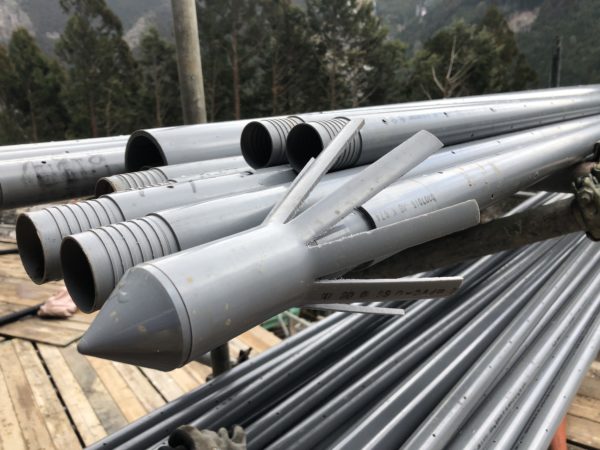
We've been conducting drainage borehole drilling for the past few days. (I'm training a Vietnamese operator.)
I'm showing them how to make sure the perforated pipe is positioned correctly.
Make sure to apply plenty of PVC adhesive, too. (That goes without saying, lol.)
Some people don't use PVC adhesive, and others are fine as long as the perforated pipe is in place.
That won't work.
Since it’s a simple job, we want to make sure we do it right.
See you later.