Hello, everyone.
This is Enta.
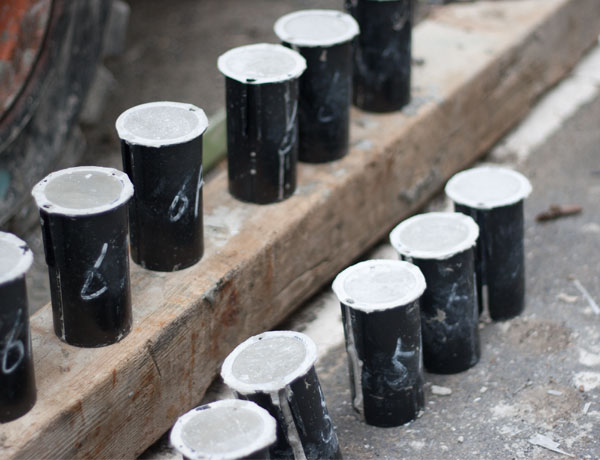
How many do you produce per day for rebar insertion and ground anchor work?
In formwork construction, the specifications explicitly require verification of both the one-week strength and the four-week strength.
Therefore, we will collect one test specimen per day and take six core samples (θ7 and θ28).
So, what about test specimens for ground anchor work and rebar insertion work?
The specifications generally state thatTwice a day (morning and afternoon) I think it says that.
This means taking samples after each pour, whether it's in the morning or afternoon. (It's pretty straightforward, lol.)
For example, let's say you administered it in the afternoon.
In that case, since no injection was performed in the morning, the test specimens will be from the afternoon only.
So, how many samples should we collect here?
Three? Or six?
The answer is three!
The quality control standards for ground anchor work and rebar insertion work do not specify that samples should be taken for one week or four weeks.
Basically, four weeks' worth is sufficient. (We'll proceed with the discussion using ordinary cement.)
So why do some people take six samples (one week, four weeks) during the first round of sampling?
In the case of ground anchor work, one-week strength data is collected in order to apply tension and secure the anchor as soon as possible after drilling and grouting.
This is necessary because tension work is performed after confirming that a strength of 24 kN or more has been achieved after one week.
"I can't wait four weeks for it to take effect,"Our circumstancesThat's right. (The reason being that the construction schedule is being shortened.)
As stated in the Ministry of Land, Infrastructure, Transport and Tourism's Standard Specifications,"However, this should be done after verifying that the mortar has reached the required strength."
It is clearly stated that...
Generally, the standard period for verifying concrete strength is four weeks.
Concrete strength refers to the strength of concrete 4 weeks (28 days) after placement; therefore, the standard period is 4 weeks.
By standardizing this, we can identify trends in variation and areas of defects.
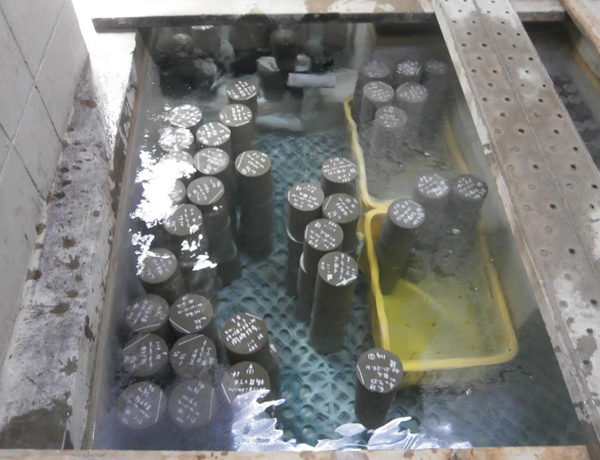
For the reasons mentioned above, four weeks is the standard duration; therefore, even if the desired intensity is achieved in one week, the full four weeks are still required.
So that means we've collected six samples.
This applies only when a final tensioning operation is performed as part of the ground anchor installation.
However, there are some rebar installers who get caught.
Reinforcement installation work will undergo acceptance testing four weeks after the concrete reaches its design strength.
Simply put, this acceptance test checks whether something passes or fails.
The standard practice is to check after four weeks of high-intensity training.
If you want to speed up the process and finish sooner, you can conduct the acceptance test one week after confirming the strength has developed.
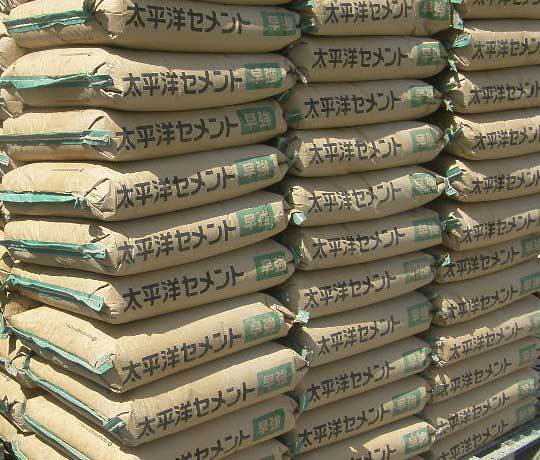
The above example was written based on the use of ordinary cement.
If rapid-setting cement is used, the curing time is reduced to 3 days for the first week and 7 days for the fourth week.
When you think about it that way, it really does cut the construction time significantly.
However, in the case of rebar insertion work,The "3-Day Intensive" is just a waste of moneyThat's it.
The reason is that, even when factors such as the number of pours are taken into account, there isn’t much difference between conducting the acceptance test on the third day and conducting it on the seventh day.
Even if there were only five piles to be installed, it would take one day for drilling and grouting, one day for cleanup, and one day as a contingency.
That's a total of three days.
There's not much difference between taking the exam on the 4th day and taking it on the 7th day, is there?
That means I’ll lose about 5,000 yen in exam fees (enough for three exams) over those three days.
If the number of piles to be driven were as high as 500 or 1,000, the cost would be astronomical.
Furthermore, you cannot expect to earn extra points for creativity or ingenuity in the quality control of this section (being able to take the exam early).
That's because it serves no purpose in rebar installation work.
I'm like, "Those exams can wait, right?" lol (I don't really care about them.)
As long as it's installed properly, it will almost never come loose, and there won't be any problems!
These days, there are jacks that are lightweight. (They’re easy to handle even if you have to carry them up later.)
It’s a waste to use one-week curing time (or three days for fast-setting concrete) for rebar installation.That's the point.

Compressive strength testing is a very expensive process.
This is an area where we want to cut costs as much as possible, but we also want to manage it carefully.
Pointless management is a waste of time and effort. And ultimately, that translates to money.
Every minute of your time is worth money.
If we can reduce waste even a little, the company will make more money, and
He's highly regarded as a construction manager!
If you keep cutting out all the unnecessary construction management tasks, you'll be able to go home without working overtime, right? lol
Right now, I think just the bare minimum plus a little extra is just right. (I used to make way too much, lol.)
If it's "the best plus something extra," no amount of time would ever be enough.
"Isn't 'just enough' good enough?"—that's what I, as a subcontractor, thought I'd write lol (You're probably thinking, "Who are you to say that, as a subcontractor?" lol)
See you later.