

Hello, everyone.
This is Enta.
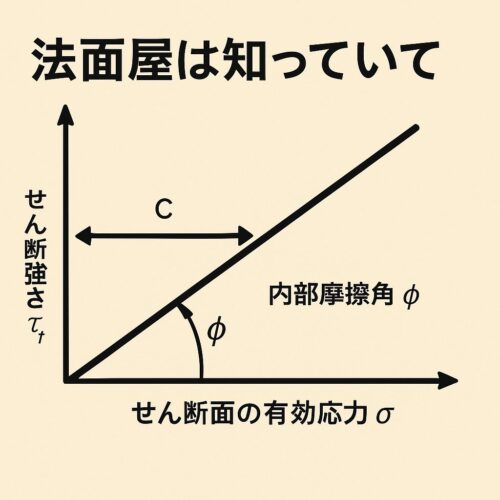
In my last post, I wrote about the strength of soil.
So, this time...We will take a closer look at the adhesion c (kN/m²).
Definition of Adhesive Strength
Cohesion (symbol: c) is a numerical measure of the force with which soil particles tend to stick to one another.
It is expressed in kN/m² and is an essential indicator for evaluating the strength characteristics of soil.
If this “cohesion” is high, slopes and excavated surfaces are less likely to collapse; conversely, if it is low, the soil cannot support itself and is more prone to collapse.
An Illustration of Adhesive Force
Sandy soil (dry sand) → Cohesion ≈ 0; loose and crumbly.
Cohesive soil (clayey) → High cohesion; the wall surface tends to stand on its own.
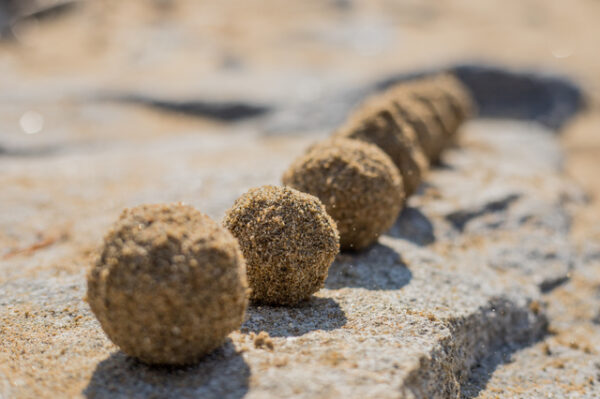
For example, when making “sandballs” in a sandbox, dry sand won’t hold its shape, but sand that contains moisture or clay will harden.
So this “property of solidifying” is what we call adhesive force, right?
Meaning of the Numbers
For example, if c = 20 kN/m²,
This means that the soil is being held in place by a force of 20 kN (approximately 2 metric tons) per square meter of shear surface area, preventing it from collapsing.
To get a concrete idea, consider a shear cross-section of 1 m²,
It possesses “additional strength” that allows it to withstand a load of 20 kN ≒ 2,000 kgf (approximately 2 metric tons) without collapsing.
This strength manifests as a ’cohesive component“ that exists even when the ”effective stress (σ’)” and “friction angle (φ)” are zero.
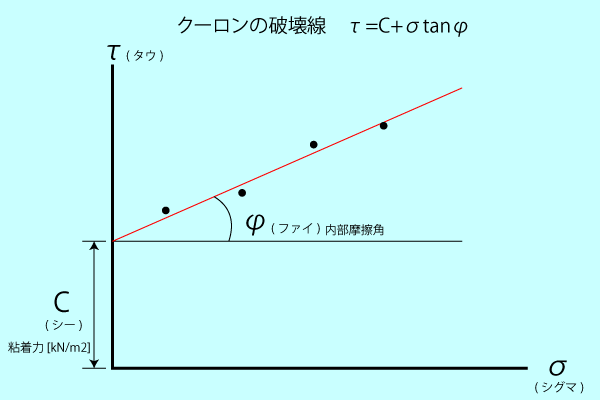
Shear strength equation:=+σ′·tan
Even when σ’ = 0 here, τ = c, and a resistance of 20 kN/m² is generated.
In terms of design, based on the Mohr-Coulomb failure criterion,
Shear strength is evaluated as τ = c + σ’・tanφ (where σ’ is the effective stress and φ is the angle of internal friction), and c is treated as the “constant cohesion component” within this equation.
Why is this important?
Slope Stability Analysis: The higher the cohesion, the greater the stability.
Feasibility of drilling: Required for estimating the self-supporting time.
Foundation Design: Essential for determining bearing capacity and slip failure.
In particular, determining whether the soil at the site is sandy soil with near-zero cohesion or cohesive soil with high cohesion is a key consideration during the construction phase.
Adhesion c [kN/m²] = The adhesive force exerted by the soil.
It is nearly zero in sandy soil, but high in clay.
In mathematics, it is a constant in the "Mole-Coulomb equation."
This is a required item in slope stability calculations.
And as an engineer, it’s important to keep in mind that c varies significantly depending on the type of soil and its moisture content.
That’s exactly why you can see how important it is to drain the water, right?
See you later.