Hello, everyone.
This is Enta.
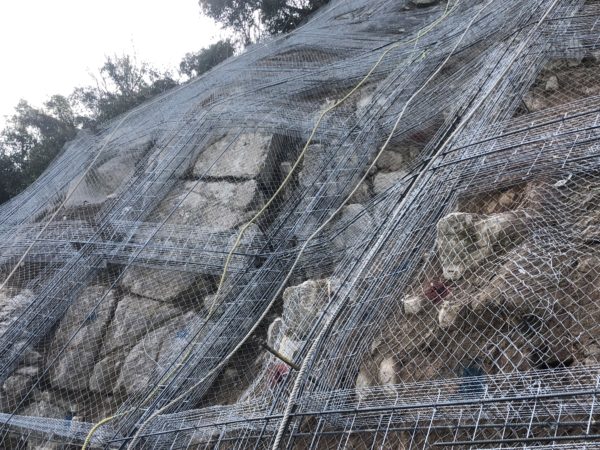
I believe this falls within the legal framework, but if it were within the boundaries shown in the photo, how would you rule on it?
The area within the design boundaries is designated for landscaping.
On the left is bedrock.
On the right side, the ground consists of soil mixed with sand, with rocks exposed in places.
Eighty percent of this mountain consists of exposed bedrock.
In particularly difficult areas, we used static blasting agents to break up the rock in sections.
The design calls for landscaping—what do you all think?
There are also sections with a gradient of 6 minutes or more in the earthwork area.
Actually, it’s not impossible to plant vegetation there. (Although it would be difficult in the long run if the ground is solid bedrock.)
It grows to some extent on the rocky area on the left as well.
However, based on current trends in slope construction, the options are either full-surface shotcrete or mortar spraying within the formwork.
For the past few years or so,Long-term maintenance costsConsidering this, the sealed construction method is the mainstream approach.
Open-Type and Sealed-Type Frame Structures
When I say that "sealed enclosures are the norm," the government officials seem strangely convinced.
Apparently, maintenance is indeed an issue in some government offices; mowing the grass costs money, and above all, it requires manpower.
From the government’s perspective—since it’s responsible for managing these matters—it naturally wants to minimize them as much as possible.
Recent trends at NEXCO also show a shift toward sprayed concrete.
They're spraying concrete nonstop on the embankment next to the highway after clearing the trees, aren't they?
In addition, repairs to the Nagata slope in the past were also carried out by applying shotcrete over existing shotcrete. (Ote Special Construction Method)
Well, that’s just the way things are these days. (Not that I intend to blame everything on the times.)
Before it gets to the point where no one can manage it anymore, we’re gradually switching to construction methods that don’t require management.

That leads to a simple idea: we just need to come up with construction methods that don't require supervision, right?
I wonder what kind of construction methods will emerge that are easy to install and maintenance-free.
For now, I think we can proceed with the airtight construction method without any issues.
At this job site as well, even for areas with only partial soil and sand, we ended up using sprayed mortar.
It used to be said that with the sealed construction method for earth-filled sections, the soil inside would be washed away by rain, leaving the interior hollow, but,
Actually, it doesn't seem to be that big of a deal.
Past facts are present lies, future rumorsThat's kind of how it is, lol
Civil engineering has been quantified based on empirical data and forms the foundation of the field today.
This means that those figures will continue to change over time as experience levels evolve.
Even in an industry that you might think hasn't changed in over 30 years (based on my experience), you can see that it's gradually changing, right?
The closed-system method is currently the mainstream approach for in-frame spray application! (Though I’m probably being a little biased here, lol)
See you later.