Hello, everyone.
This is Enta.
Did you all know that?
I also visited the site the other day and was informed that rebar insertion work appears to have been added to the Ministry of Land, Infrastructure, Transport and Tourism’s Civil Engineering Construction Management Standards—specifically, the quality control standards and specification values from March Reiwa 3.
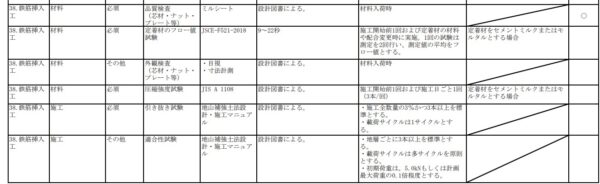
Last year, in March of Reiwa 2, “mid-layer mixed treatment” was the last item listed, but this year, “rebar insertion work” has been added below it.
At the very bottom, it says this:
| 38. Reinforcing Bar Installer | Construction | Other | Conformity Testing | Design and Construction Manual for Soil Reinforcement Methods for Natural Ground ル |
As per the design documents. | ・As a general rule, three or more samples should be taken from each stratum. ・As a general rule, the loading cycle should consist of multiple cycles. ・The initial load shall be 5.0 kN or approximately 0.1 times the design maximum load. |
Standards and Specification Values for Civil Engineering Construction Management (Draft)
It's the third photo from the bottom.
If the Special Specifications or similar documents state something like “Investigate soil conditions on-site” (which is often written in small print on design drawings these days, lol), that means you’ll need to determine τ (tau: lateral friction resistance) for each soil layer.
Standard Basic ExamIf it's just that much,Drilling → Injection → Curing → Pull-out Test → It doesn't come out, so it's OKThat’s fine, but going forward, it is increasingly likely that we will be required to calculate the circumferential friction resistance values for each soil layer listed in the design calculations.
To be honest, it's a really big hassle.
I can understand that for ground anchor work, but do you really need that for rebar installation!?
That's the contractor's take on it, lol.
Somehow, I’ve started getting asked to do nothing but weird, pointless things... (Of course, the construction company charges for this, but it seems to be included in the general contractor’s fee...)
But I always wonder—who’s the one saying things like this, anyway?
When setting standards like these, I would really like to have a clear explanation of who said what, how it was decided, and why it’s necessary.
I'm sure engineers all over the country would like to hear a convincing answer~
Well, I guess hearing about it won't really change anything, lol.
But I can't help but wonder, "What's going on here?"...
Since there is a high likelihood that this compliance test will be required in the future, it would be best to make everyone aware of it.
And today, I'm going to take that 👆 compatibility test again lol
See you later.