



Hello, everyone.
This is Enta.
I've been swamped with a sudden rush of work.
It was such a sudden assignment, I couldn't help but ask, "Why?" lol
Well, I suppose there are various reasons for that...
That said, I had a little free time between jobs, so it was fine.
Based on my experience of receiving help when my family was in a difficult situation in the past, I’ll do whatever I can to help.
I'll go to any job site.
Of course, that's assuming there's room, lol.

But that's beside the point.
Boilers are quite commonly used in cold regions.
Does anyone here use a boiler?
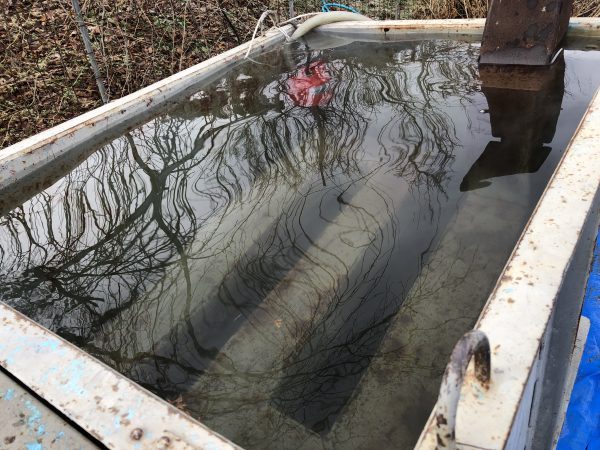
This is what our storage-type water heater looks like.
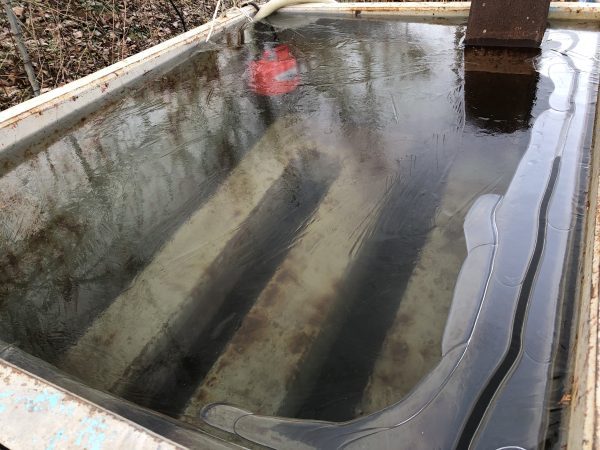
When I get to the site first thing in the morning, it's usually frozen solid.
Roughly speaking, it's about 3 centimeters of ice. Even during the day, the temperature can drop below zero sometimes! lol
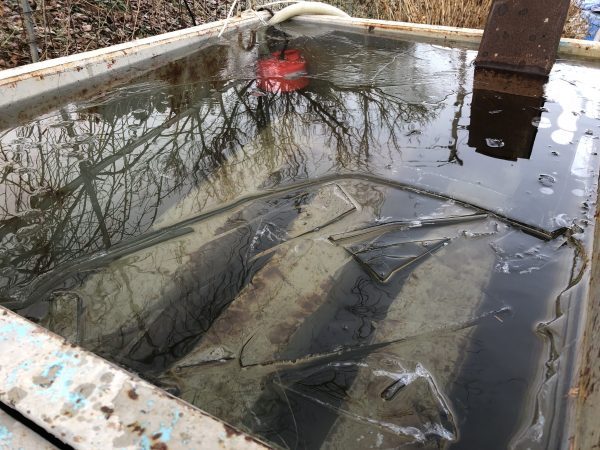
Thanks to the mild winter this year, it’s not too bad so far, lol.
Since I couldn't break it by hand, I tried hitting it with a hammer.
You don't even have to break it up—just turn on the boiler and it will melt right away.
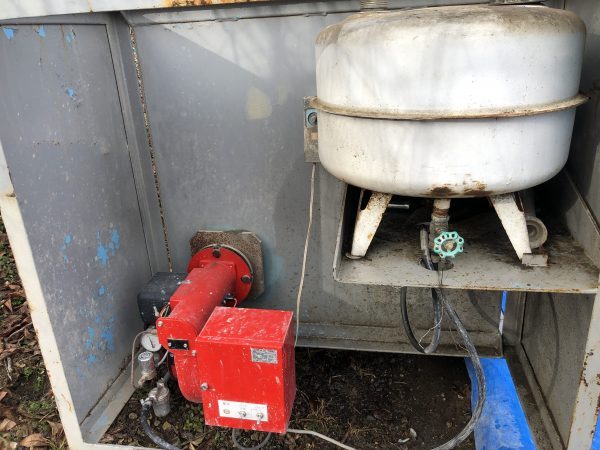
You put fuel in the top, and the fire comes out of the red part.
This heats it up all at once, so the water turns into boiling water incredibly fast.
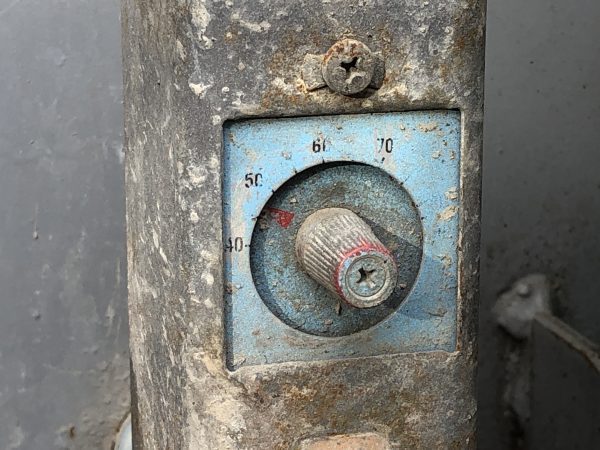
Use this knob to adjust the temperature.
Taking the final mixing temperature into account, set it to around 50 degrees.
Although it is quite sensitive to the surrounding climate, at temperatures like this, the mixing temperature of mortar and concrete is around 10 degrees.
If the internal temperature is close to 10 degrees after spraying, initial hardening will be accelerated. (This improves the hydration reaction.)
As a result, it heats up quickly and is less likely to freeze, even without the use of antifreeze or similar additives.
Once the set temperature is reached, the boiler will automatically shut off, and it will restart if the temperature drops below the set temperature.
It wasn't because they used antifreeze that it didn't freeze; it simply didn't freeze to begin with, or they had taken other measures to prevent it from freezing.
When winter comes, every service provider does its best to prevent pipes from freezing.
While antifreeze is part of those efforts, I believe the results are due to the other efforts even without it.
How much do you spend on antifreeze for the winter season each year?
If you use it for three years, you could buy a boiler with that money, right? lol
It heats up in about 30 minutes, so I highly recommend it.
My hands get numb and it's really uncomfortable, especially during the cold season, so it feels amazing to dip them into this hot water.
Since it also improves the quality of concrete and mortar, hot water is the best choice for winter construction!
See you later.


Hello, I always enjoy learning from you.
I'm a field sales representative for a manufacturer of slope protection mats.
I’m always encouraged by Enta’s blog, and I’m working my way up from the bottom.
I'm sorry to ask a question that's unrelated to this blog post, but,
Hōchō: We have decided to conduct a trial construction project at the site along the mountain ridge.
I'm trying to do the work while hanging from above, but,
If you fall, you'll die.
As a safety measure, I would appreciate any advice beyond what is listed below.
・Bring as many anchors and ropes as possible to avoid having to re-tie them.
・Check the safety of the safety harness and safety belt at the designated work area
・Breaks every 3 hours (times subject to staffing conditions)
As for scaffolding, would it be acceptable, for example, to install anchors parallel to the shoulder of the embankment to build the scaffolding?
I would really appreciate any advice you could offer.
Thank you in advance.
Kaori Honda
Thank you for your hard work.
Please do make it to the top!
You might get to see both the sights you don't want to see and the ones you do.
You won't know until you try it, lol.
As for ridge work, I wouldn't recommend bringing too many tools with you.
That goes even more so for carrying things by hand. (If you can use a machine to move them, go right ahead, lol.)
I believe the order of construction is important.
I think the first priority is to set up the ropes and other equipment to ensure safety.
However, if you have to carry everything by hand all the way to the ridge, it’s probably best to keep it to a minimum so it’ll be easier later on.
It’s fine if the rope covers the area where work will be performed, so please bring enough anchor pins and rope to cover that area.
As for replacing the cover,
Whether you are using a lifeline or a main rope, switching ropes on a slope is generally prohibited.
It’s a bit of a hassle, but please either climb up to the ridge or prepare a different rope and use that to secure the anchor. (General Guidelines for Slope Supervision)
I don't know how wide the ridge is, but if there isn't enough space to lay out the materials, start by driving anchor pins directly into the slope to secure them. Alternatively, lay out the materials one after another along the slope shoulder and secure them there.
Please make absolutely sure that the cargo does not shift and fall.
It’s wiser to make use of the surrounding trees than to try to build a makeshift scaffold.
Keep your belongings to a minimum.
As far as breaks go, I think the standard practice is fine. If we set them at fixed intervals of three hours, it might get in the way of craftsmen who want to stop at a natural break point.
If we start talking about safety, there’s no end to it, and eventually we won’t be able to do the work at all, so we have to strike a balance—but as long as we can do the work safely, there’s no problem.
Are the key requirements the use of a lifeline and a safety harness? If you’re using the main rope as the lifeline, you’ll need a rope that’s 1.5 times as long.
Is that the important part?
When working in hazardous areas, prioritize safety over workability!
Good morning. Thank you for your prompt response.
Even if there are sights I’d rather not see, I’ll do my best and look forward to it!
I apologize for asking such a basic question, but,
As a textbook on safe construction practices, would the National Association for the Protection of Specified Slopes’ Guide to Safety and Health Management be a good reference? When it says the rope is 1.5 times as long, does that mean the slope length is 1.5 times as long?
By the way, since this is a test, the work area is only about 30 square meters, so it’s impossible to use enough rope to cover the entire mountain ridge.
This time, there are no trees or anything else on the slope. It turns out that the flow of traffic is more important than the scaffolding.
I'll do my best to keep things off my shoulders so there's no wasted space (`_´)ゞ
Thank you for your hard work.
When I say "1.5 times as much rope," I mean that the number of ropes will increase by about 1.5 times. (I didn't explain that clearly enough.)
Normally, 10 rods are enough for the job, but they’re adding about 5 more to ensure the lifeline is secured.
If it's not feasible to run a rope along the ridge line, you can also drive anchors into the slope itself and run the rope from there.
Please be careful to secure the rope anchor properly.
As long as construction can be carried out safely—even if it’s in the middle of a slope—any shape is fine.
In the slope construction industry, it’s common to use ropes for scaffolding. With that in mind, please think about how to place items.
I guess it'll end up being a book on all special features. (Isn't there anything else?)
Take care!
Thank you as always. I’m a bit embarrassed to be asking such basic questions at my age, but I won’t give up on myself and will keep doing my best. I look forward to your continued support!
Thank you for your hard work.
It's definitely better than someone who, at their age, can't even ask basic questions!!
This is important. Never forget your original intentions.
When I get questions like this, I learn something new every time.
Reviewing helps solidify my memory more and more, so it’s been a big help to me, lol.
We look forward to your continued support.