

Hello, everyone.
This is Enta.
Following up on my previous post, I’d like to write about measures to address misaligned pressure plates.
Tips for Installing Compression Plates in Ground Anchor Construction (Part 1)
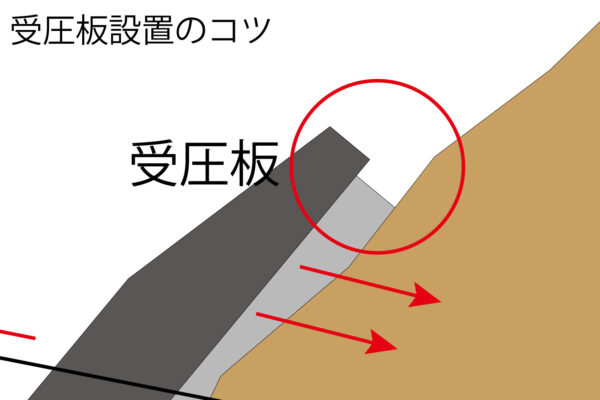
It ends up a little off, like that lol
Even if it's just about 1 cm or 2 cm, it really stands out when you're on site.
If that’s the case, especially during an inspection, there’s a good chance it will be pointed out, so you might want to apply some mortar there...
It’s not really a problem in the long run, but still, from a construction standpoint...
To be precise, wouldn't this reduce the contact area of the pressure-bearing plate, potentially causing an uneven load?
To resolve this,
1. Adjust using the zabuton frame without using the angle adjustment base.
2. Keep the angle between the load-bearing plate and the anchor as close to a right angle as possible to minimize the difference.
3. Secure the pressure plate so it does not shift during tensioning, and then apply tension.
(If I get nervous, I don't move much, but what if there's some vibration??)
4. Place a mat or similar material on the contact surface of the pressure plate to increase friction.
5. Drive an anchor pin into the pre-drilled hole in the pressure plate and secure it until it’s tight (this might be the most common method, lol)
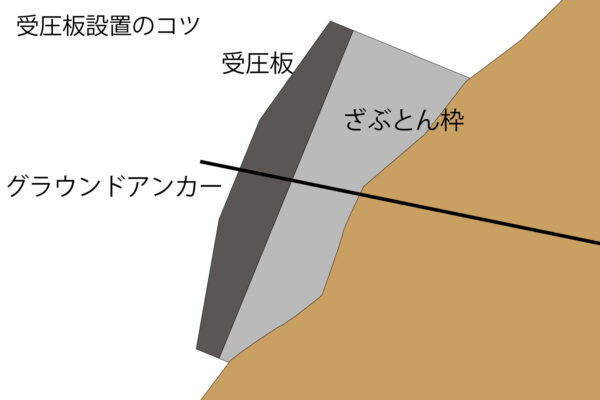
As shown above, use the zabuton frame to keep the angle between the anchor and the frame as close to 90 degrees as possible.
Just this alone makes it much less slippery.
I’m sorry to bring up the basics, but steel does slide on concrete!
They don't get along at all.
Both the steel pressure-bearing plates and the PC pressure-bearing plates are very slippery because their undersides are shiny and smooth.
I guess it's to increase the contact area, but if possible, I'd prefer it to be a little bumpy...
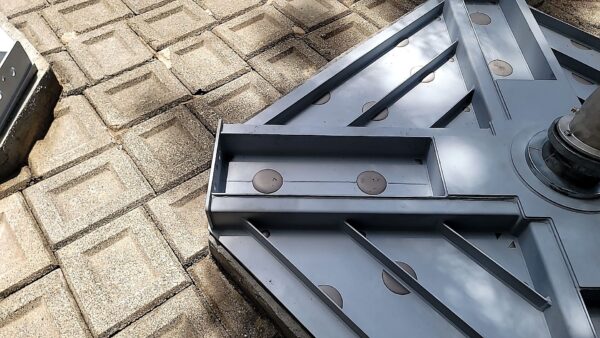
I also think a mat would be useful.
I also think the Fit Frame construction method might be the most logical choice.
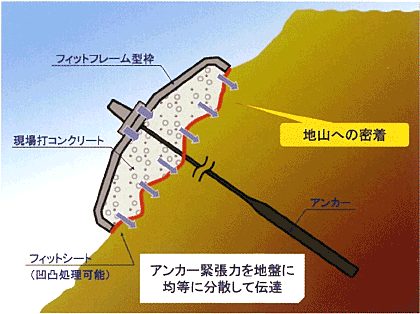
Since this method involves installing the load-bearing slab by pouring ready-mix concrete afterward, I believe it allows us to transfer the maximum amount of force to the natural ground.
There are all kinds of load-bearing plates out there, so it would be great if they’d adopt a construction method tailored to the site, lol.
It can be really tough for us on the construction side, lol
Well, I guess that's just part of the job, but I'd still prefer to do it as easily and accurately as possible, lol.
See you later