

Hello, everyone.
This is Enta.
Do you have a pressure plate installed? lol
Well, if the design calls for installing it, then I’ll install it, but there are some tricks to installing the load-bearing plate, aren’t there?
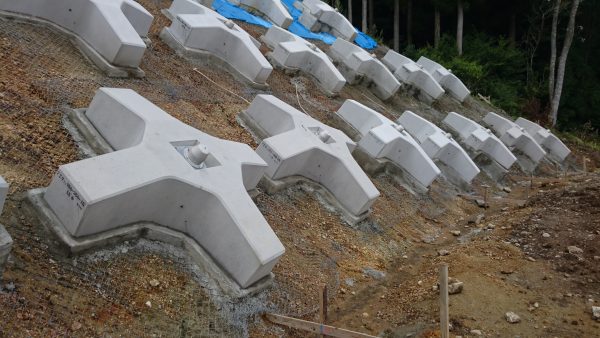
The key to installing a pressure plate is how well you can install it without shifting its position, right⁉
That's the point.
Huh?
Right? lol
That's right.
It's only natural for people to think, "Huh?"
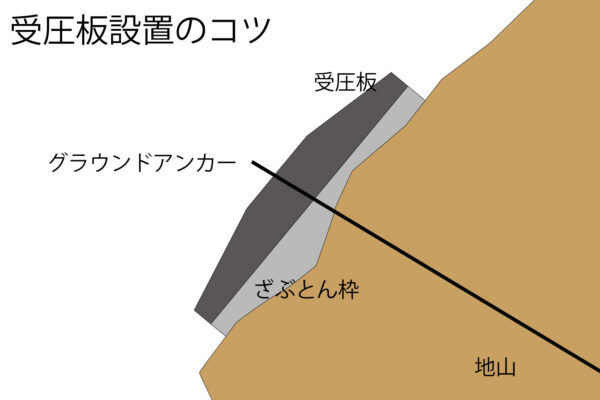
Normally,
After leveling the surface as described above, install the load-bearing plate and proceed with the tensioning of the ground anchors.
That's pretty normal.
However, the shallower the installation angle of the ground anchor, the more skill it requires.
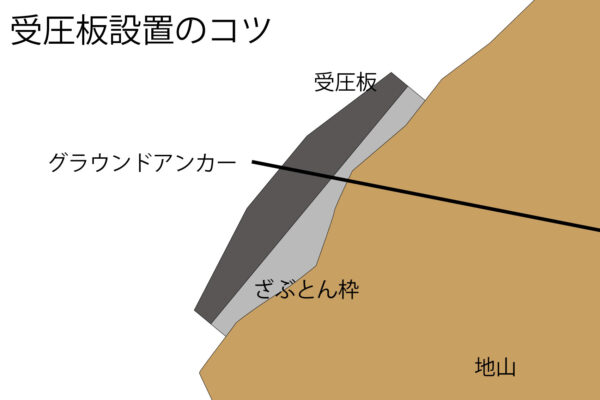
If the zabuton frame is designed to be as minimal as possible, it will be a thin zabuton frame.
In addition, they are often designed to be adjusted using a head angle adjustment base.
The reason is that it's cheaper to adjust it at the head.
Normally, since you can adjust the angle using the zabuton frame, that method is less likely to cause problems.
However, problems sometimes occur when adjusting the angle using the angle adjustment base.
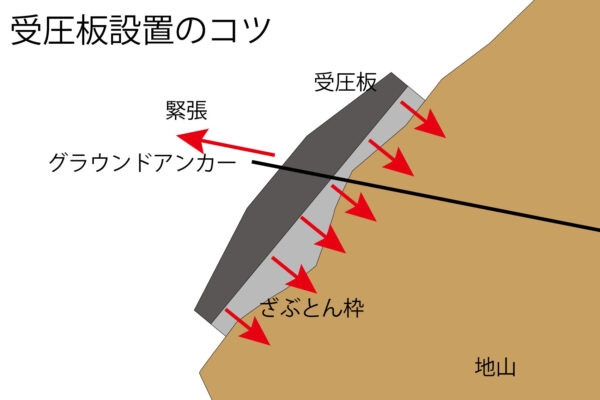
Normally, I think it would look something like this. (I’m describing it a bit exaggeratedly.)
When the anchor is tensioned, the force is transmitted through the cushion frame to the surrounding rock, right?
From a common-sense perspective, this is the norm.
But in reality, the force turns out to be as shown below.
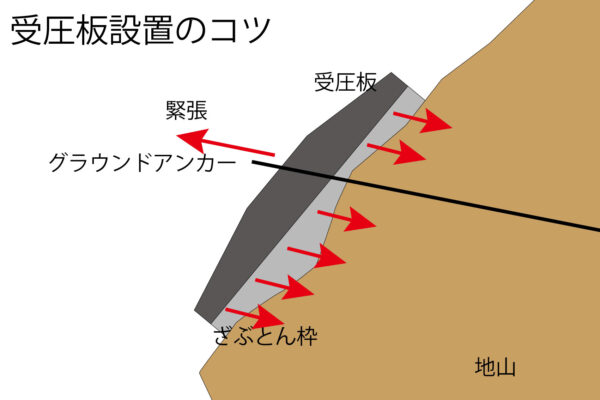
If that happens, what happens is that the pressure plate shifts lol
Every now and then, when I’m working next to an old anchor, for example, I often see misaligned load-bearing plates.
That's what's happening.
The placement angle is too shallow relative to the slope.
It won't be that far off, right?
You might think that, but it can easily shift by 1 cm or 2 cm. (Although that’s still within the acceptable range.)
What happens if it's off?
The load will decrease.
And it sticks out beyond the edges of the zabuton. (Well, it’s still within acceptable limits, though.)
If it shifts and then settles into place, the load won't drop, lol.
We'll discuss those measures next time.
See you later
P.S. I was in Tokyo the other day for the VSL Anchor Association's general meeting.
It's raining cats and dogs, but I'll keep quiet about the fact that I'm a rain magnet.