On June 14, 2008, the Iwate-Miyagi Inland Earthquake struck.
I went on a field survey, but since I wasn’t involved in the project afterward, I don’t know the details. One of the field trips at this September’s National Conference of the Japanese Society for Landslide Research was to the Aratozawa landslide site. It seemed the tour filled up immediately, so I rented a car and went to see it on my own.
However, since the area where you could view the landslide was off-limits, I could only catch a glimpse of it from a distance and barely saw anything. It was raining really hard, too... I heard that the tour group was able to go all the way into the path that had been built inside the landslide. I wonder where the entrance was?
When I went on a field survey, I took some photos—it was a spectacular sight that looked like something out of a CGI movie. Seeing this kind of dynamic natural activity really gets anyone with a background in the natural sciences excited. Since there were no casualties at this location, I didn’t have to hold back much... And since there weren’t any man-made structures there, I didn’t have to worry about the media, which loves to sensationalize man-made disasters.
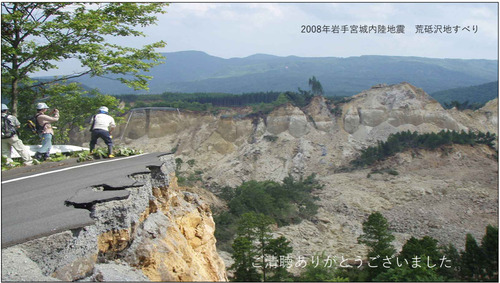
The photo above was taken back then. The photos below are a collection of a few I found online. The scenery is amazing.
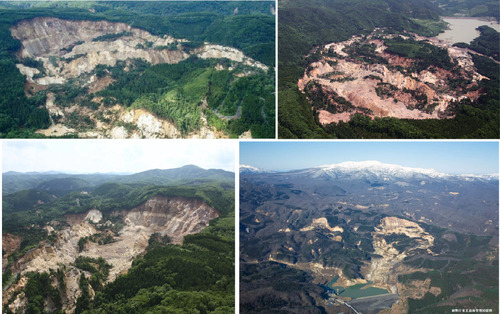
The photos below show the area before and after the landslide. I doubt anyone could have predicted this specific slide pattern just by interpreting the topography. It probably wouldn’t have been possible to figure it out even in hindsight. However, if we could retroactively set the 3D geological structure and excess pore water pressure, we might be able to reproduce it to some extent through calculation... However, since methods like the limit equilibrium method or FEM require the soil mass to remain a continuous medium, they probably won’t get quite close enough to the actual behavior.
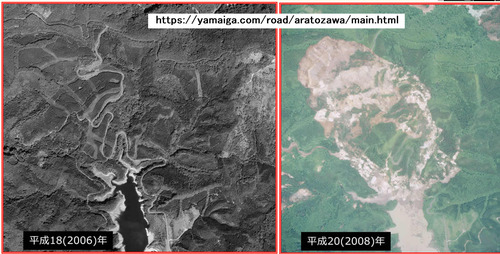
When the geological survey results were released, revealing that the slip surface was almost horizontal, I got even more excited. Since it’s a landslide with a diameter of about 1 km, it’s on a similar scale to the Kamenose landslide. I recall that it was composed of sediment accumulated in a caldera remnant, so rather than being like Kamenose, it might actually be closer to the Muroji landslide in Nara. The Muroji landslide is huge, too.
The basic principle of landslides is that, given the relationship between the soil mass load W and the slope angle θ, W·sinθ represents the force caused by gravity that drives the soil mass downward along the slope. However, when the slope is horizontal—that is,When θ = 0, the sliding force is also zero.Everyone probably wonders, “How can it move on such a large scale without any driving force?”
I believe that when the mountain split apart, the force of gravity pulled each section vertically in a wedge-shaped pattern, which in turn generated lateral forces, resulting in a lateral landslide; however, at the base of the soil mass—which is 100 meters thick—As long as it has a perfectly ordinary level of strength, friction will keep it from moving.。
Since it moved this much,The strength of the slip surface was virtually zero.We must consider this. However, I haven’t heard many discussions that focus specifically on the case where the slip surface strength becomes zero (though I don’t think no one has ever mentioned it).
Probably,The essence of this landslide lies in its “zero slope strength.”That said... in fact, this applies to all other types of landslides, as well as the sliding collapse of embankments and, more broadly, surface collapse.
I can't help but wonder why such a thrilling story isn't generating more buzz.
I believe that when a block of soil slides, it’s because the shear strength approaches zero for various reasons. Although I say “various,” excess pore water pressure is the main culprit.
In the Aratozawa landslide, there was likely water above the stable layer, with a mass of soil resting on top of that. This was not the original state of the site; rather, this structure was formed by vertical ground motion exceeding 1G. Once this structure is established, excess pore water pressure equivalent to the weight of the soil mass builds up in the water, allowing even the largest soil masses to slide with ease.
Even in the case of a sliding collapse of a cut-and-fill embankment, the slope angle of the slip surface is very gentle, at around 5 degrees. For this to slide, the strength of the slip surface must be virtually zero. Since the sides act as a brake, the embankment must overcome that resistance to slide; therefore, the strength must be zero for the balance to hold.
Even in the case of a typical landslide, since water pressure is applied to the strength of the very weak clay on the sliding surface, this value should also be quite close to zero.
During record-breaking torrential rains, excess pore water pressure builds up to the point where it lifts the soil, causing the strength of the slip surface to drop to zero in this case as well.
In short,The root cause of landslides is that conditions may arise in which the strength of the slip surface drops to zero....that's the gist of it.
When you think about it that way,All landslides can be explained by a single principleIt will turn out like this.
More importantly, if the problem is caused by excessive pore water pressure, you should realize that it would be foolish to “let the soil slide and then try to forcibly stop its movement with retaining piles or the like.” It’s like something out of Don Quixote.
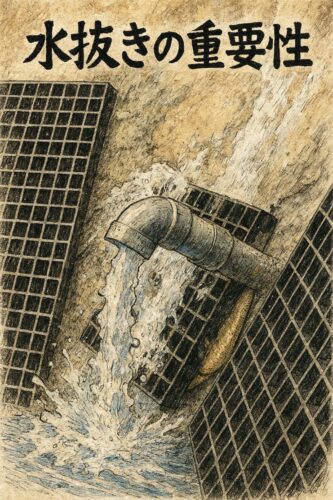
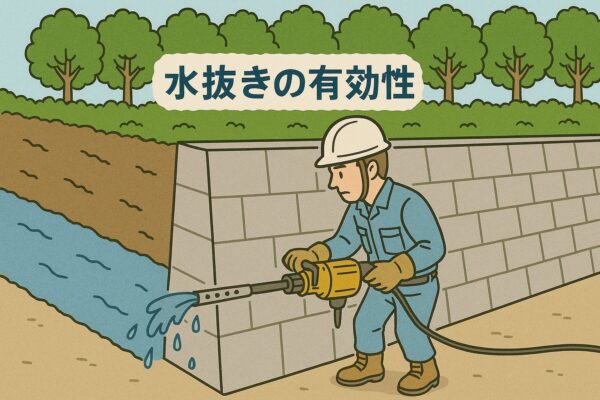
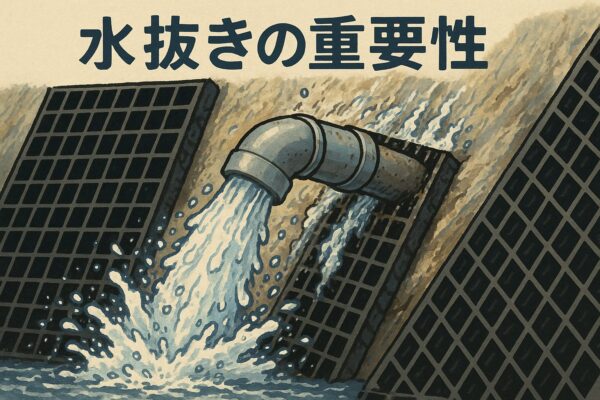
OccurSimply by creating a bypass that allows excess pore water pressure to escape to the surface, excess pore water pressure will no longer occur.(Or it will get smaller), so there’s no need to stop it by force in the first place.
"Method for Preventing Zero Slope Strength"That’s actually the most effective—and also the cheapest—method for dealing with slope instability.
—————
Have you ever heard of a hydraulic lift? While they’re used today to transport heavy loads, there’s also a theory that they were used to hoist the massive stones of the pyramids to great heights. In principle, it’s actually fairly easy to lift a mountain using hydraulic pressure. The earth-and-rock slide on Izuyama in Atami City was likely caused by something similar. Strangely enough, though, soil engineers only ever consider hydrostatic pressure.
How Did the Ancient Egyptians Stack the Giant Stones of the Pyramids? A New Theory Emerges
https://www.cnn.co.jp/fringe/35224686.html
———-
It’s something that naturally occurs to anyone who thinks about the principles behind slope stabilization work while carrying it out. Even Mr. Enta, who’s well-known in this industry, came up with this idea.
New! Enta's Slope Management School
Installing drainage rock bolts prevents excessive pore water pressure caused by water pressure from building up.
And so, we're getting to the heart of the matter.
Mr. Enta has visited us several times to discuss this construction method. This design approach is essentially based on the same principles as drainage reinforcement pipes. It primarily relies on measures to dissipate excess pore water pressure, with shear reinforcement serving as a secondary measure.
With this construction method, the generation of excess pore water pressure is suppressed, resulting in a higher level of protection against collapse. Since excess pore water pressure does not occur, the structure is unlikely to enter a failure mode easily; therefore, analysis based on frictional resistance is unnecessary. Even if it functions as a retaining structure, it should be considered primarily as shear reinforcement.
And since it doesn’t enter destruction mode, there’s no need to worry about such a bizarre concept as the slope reduction factor—in fact, a load-bearing plate isn’t even necessary in the first place.
The calculation method is shown below (though I doubt you’ll be able to make it out). Naturally, since this calculation method is protected by intellectual property rights, you’ll need to enter into a contract with me if you plan to use this design. This means we’re in a collaborative relationship with Enta.
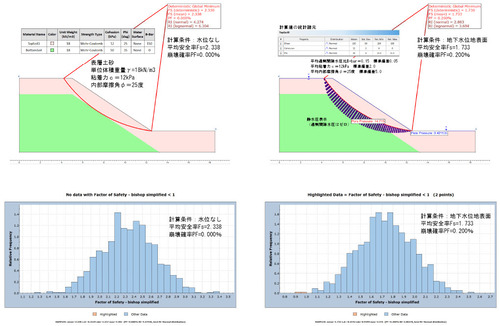
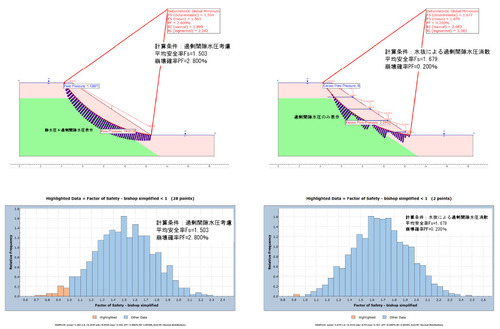
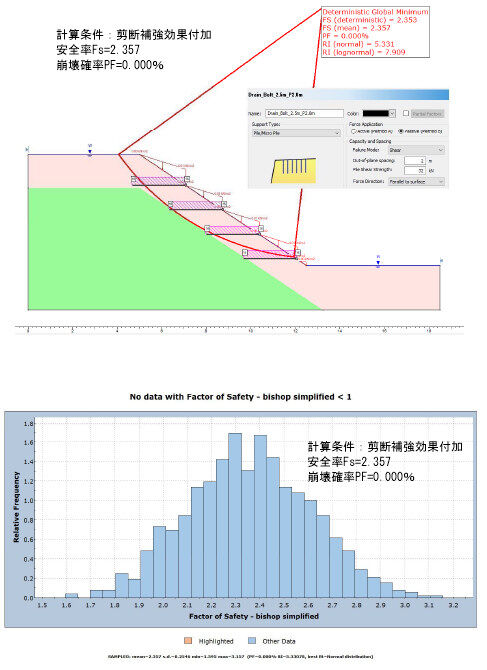
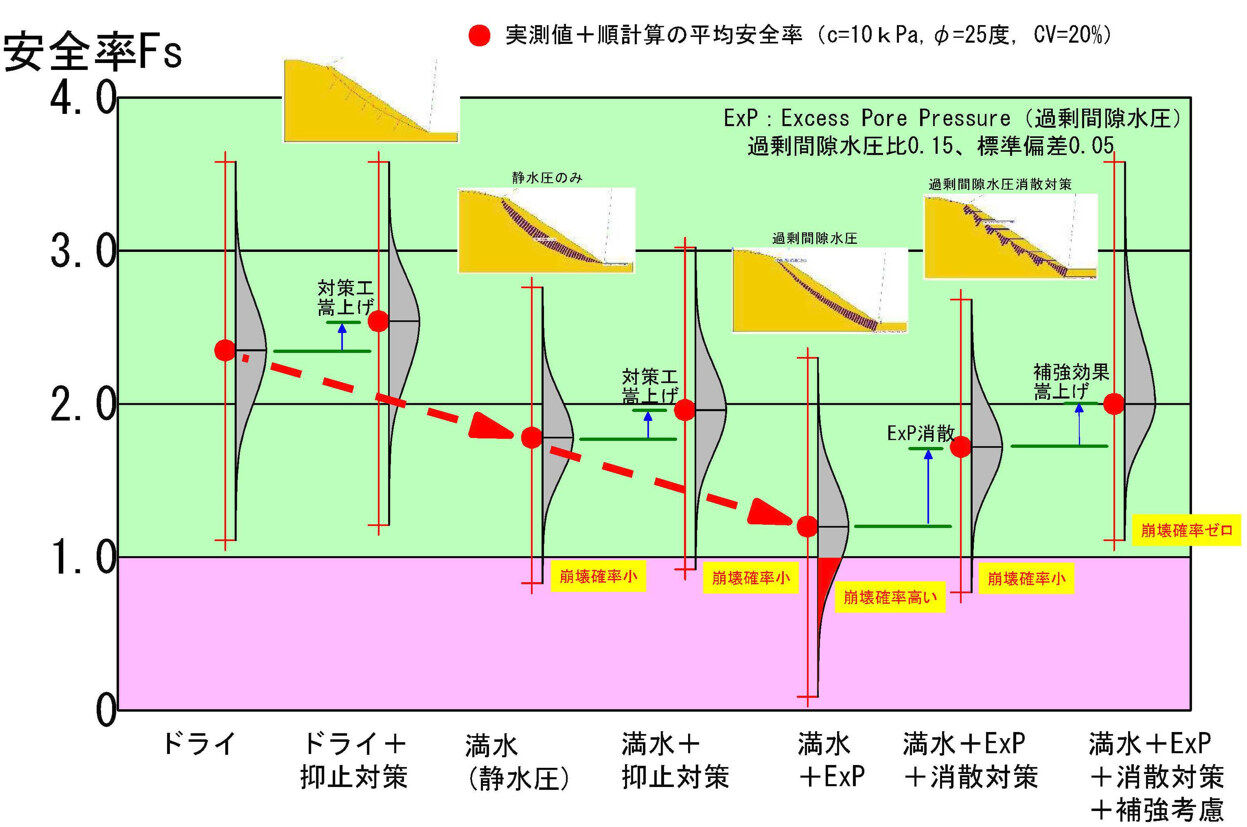
For those accustomed to inverse calculation methods, this graph showing the safety factor trends for slopes may seem quite unfamiliar. Slopes typically have a very high degree of stability. They won’t slide just because a light rain has caused water to reach the surface. Even during record-breaking downpours, the average safety factor (Fs) remains greater than 1.0.
In public works projects, a “safety assessment” would typically be conducted. However, since there is actually variation in soil strength and the excess pore water pressure ratio, it is necessary to consider these factors probabilistically. Consequently, even if Fs > 1.0, there are cases where, probabilistically, Fs < 1.0. This is why collapses occur sporadically.
If the calculated average safety factor were to fall below 1.0 (Fs 1.0).
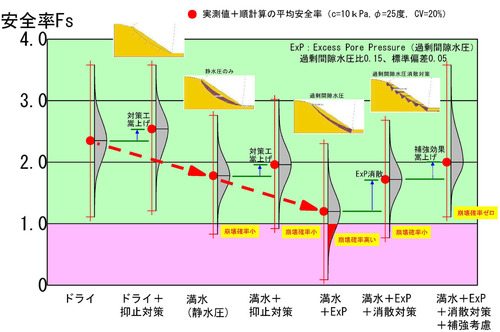
I don’t think it’s necessary to perform this kind of probabilistic analysis in individual calculations for the dewatering rock bolt method. For large-scale preventive projects, such as those involving roads and railways, where geotechnical justification is required, it would be practical and effective to perform calculations for several scenarios and compile the results into a table (in fact, there are examples where designs have been carried out using this method).
Otherwise, you can use methods similar to conventional design methods. Specifically, these include the inverse method and the planned safety factor method; you simply need to treat the reinforcement effect as shear reinforcement rather than friction. If you do that, the design approach won’t be all that different.
But there’s a world of difference between designing with the understanding of “This is actually how it works…” and doing so without that understanding.
As the prevention market grows, more and more imitation methods (knock-off methods) will start popping up. But when you’re designing a system to dissipate excess pore water pressure—or even when you’re simply touting that benefit—please be sure to check in with me first. Public relations efforts should wait until after the contract is signed.




 The photo above was taken back then. The photos below are a collection of a few I found online. The scenery is amazing.