



Hello, everyone.
This is Enta.
There are many drilling methods and machines used in slope stabilization work, anchor installation, and rebar insertion (rock bolting).
Be sure to select the appropriate equipment and fully understand the types of machinery before beginning construction.
Also, since there may be specific machine requirements in the design, it’s important to be familiar with the machines.
Primarily ground anchor work
Rotary Percussion, Skid-Type (Stationary)
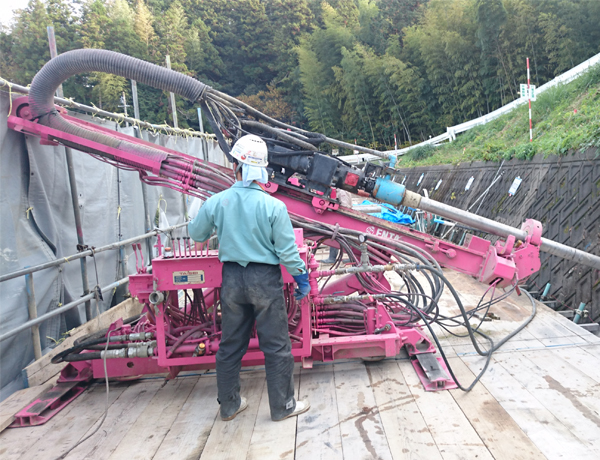
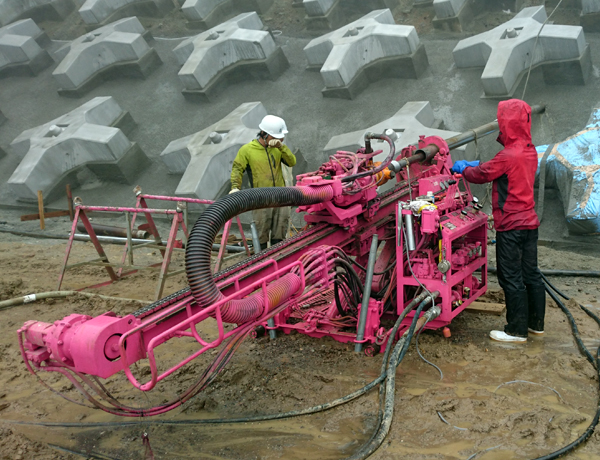
The skid-type installation method is generally performed on scaffolding.
Without scaffolding, it’s impossible to secure the structure, making construction difficult.
Sometimes we even end up driving stakes into the dirt to secure the drill bit and drill a hole, lol.
Drilling machines come in various sizes, and their drilling capacity generally increases as their weight increases.
On average, the most common weight is around 1.5 metric tons, and even the largest ones are in the 2.5 metric ton class.
The 3-metric-ton-and-over class isn't used much anymore.
In the past, there were often anchors over 20 meters long with a borehole diameter of 165 mm or more, but,
The most common diameter for anchors these days is 90 mm.
Rotary Percussion
Crawler-type (self-propelled)
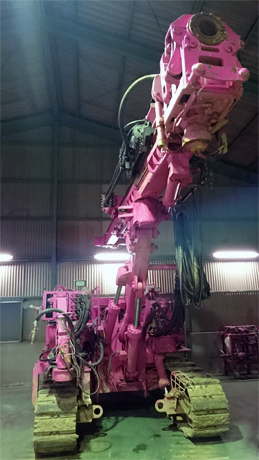
Construction is generally performed with the ground surface as the base; on slopes, the reverse-cut method is used (excavating 1–2 meters into the slope, installing and securing anchors, and then excavating further).
It is used for temporary anchors in urban civil engineering projects, as well as for observation wells in chemical grouting and in double-pipe strainer systems.
Recently, they’ve also been using double-tube rock bolts.
The mainstream models are in the 10-metric-ton and above class, but it seems that slightly larger machines have been coming out recently.
Primarily Reinforcement Installation (Rock Bolt) Workers
Attachable Drill, Crawler Type (Self-Propelled)
*Note: Names may vary by company.
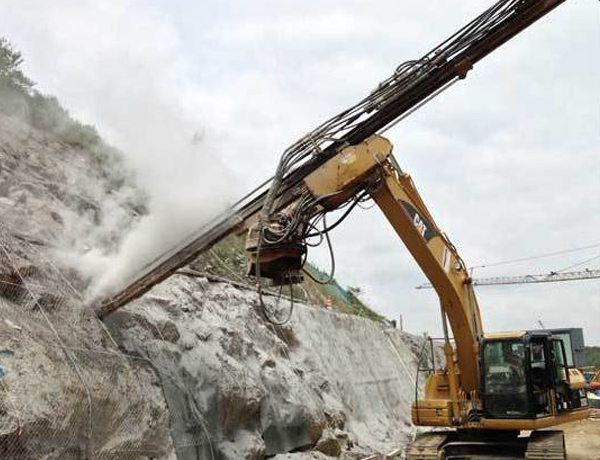
This is a suspended drilling rig mounted on a backhoe loader (BH).
Since the reaction force is counteracted by the BH, it is generally not necessary.
*Reaction force refers to the force applied when drilling, in which the drill rod (the rod used to drill the hole) is pressed against the mountain to drill the hole.
In that situation, if you rely solely on the machine, the force tends to escape toward the rear, so this is the force that holds it in place.
It operates efficiently, is easy to set up, and allows for rapid drilling.
Installation is generally performed on a dirt surface. It can be set to 0.45BH to 0.7BH.
Also, regarding the hammer head—known as the “drifter”—pneumatic models are the most common.
In particular,Yamamoto Rock MachineIt is believed that [company name] holds a significant market share.
(We also use a machine called the YD135.)
Primarily Reinforcement Installation (Rock Bolt) Workers
Suspended Drilling Rig (Suspended Type)
*Note: Names may vary by company.
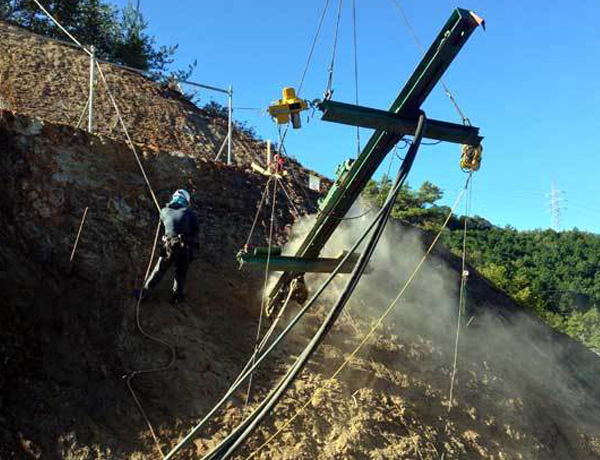
We will lift the structure with a crane and drill holes.
If there is no ground-level work platform and the concrete placement elevation is high, but a crane can still be set up, a suspended drilling method will be used.
Many people often refer to it as a "sky drill," but that's incorrect, and
Sky Drill is a construction method in which this drilling rig is mounted on the end of a crane for use.
This is a method for replacing the BH with a crane, similar to the BH type shown above.
It can be difficult to apply a reaction force, but you can achieve this by attaching a winch to the rear sleeve, driving an anchor into the mountain, and securing it with a wire.
At times, strong winds can cause the structure to be buffeted by the wind, which can be extremely dangerous.
The weight of the machine ranges from approximately 700 kg for small-sized core drills to a maximum of about 1,100 kg.
Primarily for grout injection projects, hot springs, and large-diameter piles
Rotary Drilling Machine (Skid-Mounted)
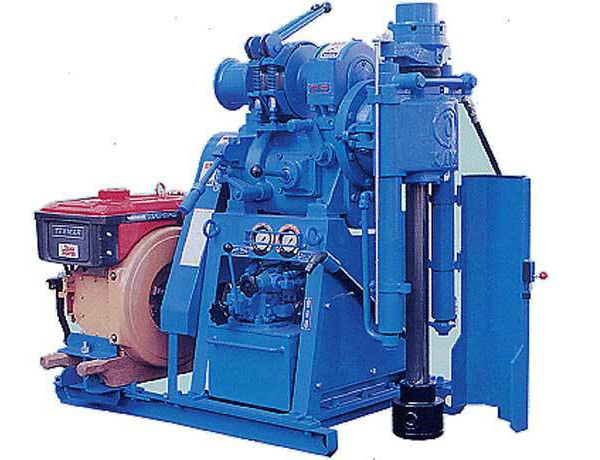
This is a rotary drilling machine without a percussion mechanism.
We drill the hole using rotation and thrust.
Apparently, in the past, this type of machine was also used to install rock bolts and drill drainage holes (horizontal boring), among other things, but
I've never done that.
This is always the medicine I use.
We use a type of drill bit called a metal crown bit.
This machine is available in sizes ranging from small to large and is used for applications such as driving large-diameter piles and drilling for hot springs.
For piles, a down-the-hole hammer is used.
This machine is classified as a lightweight drilling machine for billing purposes.
*Photo courtesy of Fuso Kogyo Co., Ltd.Here
Primarily rebar installation (rock bolt installation) and anchor installation
Spring Drill (Skid-Type)

A machine that uses a new striking method in which the percussion mechanism employs a spring-loaded system.
Since the machine weighs approximately 500 kilograms, it is extremely maneuverable and well-suited for construction work on high-altitude scaffolding.
It’s a powerful machine (for its class) that can reliably perform double-tube drilling.
It's quite useful for double-pipe rebar insertion work.
However, for anchors longer than 15 meters, conditions may become more challenging depending on the soil type.
For anchors between 10 and 15 meters, this machine can handle almost all applications, though installation efficiency may vary.
M's Co., Ltd.様
Primarily rebar installation (rock bolt installation) and anchor installation
Inverter Chisel (Skid-Mounted)
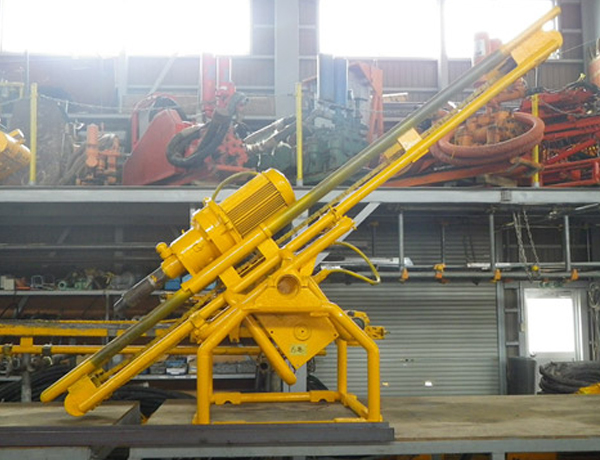
It is a machine that uses electricity to generate rotation and propulsion.
The machine itself is very small and lightweight and falls into the category of core drills.
Since it's electric, it has strong rotational torque and thrust for its size.
Since electrical control boxes are vulnerable to rain and dust, take thorough precautions to protect them.
Primarily rebar installation (rock bolt installation) involving single-hole drilling only
Slope Drill (Skid-Type)
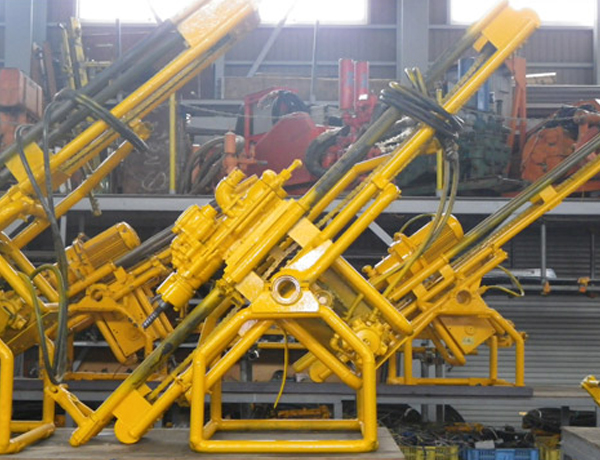
It is equipped with a rock drill called the YD100. It has the same drill head as the suspended drilling rig.
Since it is a compact machine, it can be used for construction on small, narrow sites.
Since everything is air-powered, piping and other installations are easy, and because it’s lightweight, it offers outstanding workability.
However, the impact is so strong that the rod and coupler break quite often.
*Kyowa Bosai Construction Co., Ltd.
Primarily a rebar installer (rock bolt installer)
Rock Drill (Jackhammer), 15 kg Model
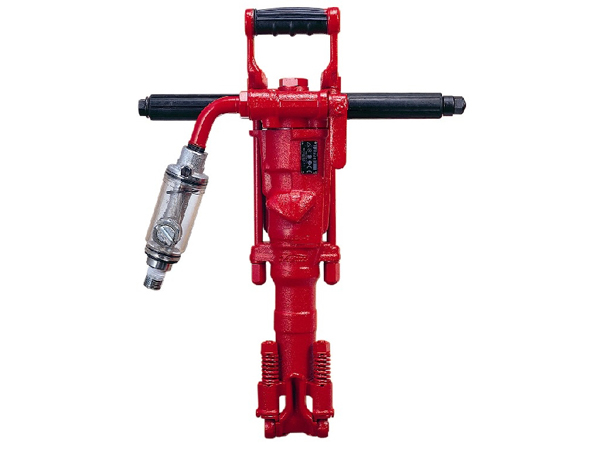
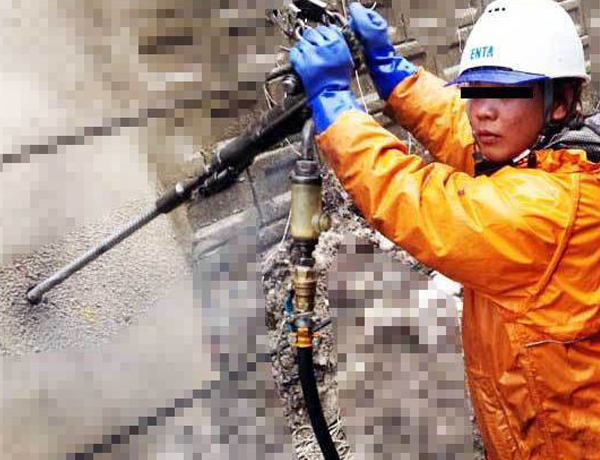
That's truly hand-dug!
This is manual drilling.
In this photo, we are drilling a hole by connecting self-drilling rods.
If the natural ground is not stable, use a self-drilling rod; once drilling is complete, the rod is fully inserted.
If the rod is to stand on its own, use a standard rod and insert it after drilling the hole.
In any case, it's going to be a tough job.
My hands are shaking. My ears are ringing. Give me a break, lol.
We set up a simple scaffold, and the maximum drilling depth is 2.5 meters. Anything beyond that becomes difficult, and,
I think the cost estimate indicated that construction wasn't feasible. (I can't quite remember...)
Primarily rebar installation (rock bolt installation) and anchor installation
Scaffold-Free Anchoring Method (Scaffold-Free System)
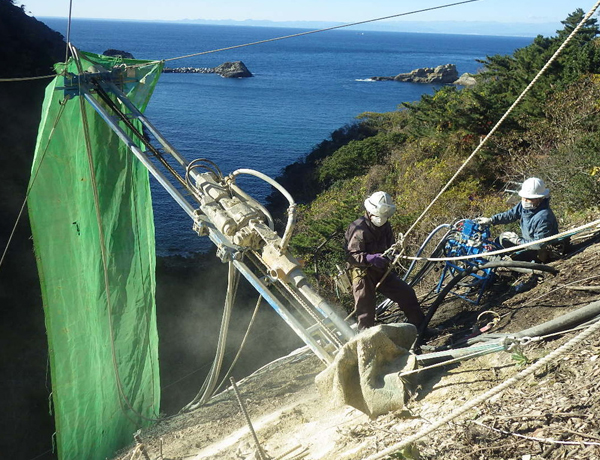
It is suitable for work in areas where scaffolding cannot be erected.
This is the only machine capable of reliably performing double-pipe drilling using a construction method that utilizes a wire for reaction force.
I have never seen any other drilling rig capable of double-pipe drilling.
In addition, since you can use a down-the-hole hammer on the inner string while operating the back hammer,
Drilling speeds are exceptionally fast for a drill of this class.
Scaffold-Free Anchoring Method
There are probably many other examples, but these are some of the most typical ones these days.
If I find any other interesting machines, I'll introduce them here.
See you later.


That's very informative. If there's only 50 to 60 centimeters of space available at a construction site, what types of models would be suitable options?
Specifically, this refers to cases where the space between the bottom of the slope and the building runs parallel to the slope and is only 50 to 60 centimeters wide. Furthermore, the slope itself is steep, and for the first 2 meters in height, there is less than 1 meter of space.
Although anchors can be extended in 1-meter increments, will this be feasible in this space? In terms of strength, we need to install anchors that are at least 5 meters long, but…
Thank you as always.
We cannot install it if it is approximately 60 cm.
Even in the case of manual excavation, since the jackhammer is about 50 cm long, it is impossible to perform the work even at an angle.
If the depth is about 1 meter, we can dig the trench by hand, but since we’ll be using 20-centimeter rebar and splicing it as we go, the material costs will increase.
Incidentally, when using manual drilling with scaffolding, the maximum drilling depth is approximately 2.5 meters (for cost estimation purposes).
In reality, even drilling a 3-meter hole is a challenge, and it’s quite difficult.
It would be better to make design changes using other methods or construction techniques.
Machinery manufacturers and the like are quick to say, “We can do it,” but please be careful—they often can’t actually carry out the work lol.
Thank you for your reply. I guess it really isn’t possible, is it? Actually, the surveying and design work are complete, and the blueprints are already finished. That’s why I started to wonder if this might be impossible to build…
It looks like we'll need to discuss this with the local government.
Good luck!
There was just one construction method!
There are quite a few examples of this type of construction on the JR lines in the Kanto region.
Is this common on JR these days??
That is core drilling.
Drilling is performed using a core tube.
It can be tough if you don't know the trick, but I think it should be doable with a minimum width of about 70 cm.
If you're struggling to decide on a construction method, I think this might be your only option.