Hello, everyone.
This is Enta.
As July draws to a close, the job site has gone into full-blown extreme heat mode.
I received more feedback than I expected on my recent article titled “Take Off Your Work Clothes with a Fan When the Temperature Exceeds 35 Degrees.”
While some people agreed, there were also quite a few who said, “Nah, I’m fine even at 40 degrees,” lol.
Everyone perceives heat differently, but since numbers serve as a standard, we can’t be vague about them, can we?
But that's beside the point.
This is the sequel to that.
Last time, I talked about external factors like temperature and humidity, but this time I’d like to write about what’s happening inside the body and how the human mind processes it lol.
Let me say this up front: this article is not meant to disparage workwear with built-in fans.
I wear it every year, too. It’s just that it’s not “absolutely” necessary.
"Cool" and "preventing heatstroke" do not mean the same thing
What inspired me to write this article was a piece in the September 24, 2024, issue of the Japan Agricultural News titled “[Farmers’ Special Report Team] Work Clothes with Fans: Caution Advised When Using Them in Extreme Heat.”
It all started with a request sent to the editorial department from a reader in the Tokai region; apparently, a man in his 40s—a friend of that reader—died of heatstroke while working on a farm while still wearing work clothes equipped with a fan.
As someone who does the same kind of outdoor work, I felt that this wasn't just someone else's problem.
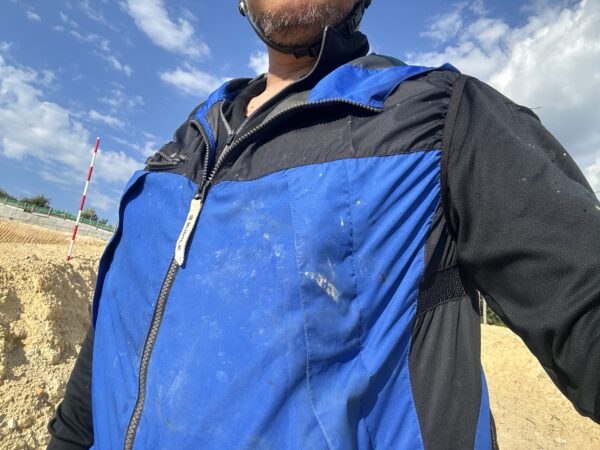
Actually, I’ve had the experience of wearing work clothes with a fan built in and feeling worse and worse, lol.
As of 2024, the manufacturer had not drawn a line.
According to the newspaper’s reporting, one major manufacturer responded, “It is up to the user to decide whether to use the product during a heat wave,” while another manufacturer explained that “effectiveness decreases in hot environments,” but added, “We have not set a specific temperature threshold at which use should be avoided.”
It states that while the effective range of the cooling effect is indicated, the data supporting that claim is not provided, and when asked about it, the response was that “we are unable to disclose it.”
In July 2026, the manufacturer released its figures.
This is the part I really wanted to write about this time.
According to an article published by HuffPost Japan in July 2026, the official X account of Air Conditioning Suit Co., Ltd., the manufacturer of “Air Conditioning Suit®,” reportedly sparked a buzz by posting a guideline on the effective cooling range.
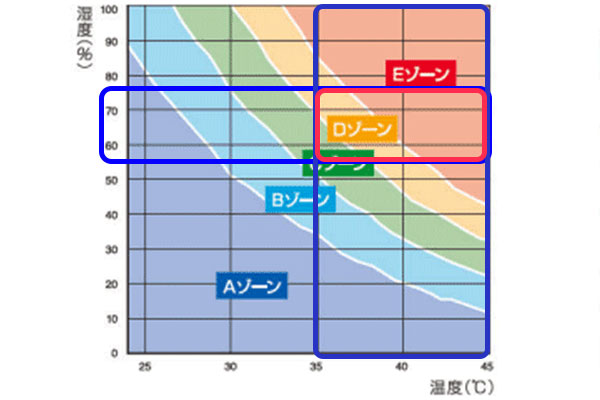
It is reported that, in a reply quoting a post by a member of the public stating, “You should seriously avoid wearing air-conditioned clothing at Comiket,” the company explained that it lists guidelines for the effective cooling range on its website and that “the cooling effect is virtually nonexistent in orange or red environments.”
According to the article, the graph identifies the point where the temperature is 35°C and humidity is 60–70% as the “comfort threshold.”
The company that makes it actually released the figures on its own initiative.
Furthermore, the company’s official website clearly states that the temperature range within which the Menstrual Cooler® is effective is limited.
The conditions for the cooling performance comparison test are also clearly specified as 30°C and 50% humidity.
The line was already drawn from the very beginning.
Maybe we just didn't notice it lol
Test Results at 34°C and 50% Humidity
The person mentioned in the article is Ken Tokizawa of the National Institute of Occupational Safety and Health.
The testing was reportedly conducted in an environment with a temperature of 34 degrees and 50% humidity.
According to the report, eight adult men walked briskly for about an hour each—once while wearing work clothes equipped with fans and once without them—and changes in their core body temperature were measured via rectal temperature at regular intervals.
The results showed that core body temperature rose to a similar degree whether the device was worn or not.
In response to this, Mr. Tokizawa pointed out that, under these conditions, “the measures were not found to be effective in preventing heatstroke.”
Isn't that a shock? lol
A paper in the institute’s Special Research Report, JNIOSH-SRR-No. 53 (2023), also states that the body cooling methods currently in use are,
It is stated that its primary effects are to lower the skin’s surface temperature and alleviate thermal discomfort, and that its effectiveness in preventing heatstroke is limited.
"It's cool" is a fact.
However, “cool” and “preventing heatstroke” are not the same thing.
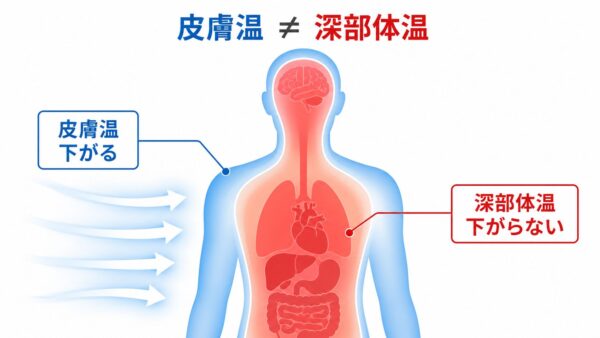
Core body temperature and skin temperature are two completely different things.
Have you ever seen a thermal imaging image in an ad for workwear with built-in fans, where the person is bright red before putting it on and turns blue afterward?
In an article in the Japan Agricultural News regarding this matter, Mr. Tokizawa explained, “Thermography measures skin temperature, which is different from core body temperature.”
He also stated, “There’s no doubt that a drop in skin temperature makes you feel cooler.”
In other words, that image isn't fake. It just shows only the surface of the body.
That means we're misunderstanding it.
The temperature of the brain and internal organs has not dropped.
Heat stroke occurs when the temperature of the body's core—including the brain and internal organs—that is,Onset triggered by a rise in core body temperatureIt is a disease that causes...
According to Mr. Fukazawa, whether or not a rise in core body temperature can be suppressed serves as an indicator of whether heatstroke can be prevented.
In the test conducted earlier, it was confirmed that wearing the garment did not affect the rise in core body temperature, but it did lower the skin temperature inside the work clothes.
Even though the skin feels “cool,” heat continues to build up in the core.
I think the scariest part is that the sensations of “hot” and “exhausting”—which are the body’s warning signs—are the first to disappear.
The fact that age makes a difference
There's another alarming figure.
In the previously mentioned JNIOSH-SRR-No. 53 (2023), a study was conducted involving 10 participants in the older adult group (66 ± 4 years) and 10 participants in the younger adult group (28 ± 4 years),
The study compared rectal temperatures after one hour of light work in four different environments with WBGT values ranging from 27.0 to 31.5 degrees.
It has been reported that when the WBGT rises by 1 degree, the corresponding increase in core body temperature is 0.1 degrees in the elderly group and 0.05 degrees in the younger group.
This means that older adults experience a rise in body temperature at twice the rate.
Furthermore, the report states that when working for one hour at a WBGT of 31.5 degrees, the body temperature of the elderly group reached 38.0 degrees—the upper limit specified in ISO 12894—while that of the younger group peaked at 37.6 degrees.
This means that even if the location, time, and task are the same, what’s happening inside the body can be completely different.
Since our workforce is aging as well, I think these figures are something we need to take seriously.
I'm sweating, but I'm not drinking enough water.
In Experiment 2 of the same report, participants walked for one hour in an environment with a room temperature of 37 degrees and a relative humidity of 50 percent, and the study compared conditions where the fan was turned off versus when it was running, while wearing dry undershirts.
Under the conditions where the fan was turned off, the rectal temperature reached 38.0 degrees, and even when the fan was running, the rise in temperature was only slightly suppressed.
Furthermore, even though they were allowed to drink as much as they wanted during breaks, their sweat loss exceeded their water intake by 0.4 kg and 0.3 kg, respectively, and
It has been reported that this may lead to a risk of dehydration.
Do any of you know anyone who loses weight during the summer? lol
Thinking About the Limits of Latent Heat in a Sauna
The mechanism that keeps work clothes with built-in fans cool is the heat of evaporation from sweat.
So, to what extent does the concept of heat of vaporization apply?
"Evaporative cooling keeps you cool!"—there are plenty of die-hard fans of evaporative cooling on social media, but I think it’s easier to understand if you think of it in terms of a sauna.
Why You Don't Get Burned in a 90-Degree Sauna
It is said that a typical dry sauna has a room temperature of 80 to 100 degrees and a humidity level of about 10 percent.
If you were to pour 100-degree water on yourself, you’d suffer severe burns, but you can stay in a 100-degree sauna for more than 10 minutes.
It is explained that one reason for this is that, because the humidity is extremely low, sweat evaporates rapidly, and the heat of vaporization draws heat away from the body's surface.
In other words, people inside a sauna are running their bodies at maximum capacity to cool themselves through evaporative cooling—which, in principle, is the same thing that work clothes with built-in fans do.
What Löyly and Aufguss Teach Us
However, when the “löyly”—the ritual of pouring water onto the sauna stones—begins, the humidity rises sharply, and it gets even hotter during the “aufguss,” when the sauna master fans the steam with a towel.
According to the descriptions provided by each facility, an Aufguss is a treatment that causes humidity to rise sharply, raising the perceived temperature and promoting sweating.
Even though the fan is blowing, it's not getting any cooler—in fact, it's getting hotter.
I hate saunas, and I just couldn't stop getting annoyed when they did the löyly!! lol
When humidity rises and the cooling effect of evaporation weakens, if you expose your body to air that’s warmer than your own body temperature, the breeze will blow toward the source of the heat.
The same thing could happen at construction sites in Japan right now during the height of summer. (Actually, it’s already happening—it’s absolute hell lol.)
As noted earlier in JNIOSH-SRR-No. 53 (2023), since workwear with electric fans draws outside air into the garment,
It states that when the outside air temperature is higher than body temperature, a mechanism that raises body temperature is thought to be activated.
According to the report, the body-cooling effect of electric fans can be either effective or ineffective depending not only on room temperature but also on relative humidity and the amount of perspiration,
It is mentioned, citing overseas research, that it may even be harmful in some cases.
The manufacturer states, "Do not wear at temperatures exceeding 50 degrees."
The precautions for use on a website specializing in workwear with built-in fans (operated by Fujiwork Co., Ltd.) state that,
It says, “Do not wear this in environments where the temperature exceeds 50°C, such as saunas, as there is a risk of burns.”
It actually does say there's a limit. It's just at the very bottom of the product page, lol.
The figures in the catalog may be based on global averages of around 30 degrees.
But we’re actually working at sites where it’s 38 degrees and 70% humidity.
Actually, I don't know what it's like between 40 and 50 degrees.
I'll be honest here lol
According to an explanatory article by Mr. Tokizawa published in the April 2026 issue (No. 158) of *Safety and Health Consultant*,
Tests were conducted under both high-humidity conditions (room temperature: 32°C, relative humidity: 80%) and high-temperature conditions (room temperature: 40°C, relative humidity: 30%), and
Reports indicate that wearing a damp undershirt while using a fan helps suppress the rise in core body temperature and reduces total body sweat output by half.
In other words, its effectiveness has been confirmed up to 40 degrees Celsius and 30% humidity, provided that the inner layer is kept damp.
On the other hand, the manufacturer states that the product should not be worn in environments where the temperature exceeds 50 degrees.
So, what about the time in between?
As far as I could tell from my research, I couldn't find the answer lol
Well, I guess that just means there aren't any results from experiments like that, huh? lol
However, the article also noted that even if temperatures do not reach 50 degrees in Japan’s natural environment, this can still occur at work sites where heat sources are present.

Why Do We End Up Thinking, “I’ll Be Fine”?
We've been talking about numbers up to this point, but finally, we come to the human aspect.
When I scroll through social media, I see posts saying, “Even when it’s 40 degrees outside, it’s no problem as long as you have work clothes with built-in fans.”
There are also a great many people who say, “I can’t do my job without work clothes with a fan.”
I have no intention of criticizing this. That’s because there are aspects of that sentiment that are well-founded.
There are certainly individual differences.
The April 2026 issue of *Safety and Health Consultant* mentioned earlier states that there are significant individual differences in the amount of sweat produced, depending on one’s constitution.
It has been reported that when walking for one hour under the blazing midsummer sun, the amount of sweat lost by some people can reach 1,500 mL, while others lose less than 500 mL.
It seems that the more you sweat, the more effective work clothes with built-in fans become.
In other words, if you say, “I’m fine even at 40 degrees,” it’s possible that you’re actually sweating a lot and that the treatment is really working.
However, this also means there is a high risk of dehydration.
The problem is that I end up applying that feeling to the craftsman in his 60s sitting next to me.
As the numbers from earlier show, the processes taking place inside the body are changing at twice the rate.
The sensation of "coolness" is also real.
Just to be clear, there is a valid reason why increasing comfort is important.
The April 2026 issue of *Safety and Health Consultant* states that this may help prevent a decline in concentration and productivity caused by discomfort from the heat.
In an article in the Japan Agricultural News, Mr. Tokizawa stated that even if the method does not prevent heatstroke, it can help reduce the sensation of heat and thirst, and is therefore expected to help maintain work efficiency and prevent a decline in concentration.
In our line of work, maintaining focus is essential to safety.
If you lose your focus while working on a slope, you’ll have an accident before you even get heatstroke.
However, Mr. Tokizawa points out that since the physical strain remains the same, one should not rely on feelings of discomfort or exhaustion,
It is also said that it is important to take breaks and hydrate just as you would when not wearing the device.
The more expensive the purchase, the more it upsets me when it gets criticized.
From here on, I’m not going to talk about the materials—I’m just going to share my thoughts.
Work clothes with fans aren't cheap.
I got the clothes, the fan, and the batteries—I picked them out myself and paid for them out of my own pocket. 20,000 yen and up... (The batteries are just so expensive, lol)
So when someone tells me, “I hear it doesn’t always work,” I feel like I’m being dismissed.
I mean, at first I was like, “What?!” and looked into it while still being a bit skeptical, lol.
It is said that people tend to gather only information that aligns with what they want to believe, while downplaying information that is inconvenient for them.
This is what’s known as “confirmation bias,” something I’ve written about many times on this blog.
The thought, “I didn’t get sick from this last year or the year before,” certainly feels like strong evidence.
But it’s also a “record of the days I happened not to fall.”
"Water-Sprinkling" Innerwear: So It Doesn't End with Just a "No"
So the question is, what should we do?
Wearing a damp undershirt and then putting on a fan-equipped work uniform over it—a method Mr. Tokizawa has dubbed the “water-sprinkling undershirt.”
This is a follow-up to the previous post by Air-Conditioned Clothing Co., Ltd.
According to an article in the Japanese edition of HuffPost, the company
"Adding moisture other than sweat—such as by getting your undershirt wet or using water-cooled items—enhances the evaporative cooling effect."...he explained.
The original manufacturer recommends wearing a damp undershirt.
All you have to do is soak an undershirt in water, wring it out thoroughly, and put it on.
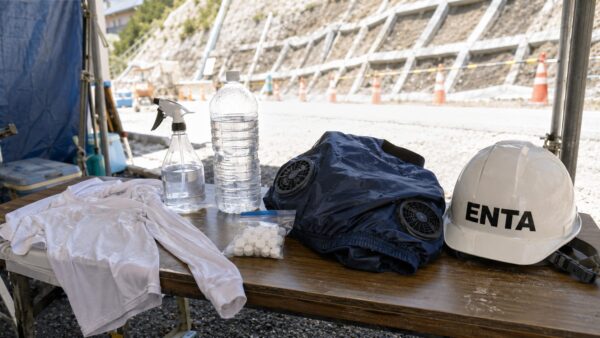
According to an article in the Japan Agricultural News, cotton is more suitable than synthetic fibers, and since it dries in about two hours in high temperatures, moistening it again with a spray bottle during breaks is said to prolong its effectiveness.
The April 2026 issue of *Safety and Health Consultant* states that the amount of water used to moisten the inner layer is 350 mL, and the heat of vaporization resulting from this amount of water is approximately 200 kcal.
According to the site's explanation, the energy expenditure for standard adult walking (3 km/h) is approximately 200 kcal per hour, so
Based on these calculations, it appears that the equivalent amount of heat is being dissipated through the primitive method of wetting one’s undergarments.
It costs almost nothing and doesn't require a battery. All you need is a plastic bottle of water and a cotton shirt.
These days, there are even items where you can fill the inner layer with water or put an ice pack in the inner pocket, right?
It really feels like we’ve entered an era of extreme heat where using such products alongside other items has become essential.
Ultimately, work clothes with built-in fans aren't "bad" or "a one-size-fits-all solution," are they?
Within the effective range specified by the manufacturer, this is a tool that will genuinely make your work easier if worn by someone who works up a good sweat.
However, once that limit is exceeded, the tool may quietly change its nature, and the most troubling thing is that the person wearing it may not even notice.
Even though my skin feels cool, I'm hot on the inside.
What I'm trying to say is that I'm not telling you to take off your work clothes with the fan attached.
All I want is for you to be the kind of person who can, even just once, ask yourself, “Maybe it’s not working today.”
That single instance of doubt might cause them to take another 10-minute break.
Those 10 minutes might save someone's life.
As you know, the "what if?" mindset is particularly effective when it comes to safety measures.
Our craftsmen, myself, and all of you—we all want to be working on-site as usual next summer, too.
Let's proceed with the installation while carefully monitoring the temperature!
See you later.
*"Air-Conditioned Clothing®" is a registered trademark of Air-Conditioned Clothing Co., Ltd.