It's been three months since I started working at my current job site.
After about three months, you start to get a general sense of the policies of the general contractor on site and what they consider to be common sense.
At this job site, I’m in charge of on-site construction management, schedule management, mentoring junior staff, and preparing daily construction reports with drawings attached. However, things won’t go smoothly unless I take into account the differences between my own common sense and that of the subcontractor, which has a long-standing relationship with the general contractor.
It’s difficult to discern these differences in common sense, and simply arguing from a theoretical standpoint will never win anyone over. That’s why, when it comes to construction project management, no matter where in Japan we work, we always use the strictest regulations for public works projects as our standard.
However, there are times when I think, “It doesn’t have to be that strict, does it?” And personally, I don’t believe that those strict standards should be applied in every single situation, no matter what.
Public Works and Private Construction Projects
For example, since this project is a purely private-sector project—not a public works project—I don’t think we should conduct all acceptance tests and inspections for various building materials strictly in accordance with public works standards. When it comes to private-sector projects, I fully understand the contractor’s desire to save as much time and effort as possible and to complete the work as quickly and cost-effectively as possible.
However, having experienced firsthand various general contractor job sites—including those overseas—I know that the on-site circumstances, as well as the construction quality and procedures demanded based on the general contractor’s objectives, can vary significantly. For this reason, I must always plan from the outset on the assumption that we’ll have to meet even the most stringent requirements.
It takes about three months to start understanding the on-site standards and unwritten rules, and that’s generally when the hassles begin.
This “hassle” refers to the disconnect between what I consider common sense and reality. The hardest part of all is when I see a job site where what I believe “must be done to this standard!” has been half-heartedly completed—whether through shoddy workmanship or inadequate inspections—and I find myself looking at it, feeling disheartened and thinking, “Do we really have to lower the standards this much…?” Unfortunately, there are actually many sites like that.
It's easy to lower your level.
If you consistently cut corners in construction management, it’s certainly easier, but doing so will lower your own standards. In reality, however, there are many cases where you have no choice but to do so, even against your will.
Even when someone insists, “Let’s do what we’re supposed to do properly!” there are those who take a broad interpretation—and then take it even further—arguing, “It’s a private construction project, so it’s okay to cut corners a little. Besides, the design supervisor is one of us, so we can just say we got approval later—there won’t be any problems. There’s no need to go through the extra trouble!”
To top it all off, if someone tells you, “It’s not a good idea to spend time on unnecessary things!” any argument in favor of doing things properly will just leave you standing there all alone. With not a single person to back you up, your opinion is, of course, rejected.
It’s true that this takes time and effort, and it would be a lie to say it doesn’t cost anything at all. But to be honest, if this keeps up, I’m starting to get really fed up with it. It’d be one thing if they just went on and on about it, saying, “Oh! Is that so?!” But when employees keep repeating incorrect claims and try to force me to agree with them, there’s no way I can bring myself to work with them, no matter how you look at it.
In particular, if I keep fooling myself like that, embers of unfulfilled potential start to smolder, and those embers grow bigger and bigger, turning into a raging fire that, triggered by some event, suddenly bursts into a roaring blaze. Once that happens, I can no longer stay at that company. I’ve left several general contractors over the years because of that very feeling.
For example, in steel frame construction,
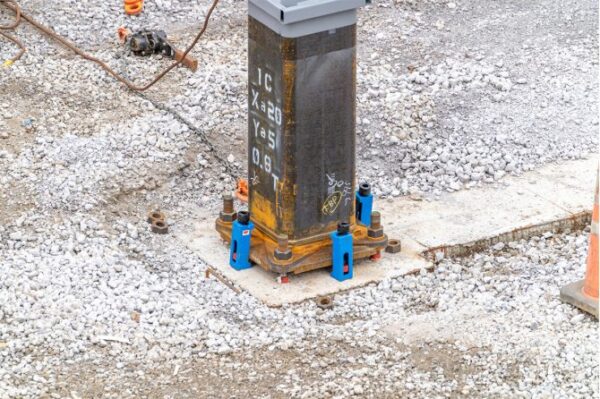
For example, the base plate installed on top of the concrete foundation in steel-frame construction is a small, unassuming component that is completely hidden, but it plays a very important role. It is supported by non-shrink mortar.How to Ensure the Height of the Steel Base Plate Is Constructed with PrecisionHowever, this greatly affects the quality of the steel-frame construction. If this height is not precise—even a 10-millimeter difference—it will not only affect the floor-to-floor heights, staircases, roof, and openings on each floor, but it will also often require the steel members to be forcibly bolted together during assembly. This results in extra time and effort required for the steel framing work, affects the finish of the exterior walls, and ultimately impacts the overall quality of the building.
For this reason, I argued that the tolerance for the top surface of the non-shrink mortar used in the support section—commonly referred to as “manju”—should be zero. Even when measuring with a “zero” tolerance, the human eye inevitably introduces an error of one or two millimeters. Consequently, if we were to follow the “±2 mm tolerance” specified in the drawings, the error could potentially be twice as large. I believe this is whereQuite loudlyHe insisted on his position and flatly rejected comments such as, “You should allow for errors as specified in the drawings!”
The steel frame construction is currently underway, but I doubt anyone has even noticed. It’s fair to say that the smooth progress of the steel frame construction is thanks to the workers who put in so much effort to achieve this “zero-tolerance” standard.
Actually, aside from this “zero tolerance,” I had another point I wanted to make. I insisted that we absolutely conduct strength tests on the non-shrink mortar and drip tests on the grout used to fill gaps. However, this was flatly rejected. They said things like, “This isn’t a public works project, and I’ve never heard of anyone doing that.” I almost retorted, “Isn’t that just because you’ve never heard of it?” but I held my tongue. My argument—the “zero tolerance for top-surface deviation”—was the top priority, andAs long as it went through, that's good enough.That's why I did it that way.
Milestone
In my case, I tend to stay with a single general contractor for about 18 months on average. And after about three months, I can usually tell whether I’ll be able to learn anything new at that particular job site. Even if there’s nothing new to learn, as long as it’s a place where I can do my job normally, it’s possible to stay on and fulfill the role I’ve been given. But in that case, I end up working just for the money. For me, that gradually becomes a source of distress."Now that's what I call living the high life!"I can certainly understand that point of view, but I put up with quite a lot myself. I try, in my own way, to find the appealing aspects of that general contractor’s organization, but at the end of the day, I can’t call white black.
Well, the contract I have with the general contractor I’m working for now was for one year from the start. Based on my current impression, that seems about right.