What Will Change Under the Invoice System?
"The [...], which will take effect on October 1, 2023,"Invoice System (Qualified Invoice Retention System)"The invoice system" is expected to have a significant impact on sole proprietors and others in the construction industry. The invoice system is a new input tax credit method established in response to the introduction of multiple consumption tax rates—8% and 10%—and will result in major changes to the rules governing the issuance and retention of invoices and other documents in transactions between businesses.
For example, if a general consumer (the client) commissions a construction company to build a new home for 30 million yen, the client will also pay 3 million yen in consumption tax. If, during this project, the contractor hires subcontractors—such as interior finishers—and incurs 1 million yen in subcontracting costs, the contractor deducts the 100,000 yen in consumption tax associated with these costs from the 3 million yen in consumption tax received from the client, and then pays 2.9 million yen to the government. This process of deducting the consumption tax paid on purchases is called the “input tax credit.” However,After the invoice system is implemented, if the purchaser (in this case, the construction company) is unable to retain invoices that meet specific requirements (qualified invoices), they will no longer be able to claim input tax credits.。
Furthermore, under the previous system, businesses with taxable sales exceeding 10 million yen paid consumption tax as taxable entities, while small-scale businesses and sole proprietors with taxable sales of 10 million yen or less were exempt from paying this consumption tax as tax-exempt entities. However, under the invoice system,Only ”taxable businesses” that have registered as qualified invoice issuers may issue invoices (qualified invoices).. In order to issue an invoice (qualified invoice), a consumption tax filing obligation arises even if taxable sales are 10 million yen or less.
Let’s take another look at how this will affect the construction industry.
What's the difference between self-employed contractors who can issue invoices and those who can't?
To reiterate, if a construction company conducts business with a tax-exempt business operator—such as a sole proprietor who cannot issue invoices (qualified invoices) and has taxable sales of 10 million yen or less—the construction company will be unable to claim the corresponding input tax credit. If another sole proprietor transitions from a tax-exempt business to a taxable business and becomes able to issue invoices (qualified invoices), the construction company will be able to claim a consumption tax credit. Therefore, from the construction company’s perspective, it is more advantageous to outsource work to a sole proprietor who is a taxable business and can issue invoices (qualified invoices) when conducting business.
Then,If a business remains a tax-exempt entity, there is a possibility that general contractors and other prime contractors may shy away from doing business with it or may even terminate their business relationship.. Even without that, it is entirely possible that a construction contractor might ask a sole proprietor, “We want to claim the input tax credit, so please register as an issuer of invoices (qualified invoices),” or “If you do not register as an issuer of invoices (qualified invoices), please reduce the price by the amount of the consumption tax.”
So, does that mean the problem is solved if a sole proprietor becomes an issuer of invoices (qualified invoices)? Well, it’s not quite that simple. Until now, sole proprietors with taxable sales of 10 million yen or less were not required to pay consumption tax, but,Upon registering as a business eligible to issue qualified invoices, you automatically become a taxable business and are required to pay consumption tax, which will place a significant financial burden on you.For example, assuming a sole proprietor with taxable sales of 5 million yen, it’s conceivable that their tax liability could increase by as much as 500,000 yen. It’s easy to imagine that the invoice system could even threaten people’s daily lives, and there is quiet speculation that “this might lead to an increase in the number of elderly sole proprietors closing their businesses.”
In addition, when issuing invoices (qualified invoices), the content of the invoice changes—including the registration number of the qualified invoice issuer, the applicable tax rates for the total consideration broken down by tax rate, and the consumption tax amount—making the procedures more cumbersome.
Applications for registration as a business eligible to issue invoices (qualified invoices) began in October 2021. Since the review process takes time, it is recommended that applications be submitted by March 31, 2023—before the invoice system is introduced. Businesses need to consider and decide early on whether they will become taxable entities or continue operating as tax-exempt entities.
However, the National Federation of Construction Workers' Unions (Zenken Soren)'s “Survey on Invoices for Self-Employed Individuals Who Are Exempt from TaxAccording to 』, delays in preparations between general contractors and subcontractors have also been observed.
If the system is implemented as is and the two parties fail to reach a certain level of agreement regarding the burden of the consumption tax, it is conceivable that the construction industry could face major turmoil after its introduction. “Even though people may be aware of the invoice system in theory, I don’t think the message has fully sunk in yet that it directly affects them,” explains Masafumi Nishi, Director of the Tax Policy Department at the All Japan Federation of Construction Workers’ Unions.
The survey was conducted from April 1 to May 31, 2022, and responses were received from across the country—from the Hokkaido-Tohoku Regional Association to the Kyushu Regional Association—with a total of 1,908 responses, of which approximately 1,300 were valid.
There are significant challenges in raising awareness of the details of the invoice system.
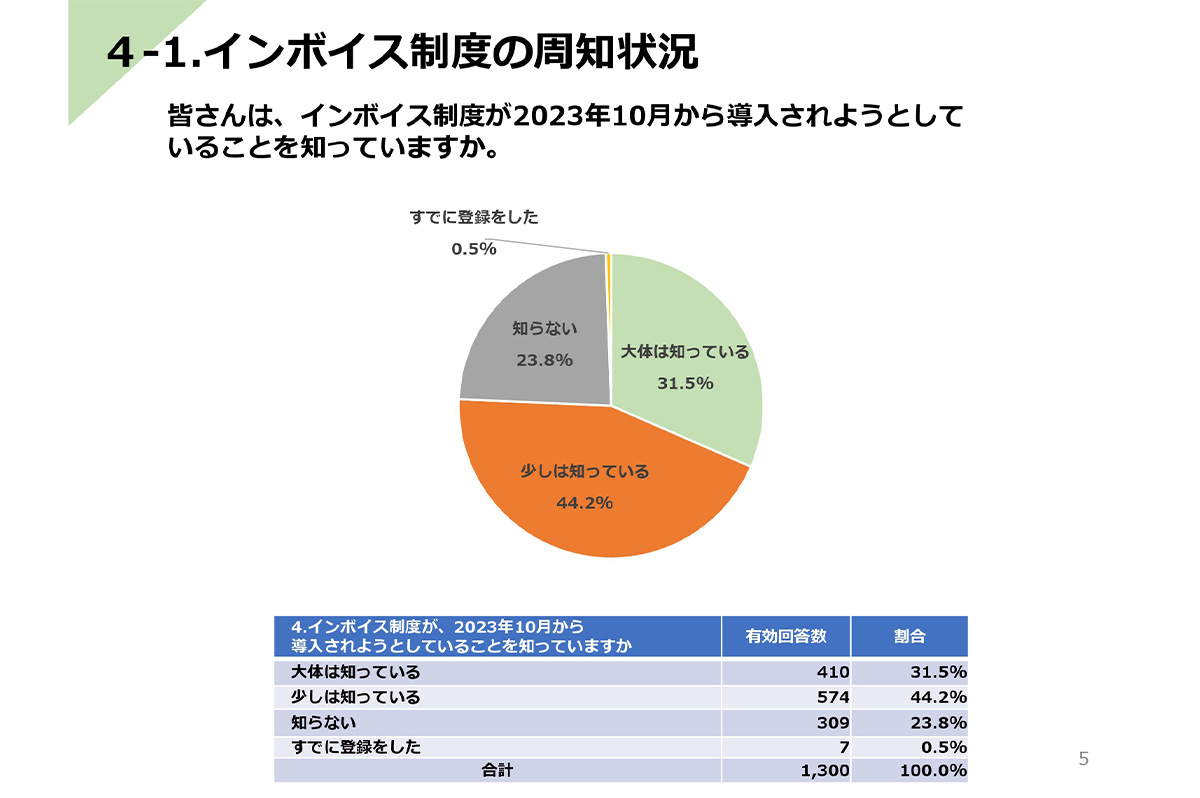
In response to a question about awareness of the invoice system, “I know a little about it” was the most common response with 574 respondents (44.2%), followed by “I know most of it” with 410 respondents (31.5%), “I don’t know” at 309 (23.8%), and “I have already registered” at 7 (0.5%).
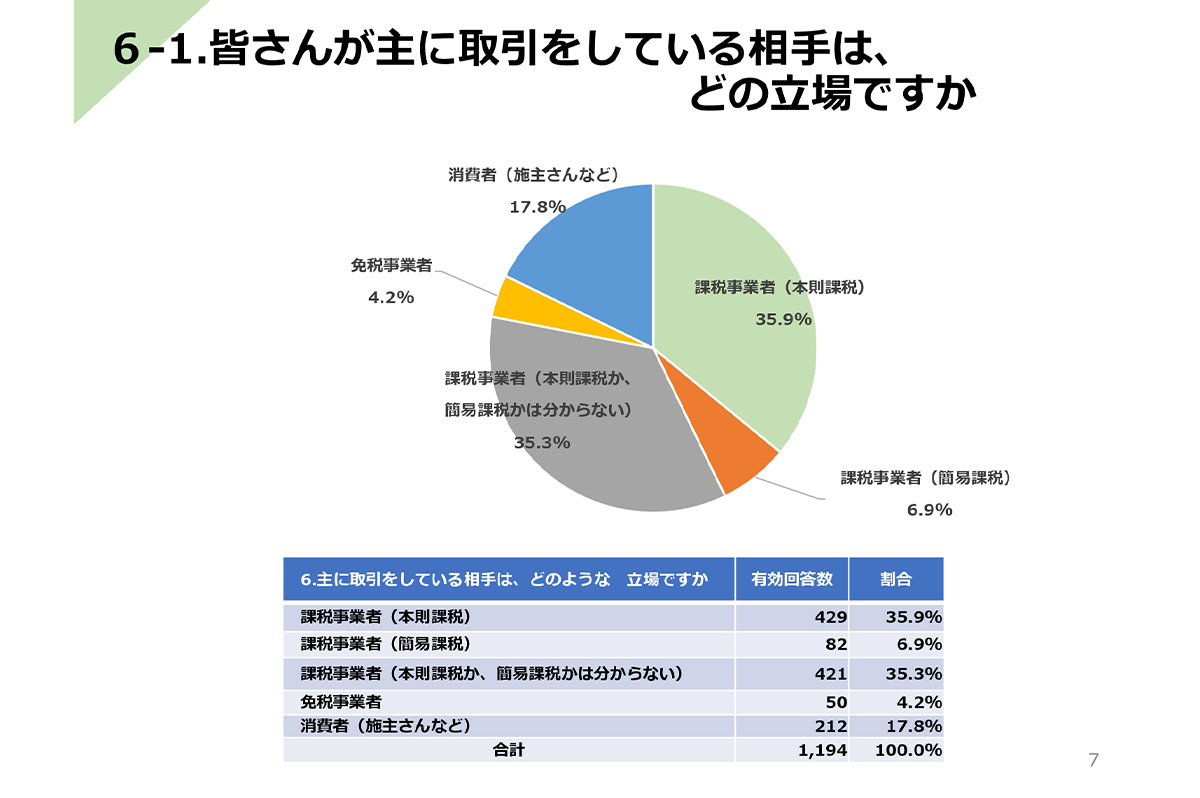
Next, in response to the question, “What is the status of the parties with whom you primarily conduct business?” the most common response was “Taxable Business Entity” (standard taxation) at 429 respondents (35.9%), followed by “Taxable Business Entity (unknown whether under standard or simplified taxation)” at 421 respondents (35.3%), followed by “consumers (clients)” at 212 (17.8%), “taxable businesses (under the simplified tax system)” at 82 (6.9%), and “tax-exempt businesses” at 50 (4.2%).
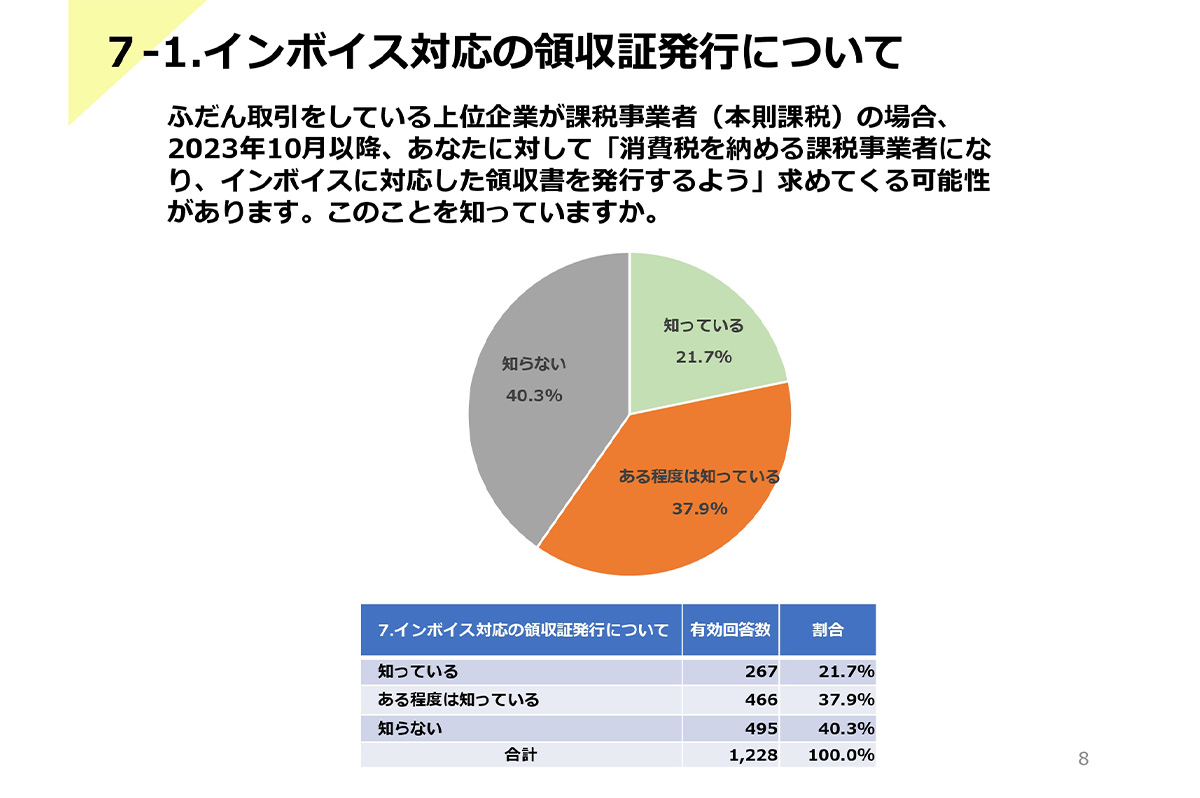
The following is an important point: “If a parent company is a taxable business entity (subject to standard taxation), starting in October 2023, it may become a taxable business entity required to pay consumption tax to you and may request that you issue invoices compliant with the new invoice system. In response to the question, “Are you aware of this?” the most common answer was “No” (495 respondents, 40.3%), followed by “I am somewhat aware” (466 respondents, 37.9%) and “Yes” (267 respondents, 21.7%).
In the survey on awareness of the invoice system, the combined percentage of respondents who answered “I’m generally familiar with it” and “I know a little about it” was 75.5 percent, which at first glance might suggest that the majority understands the system. However, since approximately 40 percent of respondents answered “I don’t know” when asked about “issuing receipts compliant with the invoice system,” it became clear that a detailed understanding of the invoice system has not yet taken hold.
Once the invoice system goes into effect, the client will not be able to claim a tax credit on input tax unless they are issued a receipt bearing a registration number assigned under the system; therefore, parent companies may require sole proprietors to comply with this requirement.
"As the All-Japan Federation of Construction Workers' Unions, we are working to raise awareness among our members about the invoice system. That said, we feel that awareness is still lacking," said Masafumi Nishi, Director of the Tax Planning Department.
Eight in ten respondents from top-tier companies said they “hadn’t been told anything.”
Furthermore, in response to the question, “In preparation for the introduction of the invoice system in 2023, have you received a survey or been asked by a company you regularly do business with whether your transactions are ‘taxable’ or ‘tax-exempt’?” the most common response was “I haven’t been asked anything” at 1,094 respondents (88.9 percent), while 137 respondents (11.1%) answered that they had “received a survey or been asked” about this.
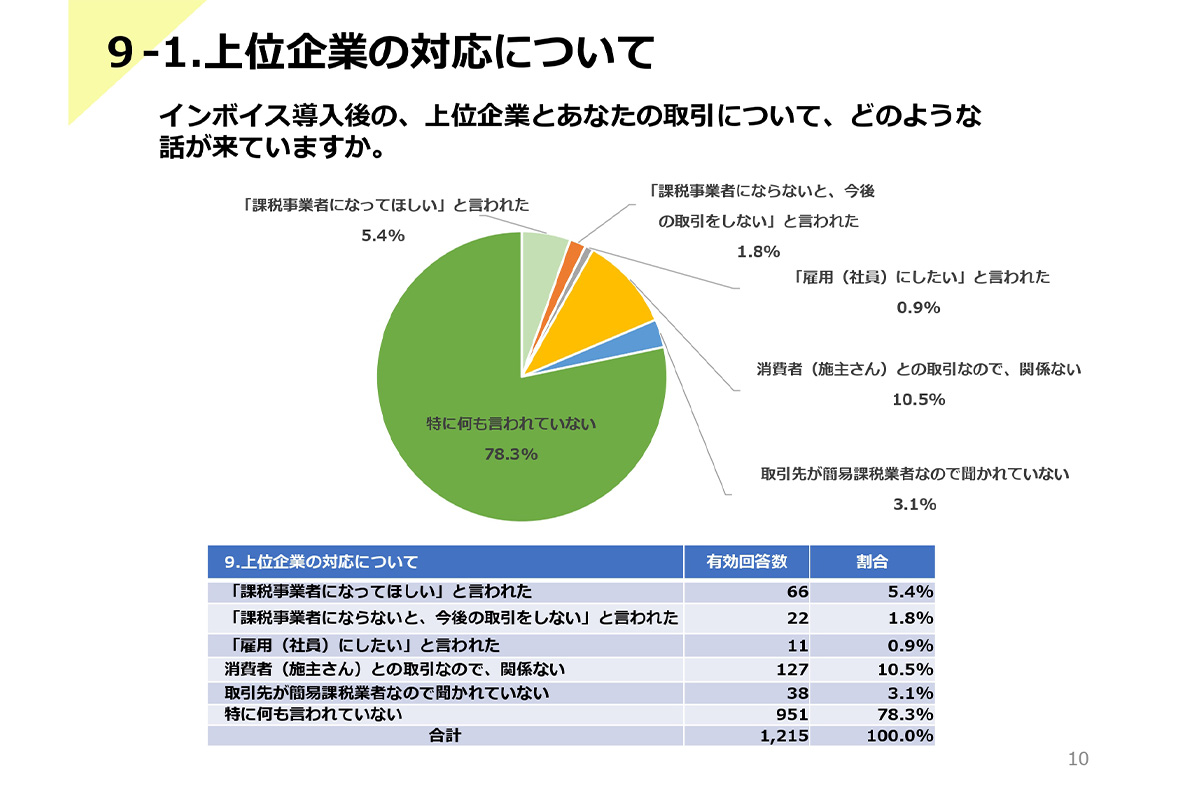
Furthermore, in response to the question, “What kind of communication have you received regarding transactions with top-tier companies following the introduction of the invoice system?”, the overwhelming majority—951 respondents (78.3%)—said, “I haven’t been told anything in particular.” “It doesn’t apply to me because these are transactions with consumers” was cited by 127 respondents (10.5%), “I was asked to become a taxable business” at 66 responses (5.4%), “I haven’t been asked because my business partner is a simplified tax system business” at 38 responses (3.1%), “I was told that future business dealings would not proceed unless I became a taxable business” at 22 responses (1.8%), and “I was told they wanted to hire me as a full-time employee” at 11 responses (0.9%).
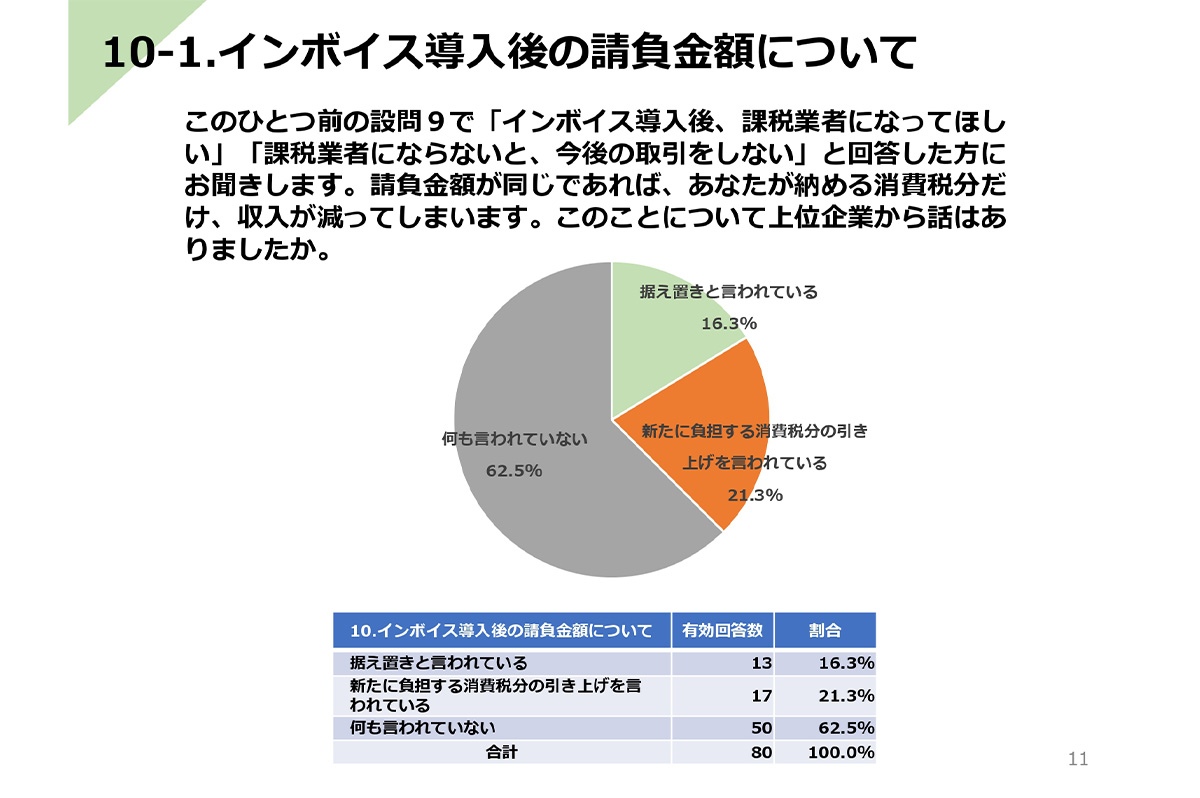
Over 60% of contractors reported that “nothing specific was mentioned” regarding the contract amount after the invoice was issued.
Finally, we asked those who responded, “We want you to become a taxable business after the invoice system is implemented” or “We will not conduct future business with you unless you become a taxable business,” the following question: “If the contract amount remains the same, your income will decrease by the amount of consumption tax you pay. Have you heard anything from your parent company regarding this matter?”
In response to the question, “Nothing has been said” was the most common answer, with just over 50 responses (62.5%); “We have been told we will have to bear the cost of the consumption tax increase” received just over 17 responses (21.3%); and “We have been told the rate will remain unchanged” received just over 13 responses (16.3%).
Looking at the survey results as a whole, delays in communication and consultation with sole proprietors at leading companies are also conspicuous, highlighting the urgent need to raise awareness of the system’s details moving forward. The All Japan Federation of Construction Workers’ Unions (Zenken Soren) has also stated that it is “currently calling for a review or postponement of the invoice system.” If the system is implemented as is, it could directly lead to a decline in wage levels for sole proprietors, suggesting that support measures—such as those aimed at passing on contract costs—will likely be necessary.