


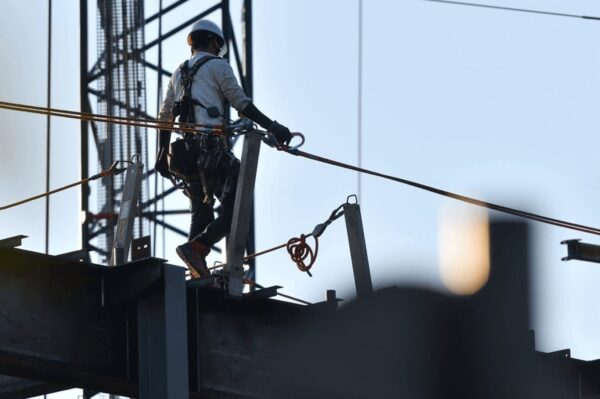
Let’s start with a local topic this time—. In August 2025, the Fukuoka Labor Bureau of the Ministry of Health, Labor, and Welfare issued a “Declaration of a State of Emergency to Eradicate Fatal Workplace Accidents.” From January through the end of July this year, there were 15 work-related fatalities in the prefecture, eight of which occurred in the construction industry—these figures reveal the harsh reality that, even in this day and age of technological advancements and stricter safety standards, lives continue to be lost on construction sites.
Collapse accidents during demolition work, fatal explosions at factories. These tragedies are not mere acts of “bad luck”; they are the result of structural problems that have plagued the industry for many years. Although more than a year has passed since the so-called “Work Style Reform” was implemented in the construction industry, workplace accidents are not decreasing—if anything, they are on the rise. Why is this happening? I would like to unravel the reasons behind this, drawing on data and voices from the field.
The Reality That "It Won't Go Away," as Proven by the Numbers
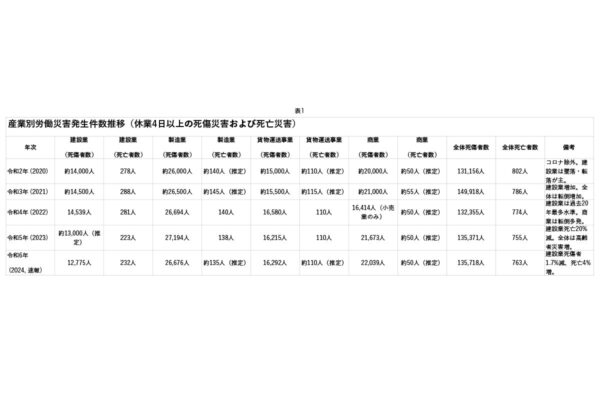
“Why don’t they go away?”—The first answer to this question lies in the harsh reality revealed by the data. According to 2024 statistics from the Ministry of Health, Labor and Welfare, the number of work-related fatalities across all industries reached 746, marking a new all-time low. However, in the construction industry alone, the figure stood at 232, representing an increase from the previous year. The construction industry continues to account for a high proportion—approximately 30%—of all fatal workplace accidents.
Even more concerning is the fact that the total number of fatalities and injuries has risen for the fourth consecutive year, reaching 135,718. In the construction industry alone, the figure remains high at 13,849, and the pattern in which falls from heights remain the leading cause of death has not changed. Even since the start of 2025, an abnormal situation has persisted in the Tokyo Labor Bureau’s jurisdiction, with nine fatal accidents occurring—three times the number from the previous year.
The case in Fukuoka epitomizes this structural problem. The fact that the number of fatalities in the construction industry had reached eight by the end of July 2025—leading to an emergency declaration by the director-general—was driven by specific tragedies such as the collapse at a demolition site in Kurume City on July 15 (two fatalities) and the factory explosion in Kanda Town in February (two fatalities). These are not merely “numbers” in a statistic; they are real human lives that have been lost.
Even more noteworthy is the structural shift in the number of workers in the construction industry. With the workforce now down to 4.77 million—a decrease of approximately 3.01 million compared to its peak in 1997—the quantitative labor shortage is leading to a qualitative decline in safety. Data from 2025 shows that the “severity rate” for civil engineering projects—an indicator of the severity of accidents—has risen for three consecutive years, highlighting the reality on construction sites where workers are forced to perform increasingly dangerous tasks with fewer personnel.
The Hidden Truth: Structural Problems Concealed by Data Categorized by Client
In seeking to understand why workplace accidents “never go away,” the breakdown of contracting entities (national government, prefectures, municipalities, and private-sector companies) appears to hold a key to the answer. However, the Ministry of Health, Labor and Welfare’s official statistics do not publish nationwide totals broken down by contracting entity. This gap in information may be one of the factors preventing the elimination of these accidents. If so, it is truly a blind spot.
This is because the approach to safety differs fundamentally between public and private construction projects. While public projects are subject to strict safety standards and require the submission of safety plans during the bidding process, private projects tend to have a structure where safety investments are easily cut due to profit pressures. According to construction investment statistics, although private-sector projects account for approximately 64.5% of the total, the accident rate for these projects remains unknown. Under these circumstances, it is impossible to implement effective countermeasures.
Piecemeal data supports this hypothesis. According to an analysis by the Okinawa Labor Bureau (2013–2022), of the 45 fatal accidents in the construction industry within the prefecture, 24 (53.3%) occurred on privately commissioned projects, exceeding the 16 (35.6%) that occurred on publicly commissioned projects.
The accidents that triggered the state of emergency in Fukuoka—a collapse during demolition work in Kurume City and a factory tank rupture in Kanda Town—are both believed to have been private-sector construction projects. The demolition of vacant storefronts is primarily aimed at disposing of private real estate, and factory maintenance work is also carried out by private companies. It is highly likely that these “invisible disparities” serve as a breeding ground for the continuation of such disasters.
The Greatest Vulnerability of Humanity—Can Human Error Be Eliminated?
The most fundamental reason why workplace accidents in the construction industry “never go away” lies in human nature itself. According to an analysis by the Ministry of Health, Labor and Welfare and the Construction Industry Occupational Accident Prevention Association, approximately 70% of workplace accidents are attributable to human factors such as “underestimating danger or complacency,” “carelessness,” and “ignorance or inexperience.” In other words, no matter how much technology advances, it is ultimately “imperfect human beings” who perform the work.
This reality highlights a fundamental dilemma of modern society. While we seek the precision of machines, we are forced to rely on uniquely human abilities such as creativity and judgment. On construction sites, human wisdom and experience are indispensable—whether it’s responding to unexpected situations that deviate from blueprints that seem like mere theoretical constructs, making flexible judgments based on on-site conditions, or ensuring quality through the skills of skilled craftsmen. However, that same human nature can also become a breeding ground for disasters in the form of inattention or complacency. This is not a technical problem, but an inherent contradiction in human existence.
Particularly serious are the “complacency” and “carelessness” that can arise among experienced workers. As years of experience accumulate, sensitivity to danger dulls, and decisions that should be made with caution are handled carelessly—this can be described as a structural flaw inherent in the human cognitive system. Overconfidence—the belief that “this much is fine”—frequently leads mid-level employees to skip safety procedures. Ironically, this is a cognitive trap in which experience, one’s greatest asset, simultaneously becomes the greatest risk factor.
This “habit bug” stems from the very nature of human learning mechanisms. In pursuit of efficiency, the brain categorizes repetitive tasks into patterns and tries to direct conscious attention elsewhere. In the day-to-day environment of a construction site, this automation process can be fatal. While the more skilled a worker is, the more adept they are at “acting without thinking,” the reality is that this goes hand in hand with a diminished ability to detect danger.
At the same time, errors caused by the “lack of knowledge and experience” among the rapidly growing number of foreign workers are becoming a serious problem. There are numerous cases where language barriers hinder safety training, making it difficult to even share a basic understanding of hazards. The reality is that the development of safety training systems has not kept pace with the speed at which technical interns and Specific Skilled Workers are being deployed to the workplace.
These human errors are exacerbated by structural problems within the industry. Cuts to safety investments driven by cost-cutting pressures, rushed work due to labor shortages, and accumulated fatigue from long working hours—all of these factors contribute to increasing the likelihood of errors. In other words, there are structural limitations to safety management that relies solely on individual vigilance.
The Irony of Work-Style Reform: Why “Improvements” Led to a Deterioration
There are some unexpected factors behind the persistent occurrence of workplace accidents in the construction industry. One such factor is the “Work Style Reform” initiative, which came into full effect in the construction industry in April 2024. Ironically, this reform—which was originally intended to protect workers’ safety and health—may actually be contributing to the rise in accidents.
According to the Monthly Labor Survey, overtime hours in the construction industry have been declining sharply since 2024. However, reports from the field indicate that this trend is not reducing fatigue but is instead leading to a lack of safety training time and a decline in work quality. As time constraints intensify, there is a growing tendency to overlook safety measures, viewing them as a “time thief.”
While the number of fatalities in the construction industry had been on a downward trend from approximately 300 in 2018, it rose again to 232 in 2024. The total number of fatalities and injuries has also increased for four consecutive years, raising questions about the effectiveness of the Work-Style Reform in improving safety.
This phenomenon is a classic example of an “unintended consequence.” While stricter regulations have led to improvements in surface-level metrics (such as working hours), the actual conditions on the ground (the quality of safety management) have deteriorated. In the construction industry, where labor shortages are severe, the reduction in working hours has led to rushed work and imbalances in staffing, resulting in a “backfire” that actually accelerates human error. It is reasonable to speculate that this has exposed the limitations of a policy that failed to fully consider on-site realities when the system was designed.
The Limits of Solutions: Why Do Countermeasures Fail?
To understand why workplace accidents in the construction industry “persist,” it is necessary to recognize the limitations of the measures currently being taken. On the surface, a variety of initiatives are being implemented at the government, industry association, and corporate levels, but their effectiveness is limited.
Limitations of Institutional Design
Standardization of safety management systems, enhanced monitoring through digital technology, and reform of training programs—while these measures are effective in theory, they are not working in actual practice. The reasons for this lie in economic constraints, technical limitations, and cultural resistance.
In the construction industry, where small and medium-sized enterprises make up the majority, the implementation of advanced safety systems poses a significant financial burden. Surveillance systems using IoT sensors and drones, and health monitoring via wearable devices—while these technologies are certainly effective—are not a realistic option for many companies when the initial investment and operating costs are taken into account.
Barriers to Employee Training
While efforts are underway to introduce multilingual safety training in response to the growing number of foreign workers and to implement experiential training using VR technology, the fundamental issues are time constraints and a lack of continuity. Due to work-style reforms, it has become difficult to secure sufficient training time within the limited hours available. The effectiveness of a single training session diminishes over time.
To begin with, individual differences in learning ability and the ability to recognize hazards cannot be resolved through education alone. No matter how excellent the educational programs may be, it is an inescapable reality that a certain percentage of workers will always have low safety awareness.
The Illusion of Technical Solutions
It’s tempting to pin our hopes on solutions based on the latest technology, but its limitations are clear. Full automation is a long way off, and much of the work on-site still relies on human judgment and skill. While technology can reduce human error, it cannot eliminate it entirely. Furthermore, system failures or malfunctions could create new hazards. It has also been pointed out that overreliance on technology carries the risk of causing humans to lose their innate ability to detect danger.
What is interesting is that the challenges involved in introducing this technology reflect a broader social phenomenon. The philosophical question of “the role of humans” in the age of AI is being played out in the physical space of the construction site. Just as self-driving cars cannot achieve absolute safety, the full automation of construction sites also faces a fundamental barrier: dealing with unpredictable situations. While technology can assist humans, it is impossible—at least at this stage—to completely replace human judgment.
Why It Won't Go Away, and Why It's Worth Continuing Anyway
There is no single reason why workplace accidents in the construction industry “persist.” Human error—a fundamental human vulnerability—the neglect of safety investments due to economic pressures, limitations in the adoption of technology, flaws in institutional design, and cultural resistance—these factors are intricately intertwined, forming a structure that perpetuates these accidents.
The most fundamental problem is that, even if we make full use of technologies such as AI and machines on the front lines, it is theoretically impossible to eliminate errors entirely. No matter how well-designed the systems are, how cutting-edge the technology is, or how thorough the training is, “perfection” does not exist. This is because the model ultimately relies on humans. Acknowledging this reality is the first step toward developing effective countermeasures.
However, this does not mean we should give up. While it may be difficult to eliminate the problem entirely, it is possible to significantly reduce the incidence of disasters. The key is to abandon the illusion of a “perfect solution” and adopt a realistic and sustainable approach.
A Realistic Strategy for Gradual Improvement
First, it is necessary to establish an institutional framework that prevents the neglect of safety due to economic pressures by clarifying the responsibilities of project owners and mandating safety investments. Raising safety standards in private-sector construction projects is expected to have a direct impact on reducing accidents. By extending the requirement to submit safety plans—as is currently done in public works projects—to the private sector and legally clarifying the client’s safety responsibilities, we can encourage a shift away from the mindset that “safety is a cost.”
Next, it is important to simultaneously and in parallel promote the phased introduction of technology-based monitoring and support systems and the training of personnel to support them. However, rather than a full-scale implementation of technology, it is more realistic to start with partial implementations that offer high cost-effectiveness. For example, targeted use of technology—such as the introduction of sensor systems specifically designed for work at heights, where falls are common, or the use of wearable translation devices for foreign workers—is effective.
Furthermore, it is essential to implement a long-term awareness-raising program that drives a transformation in the safety culture across the entire industry. This is not merely a matter of education or training; it is an effort to change the very culture that downplays safety. It is necessary to conduct regular refresher training on hazard perception to prevent “complacency due to familiarity” among skilled workers, to make management’s commitment to safety visible, and to establish a bottom-up improvement system that actively incorporates safety suggestions from the front lines.
The Significance and Limitations of the Fukuoka Declaration
The Fukuoka Labor Bureau’s declaration of a state of emergency can be viewed as a first step toward such a comprehensive strategy. Sharing a sense of urgency at the regional level, issuing specific requests to construction industry associations, and mandating that top management issue statements on safety—these are pioneering initiatives expected to have a ripple effect on other regions.
However, it is also clear that mere declarations are not enough. Without concrete action, they amount to nothing more than an alibi for the government. For construction companies that have maintained a record of zero accidents, this is nothing more than an unwelcome interference by the government. It must feel like being asked repeatedly whether you locked the door, even though you know you already did.
What is important is establishing a concrete action plan and a follow-up system after the declaration is made. Without setting numerical targets, conducting regular progress evaluations, and implementing a system to measure effectiveness, the declaration risks becoming nothing more than a mere gesture.
Confronting Questions Without Answers
"Why don't workplace accidents in the construction industry ever go away?"—There is no definitive answer to this question. This is because it is a complex issue involving a multifaceted interplay of factors, including human limitations, economic constraints, technological limitations, and social customs.
However, just because there are no answers doesn’t mean we should stop asking questions. Behind every disaster lies a life lost and the grief of the family left behind. Before they are reduced to mere statistics, these are the stories of real people.
Workplace accidents in the construction industry symbolize the fundamental contradictions inherent in modern society. It is our duty to continue striving to save as many lives as possible while striking a balance between efficiency and safety, economic considerations and humanitarian concerns, and technological possibilities and practical constraints.
I hope that Fukuoka’s declaration will spread nationwide and lead to a shift in mindset across the entire industry. While there is no perfect solution, by continuing our efforts to improve, we can certainly save lives. Isn’t that, after all, the greatest reason to keep confronting this “question without an answer”?
Explanation of Trends
Construction Industry
While the number of casualties has been declining since peaking in Reiwa 4 (down by approximately 1.71 TP3T in Reiwa 6), the number of fatalities increased by 41 TP3T in Reiwa 6. Falls account for the majority of these incidents, and fatal accidents make up approximately 301 TP3T of all industrial accidents. The goal is to reduce fatal accidents by 15% by Reiwa 9 (14th Industrial Accident Prevention Plan).
Manufacturing
The number of casualties remained steady at between 26,000 and 27,000. The majority of these were cases of people being "trapped or caught in accidents." The death toll remained around 140, representing a slight decrease compared to Reiwa 5.
Freight Transportation Business
The number of casualties has remained steady at around 16,000. The main causes are falls and traffic accidents. The death toll stands at around 110.
Commercial
Falls and the momentum from movements are the primary causes, and the number of injuries and fatalities is on the rise (22,039 people in Reiwa 6). The number of fatalities is low, at around 50. This has a significant impact on older workers.
Overall
The number of casualties has been on the rise, except for Reiwa 3 (reaching the highest level in the past 20 years). Accidents involving people aged 60 and older accounted for approximately 281 TP3T, with falls and lower back pain contributing to the increase. The number of fatalities has ranged from 755 to 802, with a slight increase in Reiwa 6.