Hello, everyone.
This is Enta.
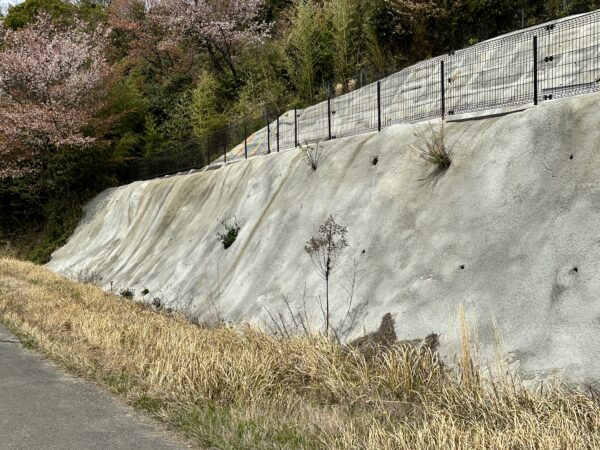
In my previous post, I mentioned that when mortar is sprayed on as a weed-control measure, there is a possibility that internal voids could form over time due to aging.
For us in the slope stabilization industry, this is a fairly common scenario.
So, when I think about what a slope contractor would do, I imagine they’d probably fill the interior with non-shrink mortar or something similar.
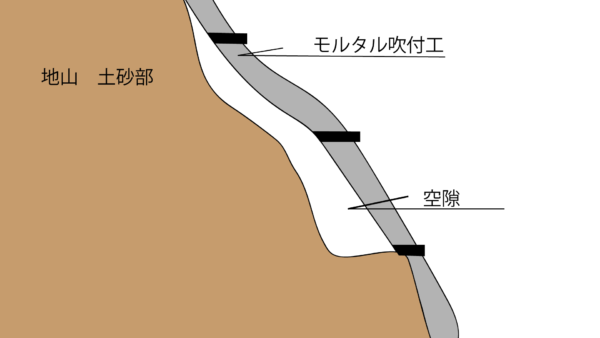
In this state, plug the main drain pipe.
Then, drill several holes in the existing sprayed mortar (at appropriate intervals, from left to right and from top to bottom).
If I were to draw it on a flat surface, it would look something like this (it's not a pebble, lol).
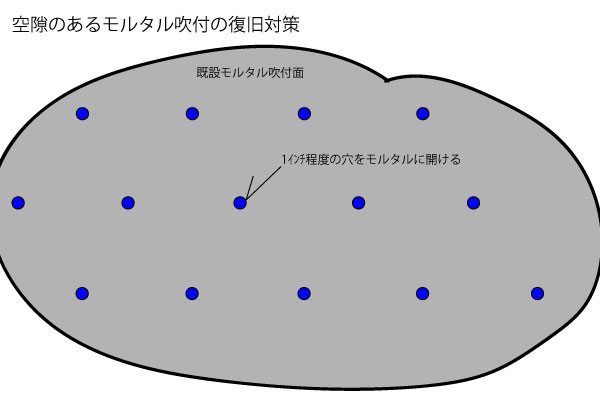
The blue circles indicate where we expect voids to be; we will inject the material sequentially, starting from the hole at the bottom here.
By doing so, you can stack them from the bottom up to fill the space.
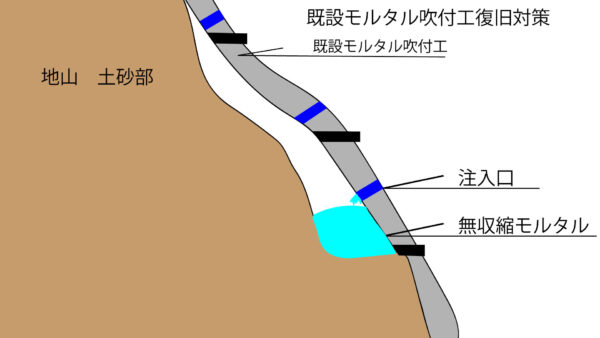
Since it looked something like this, it felt like I was filling in the gaps.
Of course, since it’s a natural flow, it might not fill completely, but it’s definitely stronger than it was originally.
It’s not that you can’t inject material by applying pressure, but since the slope is extremely vulnerable to internal pressure, there’s a possibility that cracks could form...
Well, as long as it's in moderation, lol
If you're just filling it, you'd do it something like this.
It seems like it would go smoothly if you just set the water-to-cement ratio of the non-shrink mortar a little higher, though.
So, as long as we can conduct a test run to verify the strength, I don't think there will be any problems.
To be continued next time lol
See you later.