Hello, everyone.
This is Enta.
I’ve been working on the plan for the temporary ground anchor installation since New Year’s Day.
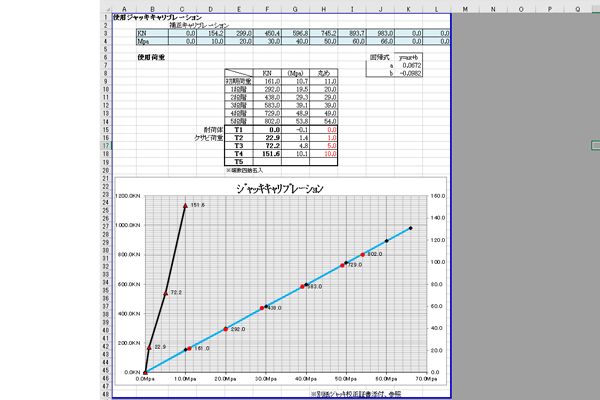
For KTB temporary ground anchors, the tensioning method differs depending on whether there are multiple load-bearing elements.
For example, if there are three load-bearing elements, that means there will be six strands of PC steel wire.
A single strand of PC wire is bent in a U-shape, with a load-bearing element attached to its tip.
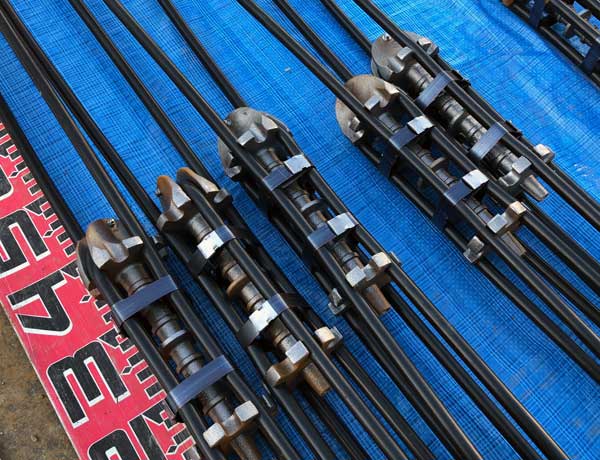
Suppose the first load-bearing element at the tip is located at 10 m, the second load-bearing element at 9 m, and the third load-bearing element at 8 m.
Install the jack, drive a wedge into load-bearing element No. 1 first, and pull it from 0 kN to the specified kN position.
Next, drive a wedge into load-bearing element No. 2 and pull it until it reaches the specified KN.
Next, drive a wedge into load-bearing element No. 3 and pull it until it reaches the specified KN.
Now we're all set to prepare for the PC strand test.
Basically, since the lengths are all different, the amount of elongation varies. We calculate that and convert it into a load, and then apply the tensile force.
From this point, apply the load up to the initial load to begin the suitability test or verification test.
In the case of KJS, we calculate the spring constant and insert a component called a "cherast" along with it.
Also, since this is a hassle, I insert a wedge into load-bearing element No. 2 when the load reaches 2 MPa, and into load-bearing element No. 3 when it reaches 5 MPa.
It's definitely easier to do it that way, lol.
Everyone has their own way of doing things, but I think it’s best to use a method that’s easy to do and easy to explain.
Once the Excel template is fully complete, I'll make it available.
See you later.