Hello, everyone.
This is Enta.
Regarding that spring drill hole I posted about the other day—it actually worked out in the end lol.
This is a 17-meter borehole drilled into sandy soil.
Drill hole diameter: φ115
It actually went surprisingly smoothly. (There's a trick to it, lol.)
Well, since the drilling angle was 90 degrees vertical this time, it might have been easier than I expected.
The biggest challenge this time was a 2-meter-thick layer of silt at a depth of about 8 meters—it turned out to be surprisingly hard.
Once you get past this, you’ll enter sandy soil again, but this time the backflow is incredibly strong, and sand rushes into the inner rod all at once.
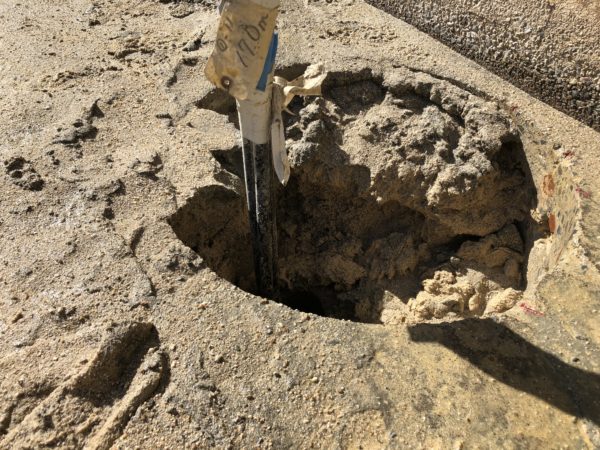
The soil was so soft that I couldn't even tell where the N-value for the anchorage zone was, lol.
If you turn off the water even for a minute, it gets clogged instantly. Plus, it gets stuck between the outer and inner layers, so it won't come out. (At first)
We also had a very hard time because no drilling fluid was coming up.
Especially for the first two, I kept taking all the inner layers out and putting them back in over and over again.
I guess I was able to do that because it was only about 17 meters. If it had been over 30 meters, I would have been really fed up.
This time, we encountered a situation where the internal pressure was higher than expected and sand backflow was severe, so if we removed the inner rod, it would sink about 2 meters into the sand.
As a result, the anchor body cannot be inserted after the cement slurry has been injected.
Even the measuring rod could only reach 15 meters out of the 17 meters.
Therefore, we had no choice but to inject the fluid through the inner rod. (The drilling fluid was kept flowing continuously.)
Inject the cement slurry without removing the inner rod.
That way, the weight of the cement slurry will help suppress the internal pressure.
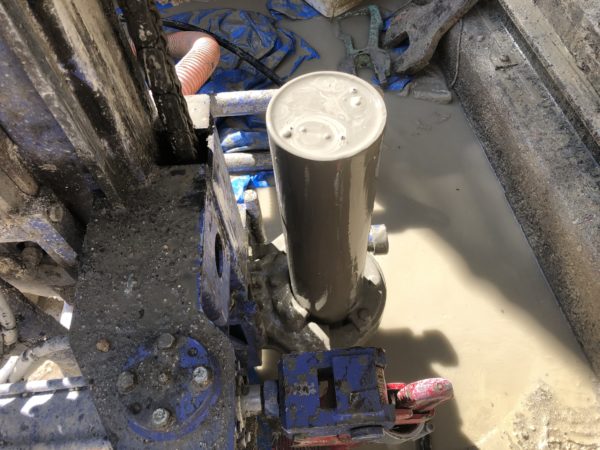
However, while pumping water, I also pumped air vigorously to flush out as much sand from the holes as possible.
After that, we quickly swapped out the hose and replaced the cement slurry by injecting it through the tip of the inner rod!
We retrieved the inner rod as soon as we confirmed that the cement slurry had overflowed.
It’s a bit of an unconventional method, but it’s a valid approach in its own right. (You could use a Kronenbit, but it’s a matter of cost.)
Since we were able to confirm the strength of that cement slurry, the tension should be fine as long as we can eliminate the friction in the anchoring soil.
There’s a bit of a trick to how you inject it, but I’ll save that for next time.
All in all, it was really great that we were able to drill to this depth using a spring drill this time.
Now that we know the limits of the core drill, we should be able to use it for the next project as well.
See you later.