Hello, everyone.
This is Enta.
Something totally unexpected happened lol
Even though I call it an “accident,” no one was injured—I just ended up covered in mortar—but when I think about what might have happened if someone had been standing right in front of me, it honestly gives me the chills.
That’s exactly why I’m sharing this openly this time. Please be sure to add this to your company’s equipment inspection checklist.
But that's beside the point.
In this post, I’ll go into detail about an incident in which the furnace lid of a mortar sprayer suddenly opened, and the wear on the bolt threads that caused it.
The Day the Kiln Door Suddenly Blown Off
That day, while I was working on site, the door of the spray machine’s furnace suddenly flew open with a loud “BANG!”
The mortar inside burst out all at once, and the equipment in front of it was covered in mortar.
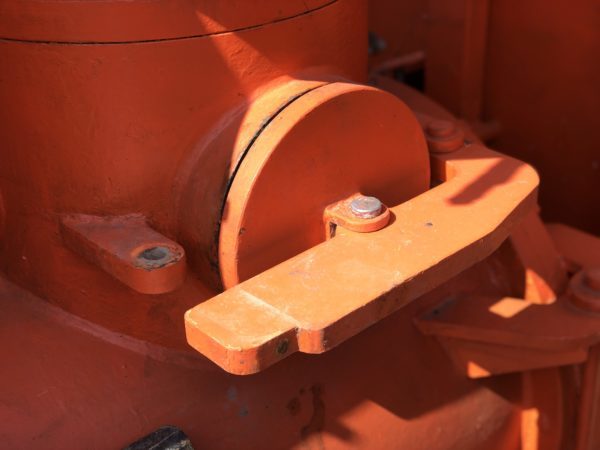
Just imagine the whole area covered in mortar. Just cleaning it up would be a real hassle, lol.
The one silver lining was that no one was standing directly in front of the door at that moment. If a worker had been standing there, he would have been hit by the flying mortar at point-blank range.
Depending on the direction in which the bolts securing the kiln lid are blown off, not only mortar but also the metal parts themselves could be propelled through the air.
I don't think this is simply a matter of being "dirty"; I believe it's a situation that could have led to serious injury if things had gone just a little wrong.
The cause was wear on the bolt's threads.
To determine the cause, I took a look around the area where the bolt had flown off.
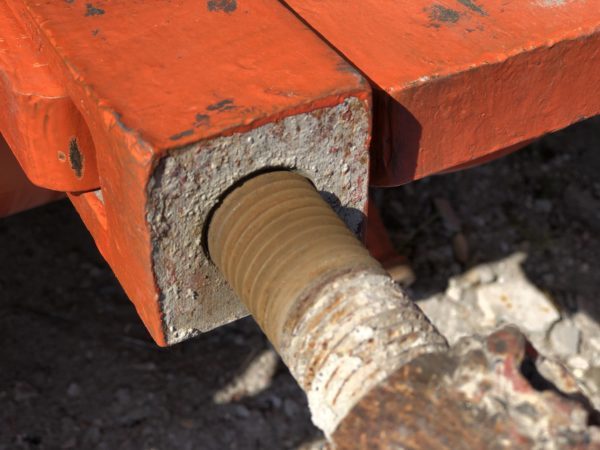
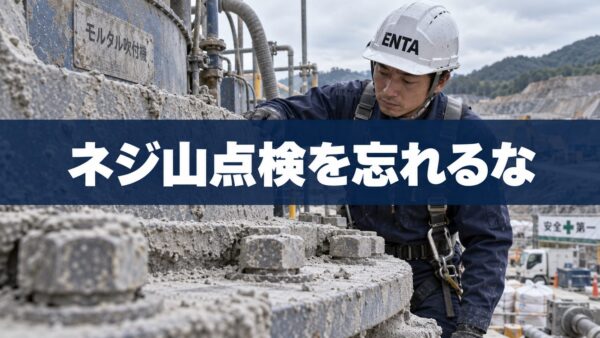
The threads visible in this photo are still fairly intact, but on the bolt that actually flew off, the threads were quite worn down.
Since it’s often hard to tell at a glance whether the screw threads are worn, I feel it’s necessary to perform an inspection that involves tracing the shape of the threads.
As shown in the photo, there was also a small amount of mortar adhering to this screw. This, too, is a very dangerous sign.
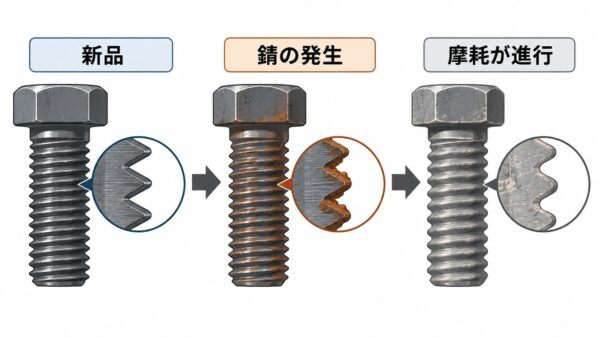
Why Do Screw Threads Wear Out? | The Triple Threat of Rust, Sand, and Dirt
So why do screw threads wear down this much? Based on what I’ve observed on-site, there are two main causes.
Corrosion Caused by Rust
First is rust.
Corrosion happens more easily than you might think.
The bolts we use areHigh-Tension BoltThere are many of these, but of course, they rust too.
Although the black rust finish (iron oxide coating) makes it slightly more resistant to rust, rust will still inevitably continue to form.
Be sure to apply grease to the screw threads. Without grease, the condition will deteriorate in no time.
Wear Caused by Mortar (Sand) Deposits
Another cause is physical wear resulting from continued use while sand particles from the mortar remain adhered to the surface.
Due to the design of the spray machine, the bolts around the kiln are areas where mortar tends to accumulate.
As shown in the photo above, if you continue working with mortar particles lodged in the screw threads, the threads will gradually wear down with a grating sound every time you turn the bolt.
The problem is that this isn't just on the bolt side, butThe same thing happens on the nut side as well.That's the point.
Even if you replace just one side, the meshing accuracy won't return to normal if the other side is worn down.
Measures You Can Take Through Inspection and Maintenance
While there are some aspects of this structure that simply can't be helped, there are still ways to address them.
- If it gets dirty, do not turn it without washing it first; be sure to clean it before turning the screw.
- If possible, use a pressure washer to rinse away any mortar residue (such as sand) from both the bolts and nuts.
- Be sure to apply grease after cleaning.
Just by doing this, you can prevent strange seizing (a condition where bolts become stuck and cannot be removed) and reduced work efficiency caused by the bolts seizing up.
It takes a little extra effort, but this is really important.
And above all, as long as there is sufficient friction between the bolt and nut, then—as in this case—This will prevent accidents in which the kiln lid is blown off due to insufficient friction on the screw threads.。
Bolts and nuts are products that, by their very nature, function only because of friction.
Be sure to check both the bolt side and the nut side to confirm that the screw threads are intact.
It’s dangerous to look at just one side and decide that “everything is fine.”
It’s really just a matter of adding a single line—“Check for thread wear”—to the daily inspection checklist, but this is exactly the kind of thing that happens when that step gets overlooked.
Before a machine breaks down, there are always some warning signs.
I think the incident with that mortar-covered machine served as a good lesson in not overlooking the early warning signs.
When you think about it, all the machinery on a construction site—not just sprayers—is essentially a “collection of consumables.”
The deterioration of a single bolt or gasket can lead to a major accident at an unexpected moment.
That is precisely why it is necessary to specify in the pre-shift inspection checklist not just “glance at the bolts,” but to go a step further and include “trace the threads to check for wear.”
It only takes a few dozen seconds, but if those few dozen seconds can prevent an accident, why wouldn't you do it?
See you later.
Bit Wear in Suspended Drilling Rigs | Consumables Management