Hello, everyone.
This is Enta.
The other day, when I got back from Kagoshima, my desk was covered with papers, papers, pap...
That's kind of a bummer, huh? (lol)
It can't be helped at this time of year.
I'll do my best.
To everyone involved: Please wait just a little longer lol
But that's beside the point.
Regarding Applications for Special Vehicle Permits
I think we tend to take moving machinery for granted.
Actually, if a vehicle exceeds certain limits for weight, width, length, or height, you’ll need to apply for a special vehicle permit.
I knew about it, too, but I didn't really understand the details, so I figured it probably didn't matter that much.
However, there were actually times when it was necessary.
So, what are these specific conditions?
| Vehicle Specifications | General Limit (Maximum Limit) | |
|---|---|---|
| 幅 | 2.5 meters | |
| Length | 12.0 meters | |
| Height | 3.8 meters | |
| Weight | Gross Weight | 20.0 metric tons |
| Axle Load | 10.0 metric tons | |
| Adjacent Axle Load | ○ When the wheelbase between adjacent axles is less than 1.8 meters: 18.0 metric tons (However, provided that the wheelbase between adjacent axles is 1.3 meters or more, and (19 metric tons when the axle load of each adjacent axle is 9.5 metric tons or less) ○ Wheelbase between adjacent axles of 1.8 meters or more: 20.0 metric tons |
|
| Circular Load | 5.0 metric tons | |
| Minimum Turning Radius | 12.0 meters | |
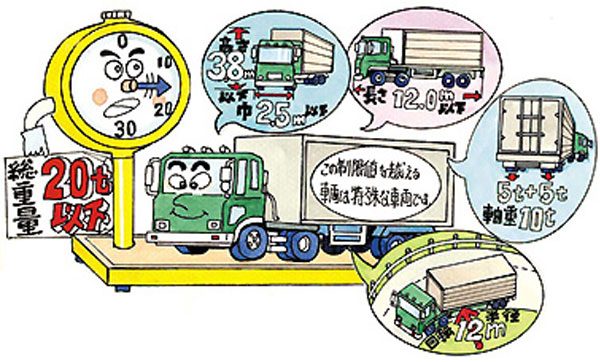
For vehicles that exceed these requirements, the company responsible for managing the transport vehicles must submit an application to the Ministry of Land, Infrastructure, Transport and Tourism.
We submit an application to the road authority—specifying when, on which roads, and via which routes we will drive, as well as details such as the lead vehicle and cargo—and obtain their permission.
So, when it comes to what kinds of machines are actually good or bad...
In the case of a spray painting contractor, there is generally no need to file an application.
An anchor contractor can probably manage with a 3-metric-ton-class drilling rig plus a unit weighing just under 6 metric tons, even with other equipment and materials included.
The total weight does not exceed 20 metric tons. (Varies by vehicle model.)
The reason is that the current large 10-metric-ton models (equipped with a crane) have a curb weight of about 11.5 to 13.5 metric tons.
That means, simply put, 20 t – 11.5 t = 8.5 t, and 20 t – 13.5 t = 6.5 t.
Depending on the vehicle model, the range is from 6.5 metric tons to 8.5 metric tons.
A standard-class drilling machine should work just fine.
But, unfortunately, the crawler is a problem.
Even the lightest crawler-type rotary percussion models weigh about 8 metric tons.
This is probably the absolute limit for this model.
When transporting a crawler-type rotary percussion drill, it might be easiest to use the shipping company that the rental company uses.
The leasing company handles that part perfectly.
(If you want to know more, check out the Ministry of Land, Infrastructure, Transport and Tourism website below.)
Ministry of Land, Infrastructure, Transport and Tourism(Regarding Applications for Permits for Special Vehicles)
See you later.