Hello, everyone.
This is Enta.
It's starting to get a little chilly, isn't it?
Only in the mornings and evenings, though.
Is this going to be a mild winter? But there are a lot of stink bugs around—so maybe we’ll get heavy snow???
Either way, it's just business for us slope contractors, lol.
Let's take care of our health and do our best.

But that's beside the point.
I’ve taken the liberty of starting this glossary of civil engineering and slope engineering terms.
I'll just post them as they come.
Have you heard of slaking?
Is this a term that's unfamiliar to slope engineers?
Well, civil engineers use it all the time, and I think it’s pretty common among geological consultants as well.
The phenomena we see every day actually have names.
Especially regarding soil conditions.
And “slayking” in this context is a geological term.
Simply put, when soft and hard rocks are repeatedly exposed to cycles of drying and wetting, they break down from the inside and become finer and finer.
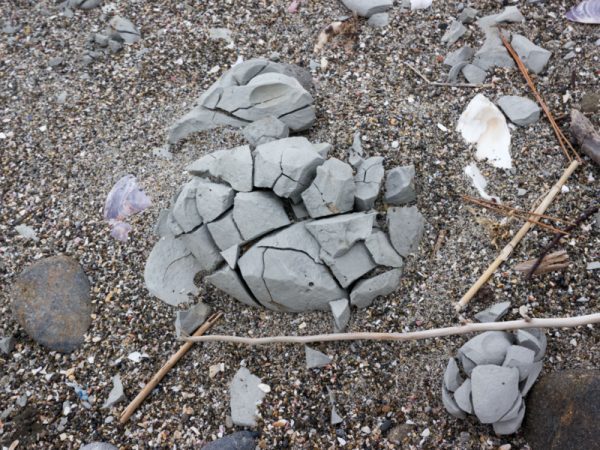
In some cases, the anchorage layer in anchor work consists of mudstone.
In that case, we drill into fresh mudstone and inject the material, but even if the rock becomes saturated during drilling, the drying process does not proceed.
This is because, ultimately, an anchor body is inserted and cement slurry is injected.
That’s why it prevents the fabric from drying out too quickly.
Since the material tends to remain moist, the likelihood of slaking is low.
Try using the word “slaying” at some worksite or other lol
You'll really benefit from using it.
See you later.