Hello, everyone.
This is Enta.
The other day, while talking with someone, I heard a story that really resonated with me.

I have a question about some documents, and...
For us public sector workers, paperwork is just part of the job, isn't it?
Before construction begins, you’ll likely need to prepare and submit various documents, such as the construction plan, meeting minutes during construction, monthly progress reports, safety documents, and, finally, the completion documents.
If you work in construction management, you’re sure to recognize this, right?
These days, with photography becoming increasingly digitized, I don't print photos as often as I used to.
However, I believe you are still printing out and submitting the documents.
Well, I suppose there are cases where PDFs are used, but when it comes to documents, paper is easier to read and manage, isn't it?
Ultimately, though, I do think converting everything to PDF is a good way to manage data.
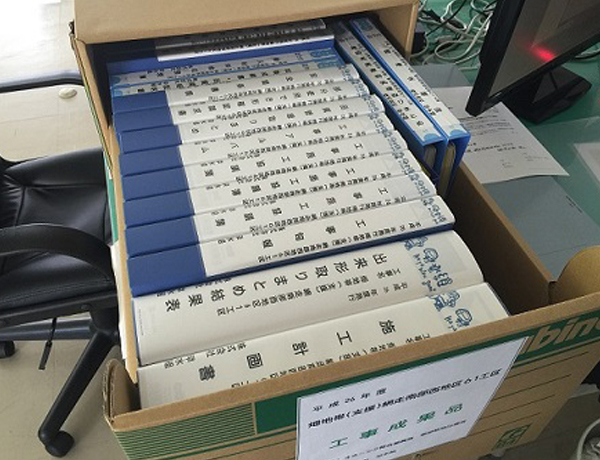
According to that person, the quality of the documentation gives you an idea of the quality of the work on-site and how it’s managed.
Basically, people who produce messy (hard-to-understand) documents also have messy work environments.
They say there are clear signs of inadequate construction management.
Apparently, people whose paperwork is flawless also do flawless work on the job, so they rarely get any specific feedback—and even when they do, it’s usually very minor. (Apparently, they get nitpicked over such trivial details that it’s hard to even understand what they’re complaining about, lol.)
There was a time when I was really particular about paperwork, too—I got so hooked on it that I even wondered, “Do I really need to go this far?”
And that was around the time I realized something.
When you present the documents in a clear and easy-to-understand way and have polished them to perfection (in your own mind), the on-site inspection is a breeze.
Even if I spend half a day going through a thorough document review, it makes me so happy when the inspector tells me my documents are well-prepared. And then the rest of the inspection goes by in a flash.
If the paperwork is full of errors, the site will be inspected very thoroughly. (I had quite a few of those when I was younger, lol.)
From the government agency's perspective, this means they can't trust either the paperwork or what's happening on-site.
If someone can handle paperwork perfectly, that means they’re perfect on the job, too.
Well, I do think it’s not good to be too particular about things, but I suppose moderation is best in everything.
However, to know where to draw the line, you also need to get somewhat absorbed in your work.
Since a supervisor’s final score is entirely based on the evaluation score given after the final inspection (in the case of public projects), focusing on that score is likely one of the supervisor’s goals.
It's so great to get recognized right there on the job at the very end.
I think it would be a clear goal for the site supervisor to aim for this area for now.
See you later.
P.S.
Since I’m no longer a general contractor, I don’t get recognized on-site anymore, but to be honest, I’m kind of jealous lol.
I’m always so happy when former colleagues or directors I know reach out to tell me they’ve received an award. (It’s the greatest reward a director can ask for!)
So, personally, one of the things that brings me joy is being able to help out in those kinds of situations.