Hello, everyone.
This is Enta.
Heavy rain has been falling in various parts of Aichi Prefecture for the past few days.
The area where I live is, shall we say, relatively free of mountains.
So, it won't collapse or anything like that.
If the area behind your house is designated as a steep slope zone or something similar, you should definitely be extra careful.
How to Tell at a Glance Whether Something Will Collapse or NotThere is.
That is,A place that has never collapsed before will collapse.
You were thinking, “That’s obvious!” weren’t you?
Surprisingly, people don't really notice this part.
It is not uncommon for the area next to a retaining wall or anchor to collapse.
Be careful of mountains where you’ve never seen a landslide before!
But that's beside the point.
Site Conditions II
Market unit prices for rebar installation work.
Scaffolding + Single-Hole Drilling = Site Conditions II
Right?
The bore diameter is φ65.
I believe the design team reviewed the site conditions—such as the columnar diagram—and classified them as Site Conditions II.
That's fine, though.
It’s an answer derived from the principles of design philosophy.
So, actually...In many cases, it is not possible to perform the work properly.That's the point.
Why Can't They Do the Work Properly?
Actually, there are many cases where the rock mass in Field Condition II—which is generally considered to be self-supporting—is not self-supporting.
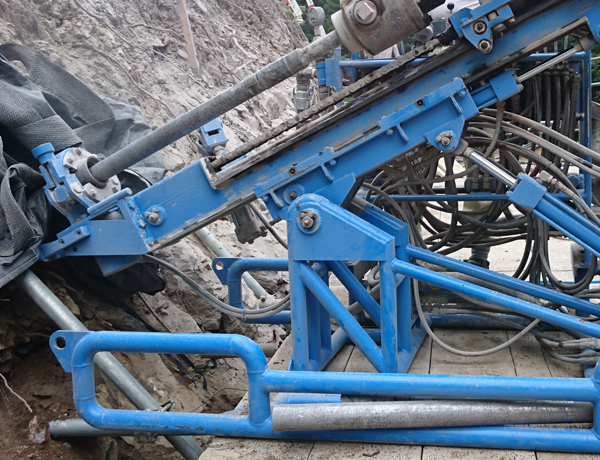
If it's a dual-bore drilling operation, there won't be any problems, but in the case of single-bore drilling, the only option is to push it in.
Since we can't add this on the spot, we can't mark it for modification.
As a result, the only option left is to push it in.
A surefire way to do it is
A veteran surgeon can create a hole in an instant. (To make it stand on its own.)
Generally speaking, single-hole drilling is a relatively simple process, so it’s a method that anyone can easily get started with.
Whether you're doing this for the first time or it's your second time, you can perform the drilling.
However, it’s worlds apart from the work of an anchor technician with years of drilling experience.
Speed, safety, and precision in construction.
Even if it's just a single hole, it's best to leave it to a professional.
Even so, we want to do it in-house
Studying is important, and it’s necessary to take on challenges.
How can I make the hole self-supporting?
While gravel, cobblestones, and crushed stone aren't an issue, when dealing with soil and sand, be sure to keep a close eye on the slime.
When it comes to new operators, they just don't see the slimes at all.
I'm just staring blankly as the hammer moves along the guide rail.
Is the slime coming out properly? What about the rotational pressure? What about the feed pressure? What about the air pressure?
It’s important to keep that in mind and always think about the mountain.
Cannot enter through the gravel or crushed stone behind the blocks or behind the stone wall.
Since that's practically impossible, please drill a hole in that specific section of the casing.
For example, if there is crushed stone in the first 50 cm, drill about 1 meter using casing, and then continue drilling using the inner drill string.
The crushed stone section is not blocked off because it has an outer casing.
If you insert the rebar and remove the formwork, you can ensure a solid construction.
However, this is difficult to do with machines like inverter chisels. (I wonder if it’s possible to use a double-tube setup these days?)
What about the grout?
The grout is injected from the bottom through a hose secured to the rebar, but it does not rise into the areas filled with crushed stone or gravel.
At this point, you could either give up and use a rapid-setting agent, mix in some fiber, or make the grout quite stiff,
Please submit it using one of these methods.
I think the general rule is to use a stiffer grout.
Drilling is difficult.
"I've been drilling for three years!" But I still have a long way to go.
Since you can't see what you're doing when drilling, you have to rely on your instincts and the instruments to guide you—it's a field where intuition and experience are key.
You won't get better that easily, and you won't be able to dig any faster.
I've been back on site recently and am using a spring drill for the first time in about two years, but it's so scary... lol
And it's slow, lol.
It's a total failure.
By the time this job is done, I wonder if I'll be able to remember a little bit... lol
See you later.