



Hello, everyone.
This is Enta.
The other day, on my way back from a job site, I received a call saying that they didn’t have enough drilling fluid at one of the sites and needed an MG-20-class pump,
I immediately called a friend and went to borrow it.
It's been about five years since that pump was last used, but,
It’s been about five years since the last overhaul, so we decided to give it a quick tune-up and send it out to the job site.
Right now, there's not a single person at the office, and I'm the only one at the job site...
Looks like I'll be working on the pump this weekend...
I need a mechanic! I really, really need one...

But that's beside the point.
I was just staring intently at it right there on the spot.
This...
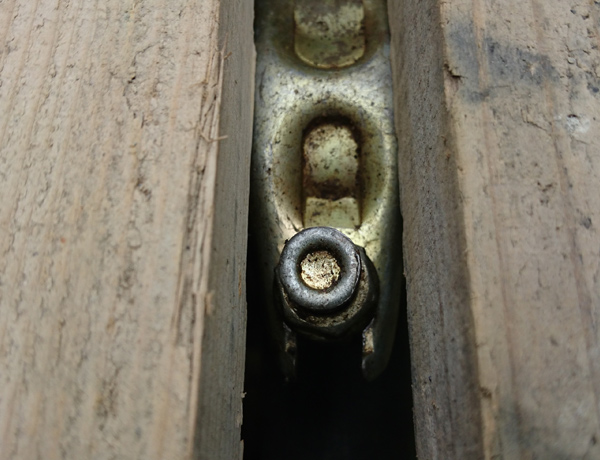
I kind of feel like someone's watching me...
I just felt like this guy was staring at me a lot.
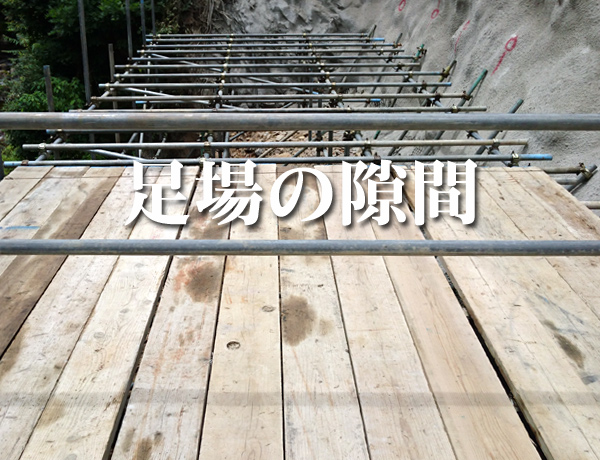
I measured it.
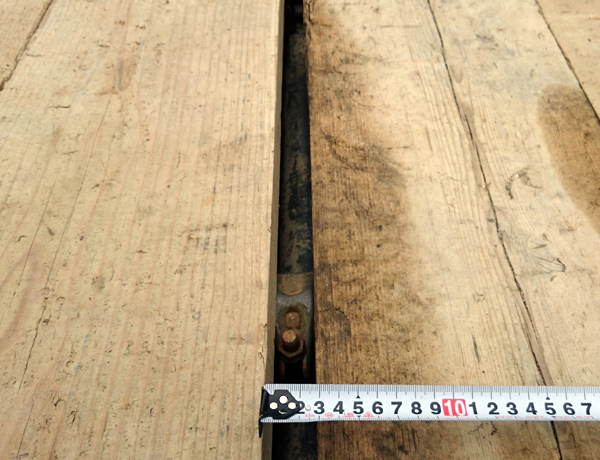
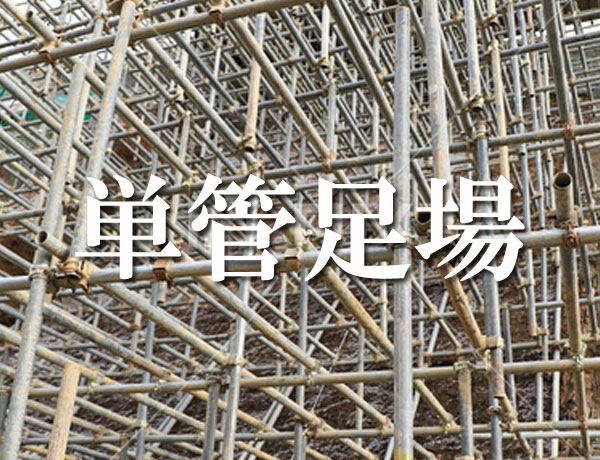
Gap in the Single-Pipe Clamp
There's just no way to fill this gap, is there?
But this gap...
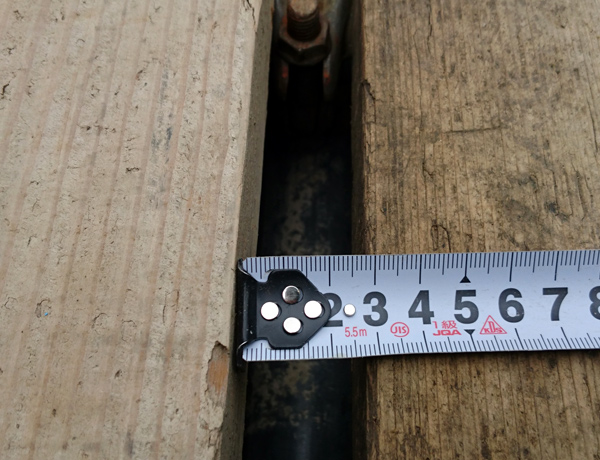
It's exactly 3 cm!!!
I was really surprised!! Or rather, I had no idea.
3 cm—you know, that thing!
The gap between scaffolding planks must be 3 cm or less.
I often get called out by patrol officers for leaving a gap of more than 3 cm, you know~
But come on, it's not like it's going to fall just because there's a 3-centimeter gap!
That's what I was thinking at the time.
That's right. No matter what I do, there's just no way to get it to go down, huh? lol
ButThis is 5 cmWhen I thought, "What if..."It creates a gap where your toes can definitely get stuck or your foot can twist, and
This can cause you to fall or trip.
There's a chance you could fall because of that momentum.
"So that's what the 3 cm was for, huh?" I found myself thinking to myself on set, lol.
Strict Safety Management
As a construction industry, we are bound by all sorts of laws, but,
It makes me think that the people who designed it have considered safety from various angles.
But since I think that’s a bit over the top, I guess I’m still pretty lax when it comes to safety, lol.
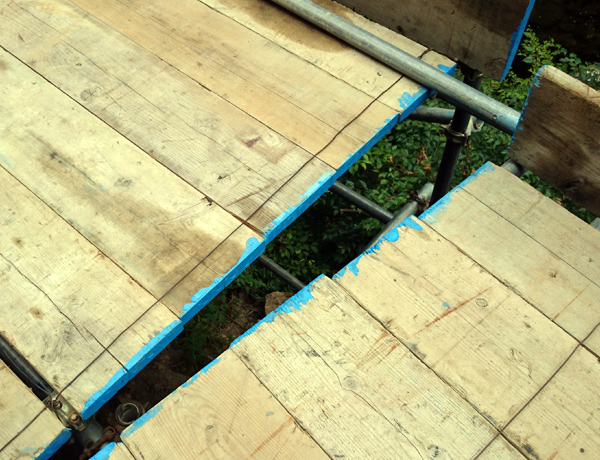
For an opening this size,
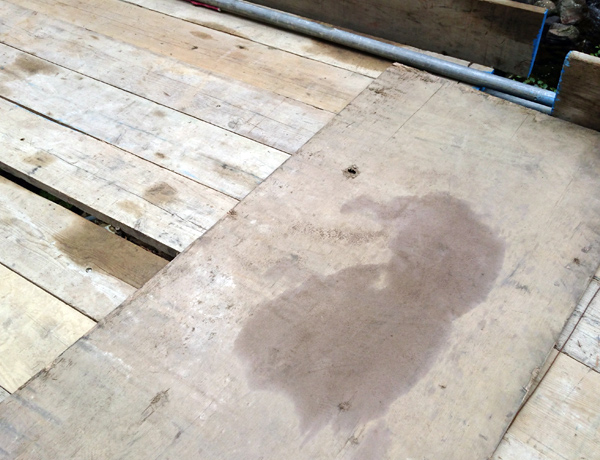
You can do it this way, though~
It's like this!
(Please don't tell me to pin this, lol)
A long time ago, during an inspection by a general contractor, I was asked, “What would you do if this plywood were rotten?”
When I said, “It’s not rotten, so it’s fine, right? (Since I was young),”
People told me I wasn't safety-conscious, and I got bullied lol
He was a person who took safety very seriously.
I still remember that to this day, lol. Thanks to that, I've become well-versed in safety.
The head of safety at that major general contractor back then!
Thank you very much!
I'm actually grateful now! Back then, I thought he was a damn old geezer, lol.
If you want to learn about safety, go to a general contractor
I used to handle quite a few projects for major general contractors back in the day.
There were all sorts of things I learned there, but I definitely became much more safety-conscious.
The level of safety management is different.
As expected, there was a big difference in our levels of knowledge.
For engineers, there’s a big difference between those who have worked on general contractor job sites and those who haven’t.
This is an indisputable fact.
As is the case with construction contractors in general, companies that can handle projects for general contractors effectively are, as expected, reliable.
It’s important to try learning the ropes at a general contractor’s construction site at least once. (Though there are definitely some tough times, lol.)
See you later.

Instead of just pointing out problems,
It would be great if you could help me come up with some solutions (~_~;)
Thank you as always.
Yeah, that's right lol
I get called out all the time, don't I? lol
Well, since we're a subcontractor, part of the job is to follow the general contractor's instructions, right? So it's a bit tricky.
I'm sure it's fine now, since most companies have measures in place!