Hello, everyone.
This is Enta.
I wrote the other day about the collapse incident in Nishinari, Osaka, and while I was researching various aspects of stone masonry, I discovered that the Ministry of Land, Infrastructure, Transport and Tourism had created a retaining wall inspection checklist.
Someone mentioned it on Twitter, which was a huge help.
Our Family's Retaining Wall Checklist
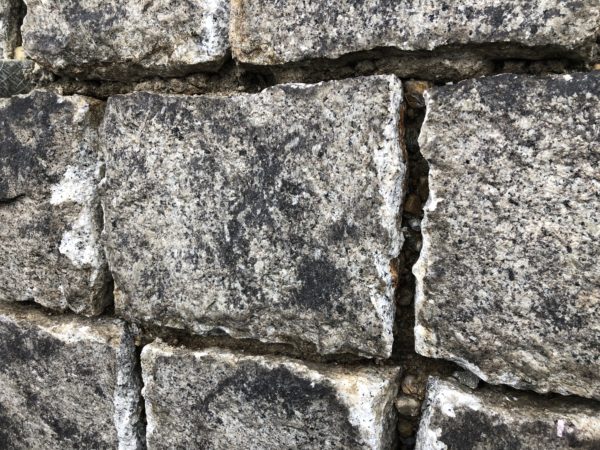
I think the stone walls commonly seen on most private properties are either interlocking blocks or dry stone walls.
We don't often build gravity retaining walls.
After all, that would significantly increase costs.
Especially when it comes to concrete structures, they’re necessary right from the design phase, and since the foundation needs to be solid, I think it makes perfect sense that they wouldn’t end up being something as inexpensive and simple as dry stone masonry.
However, please be aware that it is surprisingly more fragile than it looks and is quite vulnerable to water.
The sprayed mortar we apply is the same; it is, after all, merely a surface treatment. (Protection of the surface only)
It’s completely different from a gravity retaining wall, where the weight of the stones is used to press down firmly to prevent it from collapsing.
I think that, unlike in our slope stabilization industry, many ordinary people are surprisingly willing to spend money on their home foundations, but they don’t spend money on slopes.
If the slope collapses, even the foundation itself will be swept away (in the case of land with a slope).
I think there’s a very real possibility that, in the worst-case scenario, it could end up like the housing project in Nishinari this time.
Here are some photos of the collapsed residential building in Nishinari taken before it collapsed. (Google Maps really comes through!)
If you happen to live in or own a home like this, please check it using the Ministry of Land, Infrastructure, Transport and Tourism’s stone masonry checklist.
There’s a very high chance that the situation has become extremely dire.
This is especially true when the masonry is dry-laid.
Also, since water can cause quite a bit of damage, please check the water flow during rainfall.
If it appears that an excessive amount of fine-grained material (such as sand) is being washed out from behind the stone masonry, there is a very real risk that the interior has become hollow.
If it's protruding, it's already an emergency. You should have a specialist take a look at it.
I imagine that when you say something like this, you’ll often be asked to check with local construction companies or civil engineering firms.
However, while I think civil engineering firms in mountainous areas are fine because they have experts in slope engineering, it’s a bit of a mixed bag when it comes to construction companies and civil engineering firms in urban areas.
It might be mostly repair work.
The problem isn't on the surface of the stone wall—it's happening inside.
Be sure to consult a slope engineering expert.
I hope that we can help prevent even a small number of slope collapses in urban areas like these across the country.
Please carefully review the checklist.
Our Family's Retaining Wall Checklist
See you later.