Hello, everyone.
This is Enta.
For a long time now, I've been wondering whether I should write here or not.
There's a construction method that makes me think that.
Well, I figured, "Oh well, why not?" so I'll give this a try lol
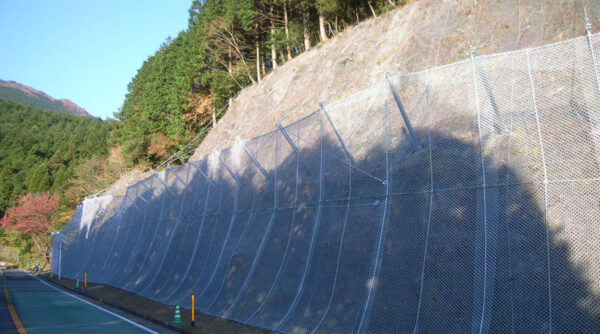
This is a pocket-type rockfall protection net installed using conventional methods.
It's commonly referred to as the "P-style," right? (I think)
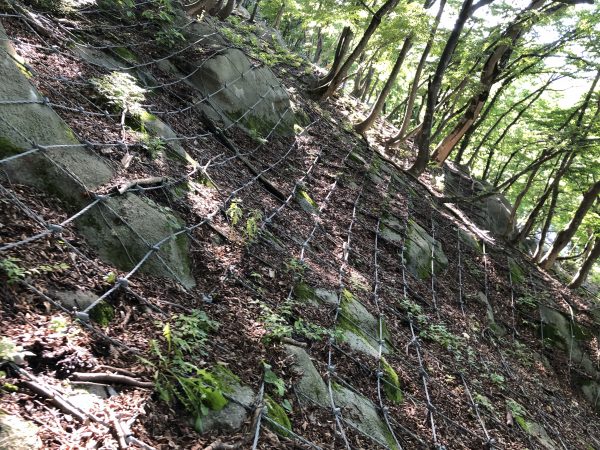
This is a rope net installer. (We do this a lot in Nagano, too.)
And, well, recently—or rather, for the past 20 years or so—
The Ringnet method, which originated in Switzerland, is known as the high-energy net method.
From there, various types of high-energy rockfall protection barriers (including protective nets) gradually began to be developed.
I have absolutely no objection to companies developing and promoting various construction methods, but,
I get the impression that the High-Energy Net Method (hereinafter referred to as “High-Energy”) is a bit of a stretch in terms of its underlying logic as a construction method. (Just my personal opinion.)
It’s fine since you can make the numbers work however you want, but I think it feels a bit excessive as a preventive measure.
The reason is that the conventional method is simpler and cheaper.
I suppose that means they’re switching to high-energy methods because conventional methods just can’t keep up, but,
Please just take what I'm about to write at face value.
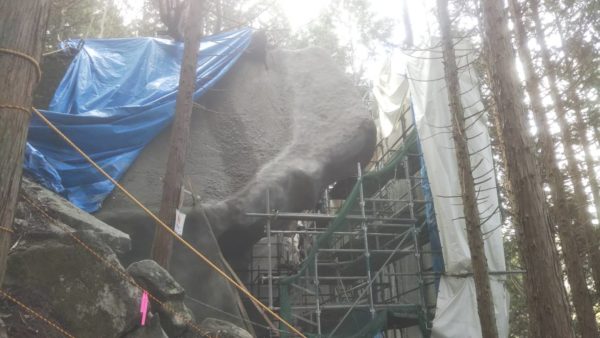
It's actually easier and cheaper to secure the boulders and rock formations directly, isn't it?
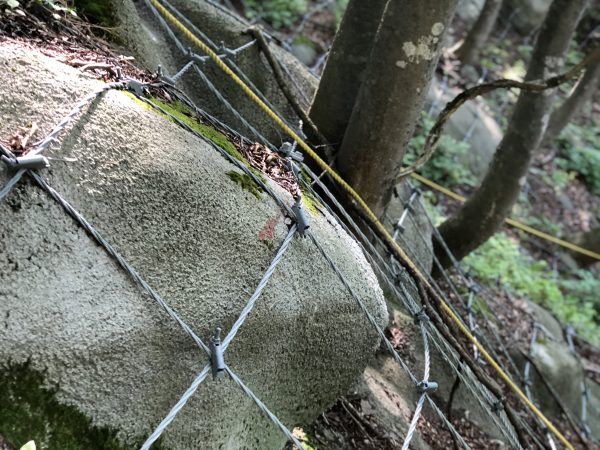
It's easier and cheaper to use a rope net to reduce the spacing and keep them in check.
And maybe add the P-formula to supplement that?
Secure the stones directly + Use the P method to secure any loose stones
This is the cheapest and easiest method—anyone can do it.
When you go all out with high-energy methods, the construction costs are so astronomically high it’s scary.
And then there's the dilemma where nobody makes any money lol (especially the general contractor)
More importantly, we need to stop them one by one, without fail.
That way, it's more resistant to earthquakes and other disasters.
I checked out that high-energy spot in Ishikawa—it's crazy, lol.
What "high energy" means... Well, I guess it just means "unexpected."
There are various construction methods ranging from 100 to 1,000 kJ. Conventional methods are generally 200 kJ or less.
With a stone that’s 2 meters in diameter, it would be nearly impossible to calculate unless you stop it directly. (That’s about the limit.) It exceeds 1,000 kJ, after all.
Well, there might be some differences depending on the calculation method or construction technique, though.
I’m sure there are various people’s motives and political considerations at play, so I don’t intend to go into all the details, but,
It's something I've been thinking for a long time, lol.
As an engineer, I’m like, “Huh?”
I'm guessing there are probably a lot of people who feel the same way.
A slightly simpler construction method would be better.
Even with design consulting, there are all sorts of issues—like the government not being able to acquire the land, or the rock formation covering too large an area, and so on—and,
Since the manufacturer takes care of everything...
Well, I'm sure there are all sorts of things you'd like to say, but I'd like to do my best to make this work.
See you later.