Hello, everyone.
This is Enta.
The slightly unusual mounting frame I mentioned the other day was finished.
The thing is, I was playing it at home, and it just hit me—it was already over!
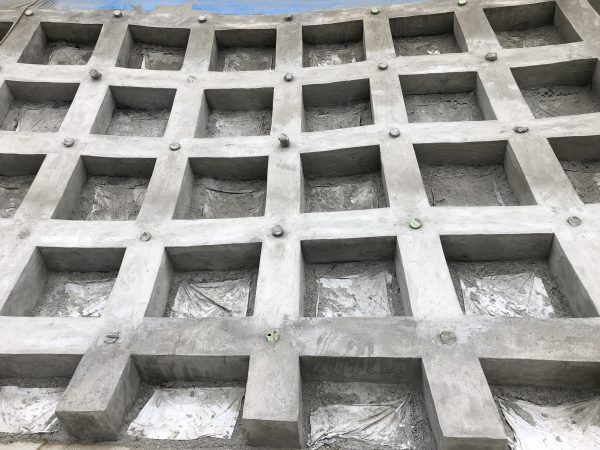
Next up is the rebar insertion work using a suspended core drill.
But I'm in a bind because there's no one around, lol. Even though it's still this time of year, the construction crew can't get out there.
I'm in my 30s or 40s and want to try working as a slope engineer or anchor installer!
Is there anyone out there who has a family but wants to change jobs—and wants to become a construction manager?
I want a job with real responsibility! I want to become a foreman!!
There are probably many reasons, but we're looking for people who are eager to give it a try!
By the way, Iwakura City, where Enta is located, is a relatively rural area. Land prices are a bit high, but it’s a great place to live.
Why don't you try running an anchor installation business or a slope stabilization business in Iwakura City?
By the way, we're also accepting applications in Azumino City, Nagano Prefecture.
How about just talking?

But that's beside the point.
What Is a Rope Net Technician?
Well, since quite a few people already know about this, I’m not sure if I should even explain it, but there might be some who don’t know.
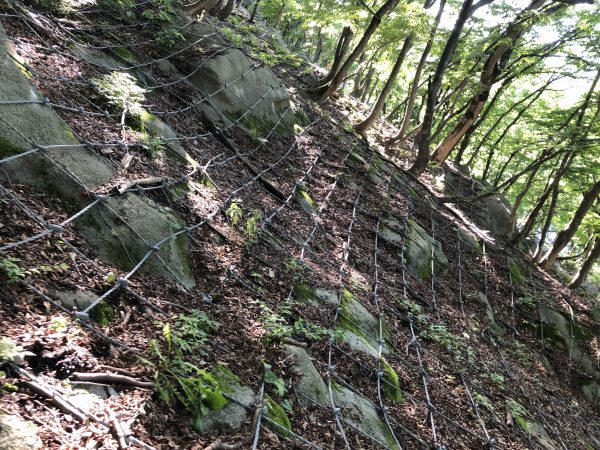
To put it simply, this construction method...Construction Method for Directly Securing Rock MassesThat's it.
The installation process is surprisingly simple, and once you've done it once, it becomes relatively easy.
It takes a little practice, but the differences are mostly just minor variations depending on the manufacturer. (The names and ingredients differ.)
Large boulders are installed using only the rope netting as is, but
Sometimes there are relatively small rocks wedged between larger boulders, and these may slip through the gaps in the rope.
In that case, cover the area partially with netting and secure it with a coil or similar fastener.
Since the construction is completed using only rope netting, you can’t tell at all when viewed from a distance.
It’s a construction method that’s even harder to spot because it involves cutting down very few trees.
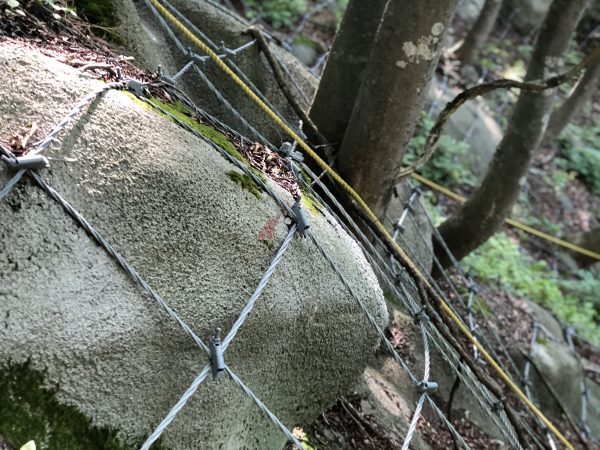
Even if the rock blocks are not very large, they may be secured using a rope net system after applying sprayed mortar as a supplementary measure.
There is also a reverse version, in which mortar is sprayed from above after the rope net installation is complete.
If the boulders are particularly large, foundation reinforcement may be performed.
Although slope stabilization projects have decreased to less than half of what they were 20 years ago, the number of rope-based projects hasn't actually decreased that much.
Rock nets, rope nets, rope hangings, curtain nets, and the high-energy rope systems that have been trending lately.
On the contrary, the number of high-energy types might actually be increasing...
That said, even though it’s only a slight decrease, the number of companies has been dropping, so rope-related businesses are swamped come the end of the fiscal year, lol.
We do it a little bit too, but I prefer rope nets over rock nets, lol.
Construction management is a breeze, too... (Walking around in the mountains and searching for stones for the design is really hard work.)
But when you look at traditional construction methods like this, they really are simple.
I guess it's the simple design that makes it sell, doesn't it?
Conversely, should we aim for simplicity when developing construction methods?
There are so many different types of slopes—it's really a deep subject, isn't it?
See you later.