Hello, everyone.
This is Enta.
I'm still not feeling quite myself, so I'm feeling a bit sluggish, but I can't afford to make excuses.
Anyway, this week is going to be busy, so I've got to do my best!!

But that's beside the point.
Is it difficult to replace machinery on-site?
I think this happens at any worksite: sometimes the work doesn't go as smoothly as expected with the machinery you've brought in.
It’s easy to think, “Let’s just replace the machine,” but in reality, it’s not that simple.

That happens at our house all the time, too.
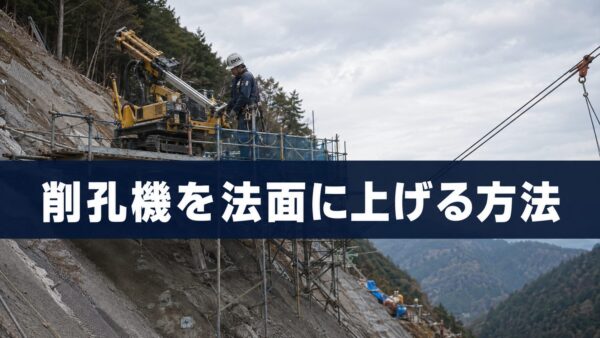
In some cases, the anchor hole may be too hard at the anchorage point.
If it takes nearly an hour to drill the final meter of the anchorage section, I’d want to bring the larger model.
However, the higher-end models are heavier.
Generally speaking, the weight of rotary percussion instruments is,
It would be something like the 0.5-metric-ton class, 1.5-metric-ton class, and 2.5-metric-ton class.
In our case, for mountains under 20 meters—roughly speaking—we usually take a 1.5-metric-ton-class vehicle, but,
As expected, it has less power than the 2.5-metric-ton class.
Especially the hammer.
That's why drilling inevitably takes time.
However, one reason why it can't be changed so easily is that,
1. The Need to Redo Stability Calculations for Scaffolding
2. Scaffolding Reconstruction (Reinforcement)
3. If the height exceeds 10 meters, a notification must be filed with the Labor Standards Inspection Office (at least 30 days prior to the start of assembly).
4. Replacement of the Construction Plan
5. Replacement of the Installation Manual
6. If the machine installation area is expanded, the scope of work must be revised.
and so on
The same applies to sprayers; for example, there are cases where users switch from a small sprayer to a standard sprayer.
Although the spray volume clearly differs, there are also cases where space is limited. Selecting the right machine in such situations is extremely difficult.
1. Explanations regarding changes to the placement of machinery required for construction, such as expanding or reducing the installation area, etc.
2. Replacement of the Construction Plan
3. Replacement of the Construction Procedures Manual
and so on
As I wrote above, the fact is that in most cases, the actual amount is not quite that high.
However, when it comes to a general contractor’s construction site, it’s a different story.
If you don't do it perfectly, you won't be recognized.
Of course, it goes without saying that it’s too late once an accident has already happened.
There is a very real possibility that construction will be completed before the construction manager has a chance to gather all these documents.
In most cases, if changing the machine wouldn't make much of a difference, it's better to proceed with the work as is.

It’s important for craftsmen to choose the option that’s even a little bit easier, but behind the scenes, there’s a supervisor putting together a mountain of paperwork, lol.
However, on-site, it’s important to propose ways to move forward—even if only a little—discuss them, and give them a try.
It's not that everything is bad, but...Making the Best of the Current SituationThat’s important, too. (Craftsmen who can adapt to the current situation are the ones who really know their stuff!)
However, especially on general contractor sites, if you don’t hold a meeting beforehand and follow through, they’ll point out that you’re doing things differently from the work procedures manual, and it’ll be a hassle lol.
However, in my experience, things usually work out just fine with the first machine you try.
(The craftsmen will become accustomed to the job site and be able to handle the work.)
See you later.