Hello, everyone.
This is Enta.
The other day, I found a really old legal framework in the Kanto region and was checking it out lol
(Like a suspicious person, lol)
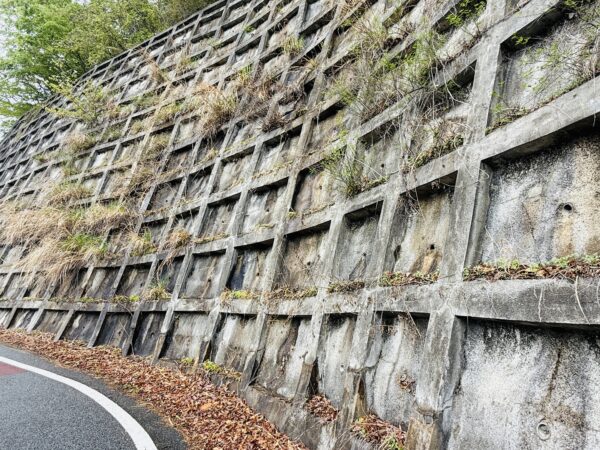
One of the key features of this installation is that it uses a waist-level blow.
"Waist spraying" refers to the process of first spraying the area down to about waist level.
After that, spray the top section.
The reason we do this is to prevent any overspray that falls from above from landing in the mesh at the bottom.
This construction method is based on the idea that if air blows in from above and a lump of uneven size remains in the mesh at the end, it will result in poor quality.
I think it used to be pretty standard practice.
But that downside really comes through, lol.
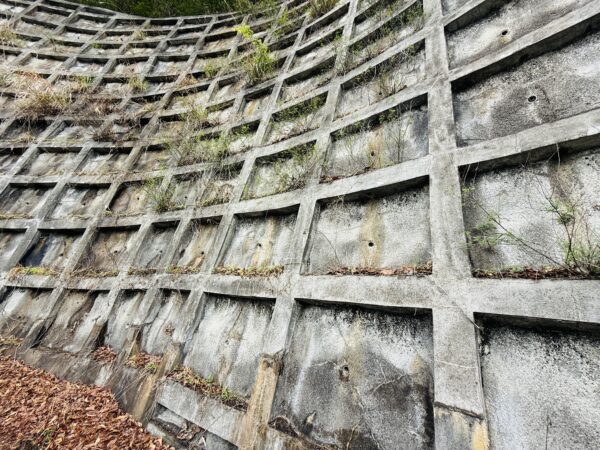
Overall, there's efflorescence appearing horizontally, isn't there?
That's the downside.
Since several days have passed since it last reached this bottom section, a cold joint has formed.
The general process is as follows:
Blowing at the waist → Leithans → Age-related deterioration → Cold joint → Age-related deterioration → Efflorescence.
[The Relationship Between Efflorescence, Leakage, and Cold Joints]
In the construction of concrete structures, “efflorescence,” “laitance,” and “cold joints”
All of themA phenomenon that significantly affects construction and the final finishThat's why proper management is so important.
「Reitans" is applied to the surface of the poured concreteA fragile layer formed by fine particles and moisture in the mortar that rose to the surface and then settledThat is.
This tends to occur immediately after pouring or during finishing.
This latencyIf you proceed to the next step (joining) without thoroughly removing the residue, the bond at the joint will be incomplete, and
A structure known as a “cold joint,” which consists of layers (mille-feuille)...occurs.
Cold joints not only cause cosmetic deterioration, but also,Due to a decline in watertightness。
And thisIf there are gaps (layers), the soluble salts inside are more likely to dissolve into the water, eventually causing “efflorescence” (white deposits) to appear on the surface.
In short, improper treatment of the laitance during the initial spray application leads to the formation of cold joints, which ultimately contributes to efflorescence.。
A management error early in the construction process (failure to remove the curing compound) led to a structural defect (cold joint), and
Since this leads to a deterioration in the finish's appearance and durability (efflorescence),It is absolutely critical to ensure proper processing and curing at each stage.
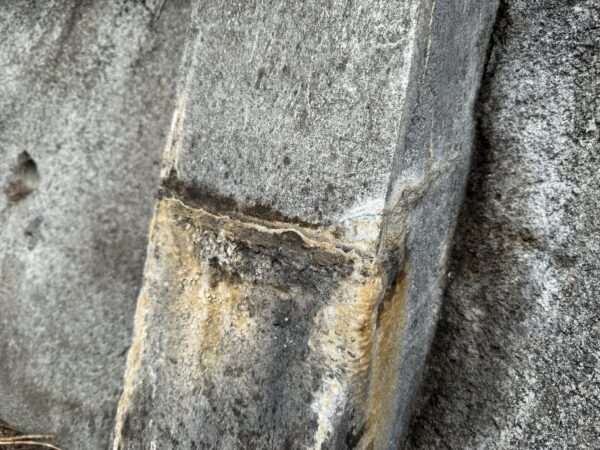
The solution to this is to remove latency, but that’s difficult from a legal standpoint!
I know some of you might be thinking, “With a pressure washer?” but spraying water on a slope is way more dangerous, lol.
Therefore, it is preferable to avoid cutting from top to bottom as much as possible (using a construction method that avoids creating joints).
However, with long sloped surfaces, joints are inevitably formed.
So, maybe using something like a primer—such as a mortar adhesive—could be an option?
I can't say for sure whether efflorescence will appear right away, but these kinds of precautions are necessary.
That said, we slope contractors have tried all sorts of things in the past, but in the end, the best approach is to blow it through as vertically as possible!
I think this is the best option, lol.
Some people might tease, “What about the cross-section!?” but we’ll spray it as soon as possible!
That's about it.
There's only so much you can do on a slope, after all.
Rather than saying that the approach to this in particular amounts to “thinking on autopilot,” I’d say it’s more like, “Oh, that’s just how it is,” lol.
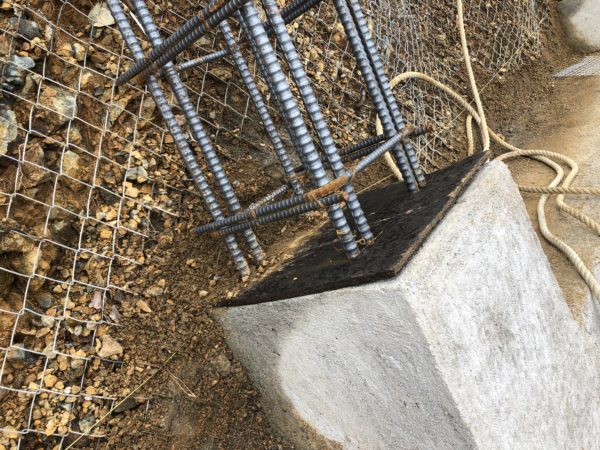
I once saw a vertical frame cross-section like this in Shiga Prefecture! It might be fine if you just put it in, but this is one construction method you absolutely must not use.
It would completely undermine the continuity of the legal framework. You absolutely must not do that.
(I think both the consultant and the construction company’s supervisor are at fault here.)
The rebar is exposed here too, so it’s definitely going to start rusting from this point on—(Is this just normal along Lake Biwa??)
See you later.