Hello, everyone.
This is Enta.
In light of the Kobe Steel scandal, the issue of students who have received job offers for next spring is now coming to the fore.
It's a shame for those who had already received job offers...
Let's get right to it—why don't you come to Enta?
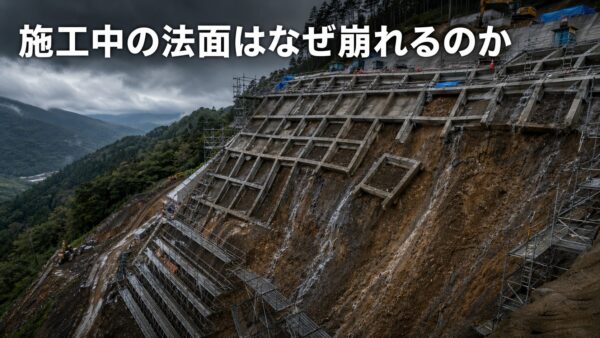
Why not give civil engineering a try? Why not become a slope engineer?
Civil engineering is cleaner than you might think, the pay is surprisingly good, and you have an insane amount of freedom! (Compared to our company)
Well, for now, just come by the glue shop and pick up some glue so we can get to work.
You won't want to leave such a fun workplace!
Probably, lol
But that's beside the point.
This is a continuation of my previous post.
Reinforcement Bar Installer: What Should You Do in Situations Like This? Part 1
Reinforcement Bar Installer: What Should You Do in Situations Like This? Part 2
This time, I'll be proceeding by asking myself, "What would I do if I were Enta?"
1. If it is possible to pour concrete using the same machine, we will adjust the angle.
First, I'll check if I can pour within ±2.5 degrees (though that's probably not going to happen, lol), and then I'll figure out at what temperature I can pour.
For example, let's say concrete can be poured at +10 degrees.
In this case, since the design angle is 30 degrees, adding 10 degrees results in a placement angle of 40 degrees.
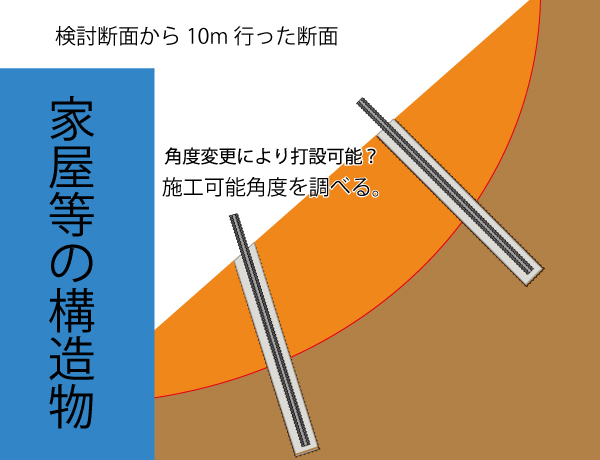
We will perform the stability analysis using this angle.
Please borrow the design calculations from the city office.
We will verify the safety factor at the cross-section specified in the original design. Then, we will analyze the angle at which construction can be performed this time, using the specified angle.
If the safety factor falls below 1.2, increase it to 1.2 by, for example, extending the rebar embedment depth.
2. If it is physically impossible to use machinery, we will switch to self-tapping bolts for installation.
Even though it’s called “self-drilling,” since machinery can’t get in there, it’s obviously done by hand.
However, since digging by hand is quite labor-intensive, keeping it to a minimum will improve construction efficiency.
Use machinery wherever it can fit (by adjusting the angle); if it absolutely won't fit, dig by hand.
However, since manual drilling is limited to 3.0 meters in the cost estimate, it is not possible to drill any deeper than that.
Even on construction sites, drilling a 2.0-meter hole is a real struggle. (Though there are some people who are pretty good at it, lol.)
In line with recent trends, self-drilling rock bolts are also recognized as permanent if they are galvanized.
However, this applies only when there is no other option.
If the standard construction method (Site Conditions I, II, and III) can be used, it takes precedence.
If the borehole wall is not self-supporting and a double-pipe configuration cannot be formed, this may be subject to modification; however,
Depending on the local government, self-piercing may not be allowed at all!
The Ministry of Land, Infrastructure, Transport and Tourism and NEXCO are carrying out construction based on design changes made by Enta.
See you later.
P.S.: K.F. has joined our list of retailers for clip spacers and bolt scales.
Please feel free to contact us.
Manufactured and Sold by Wakazono Seisakusho
Bolt Scale, Dedicated Box, Clip Spacer, and Greenery Spacer
Please see below for inquiries and retail locations.
Natural Applied Sciences, Inc.
(Slope Greening Materials Group)
Phone: 052-212-1441
Koiwa Wire Mesh Co., Ltd.
(Contact the Chubu Branch)
Phone: 0568-75-7710
Showa Co., Ltd.
(Kagoshima Prefecture)
Tel. 099-296-1234
Fujiwara Industries Co., Ltd.
(Bolt scale only)
Phone: 06-6683-0797
Ura-Tsuji Industries, Inc.
(Shimane Prefecture)
Phone: 0852-24-6881
Corporation Tosei
(Shizuoka Prefecture)
Phone: 054-631-9110
Fax: 054-631-9112
KF Co., Ltd.
(Osaka Prefecture)
Phone: 072-232-6060