Hello, everyone.
This is Enta.
Here are the final on-site conditions, Part III!
If you haven't seen the previous episodes, click here
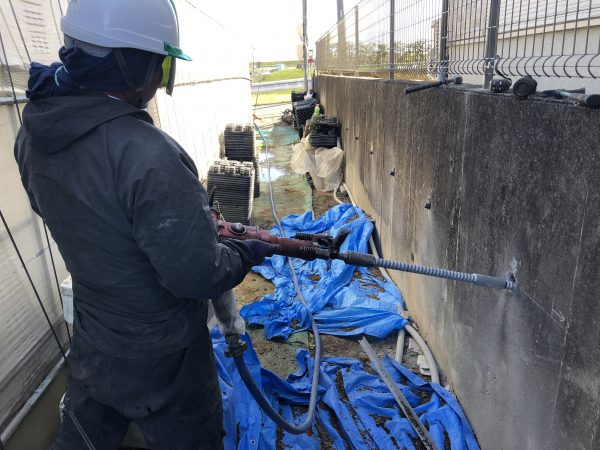
Site Condition III is exactly what you’d call hand digging!
The table of unit prices for the civil engineering market is as follows.
| Types of Scaffolding | Slope Vertical Height | Drilling Length | Drill Hole Diameter |
| Rope Scaffolding | 40 meters or less | 1 m ≤ L ≤ 2 m | 42 mm ≤ φ ≤ 50 mm |
Site Conditions I and II do not apply, and locations where drilling rigs or cranes cannot access are classified as Site Condition III.
Furthermore, although the method is generally manual digging, single-hole drilling is the standard practice.
The key points to note here are that the drilling length is up to 2 meters and the maximum bore diameter is φ50.
In fact, if the borehole diameter is any larger than this, we won't be able to push the rock drill through, and it will become quite difficult.
The basic drilling method involves changing the drill rods in the following order: 500 mm → 1,000 mm → 1,500 mm → 2,000 mm.
Some people drill holes at 1-meter intervals.
As much as possibleA smaller drill hole diameter is better.That's it.
If possible, self-drilling would be best, right? lol
Digging a single hole by hand is really hard work.
If this could be drilled using self-drilling bits, workability would improve significantly, but I suspect that, depending on the contractor, the quality of the work might actually decline.
For self-drilled grouting, we recommend choosing a company that has a thorough understanding of the construction process (to avoid issues such as insufficient grout injection or poor grout adhesion).
This concludes our explanation of Site Conditions I, II, and III as they apply to market unit prices for rebar insertion work.
However, there are many cases where the on-site conditions are not suitable.
For example, in cases like the one I’ve written about frequently—where the borehole wall cannot stand on its own—a double-pipe borehole is used.
For details on the cost estimation methods and construction techniques used at that time, please refer to materials such as the “National Association for the Protection of Specified Slopes: Cost Estimation Examples for Rock Bolt Work (Reference).” (I think it’s mostly covered there, lol.)
Alternatively, if you're not quite sure, please feel free to email me, and I'll help you decide.
See you later.