Hello, everyone.
This is Enta.
Today’s post is a continuation of the one from the other day.
If you haven't seen "Site Conditions I" from the other day, please check it out above.
So, since this time we’re talking about “Site Conditions II,” let’s start by asking: What exactly are “Site Conditions II”?
The other day,Sites that do not meet Site Condition I fall under Site Condition II.
Construction sites where cranes and other equipment cannot be set upTherefore, scaffolding will be installed.
For scaffolding installation, the hole diameter for single-hole drilling will be φ65.
As you can see, here is the table of market unit prices for civil engineering work
| Types of Scaffolding | Slope Vertical Height | Drilling Length | Drill Hole Diameter |
| Temporary Scaffolding (Single-Pipe Scaffolding, Earth Scaffolding) | 40 meters or less | 1 m ≤ L ≤ 5 m | 42 mm ≤ φ ≤ 65 mm |
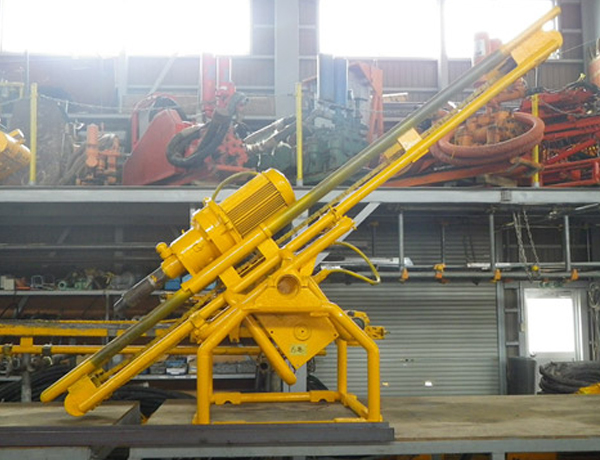
In this context, the worksite typically uses a lightweight drilling machine (such as the inverter chisel shown in the photo above), and the scaffolding width is about 2 meters. A "lightweight drilling machine" generally refers to a machine weighing around 300 kg.
However, these days, it’s common to use spring drills to bore holes even on scaffolding that’s about 2.0 meters high.
If you carefully calculate the drilling angle, set the scaffold height, and assemble it properly, you can drill holes using a spring drill. (Since the spring drill (500 kg) is larger than a lightweight drilling machine, it’s difficult to maneuver.)
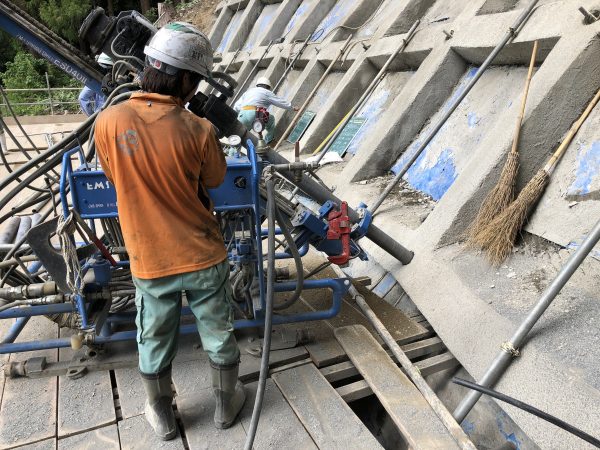
"No way—a drilling machine wouldn't fit in such a tight space, right!?" That's what you're probably thinking, isn't it?
It's usually possible to get in. About 90% of the time... or at least 80% of the time, you're guaranteed to get in!
Based on my experience, there have been countless times when I thought, “There’s absolutely no way this is possible!!!” but in the end, we somehow managed to get the machine in, drill the hole, and finish the job lol.
This is where the contractor's creativity, patience, and experience really come into play.
Did you understand Site Conditions II?
I don't think selection and adaptation are all that difficult, but ultimately...The issue is the stability of the borehole wall during drilling.There's no doubt that it will happen.
In this case, the advantage is that you can quickly switch to double-pipe drilling using a spring drill or similar equipment, and making the change is also easy. (For details on drilling, please refer to “Site Conditions I” from the other day.)
However, please be aware that it may be difficult to adjust the width of temporary scaffolding.
I think it was classified as "optional temporary construction" right from the ordering stage, so the government agency doesn't want to spend money on it.
It's a subtle way of saying, "I'm not going to look beyond the design, okay!?"
I believe the main difference is simply that the calculation method changes from "Site Conditions II" to "Cumulative Calculation" (double-pipe drilling for anchor work).
See you later.