Hello, everyone. This is Enta.
"Why don't public works companies make a profit?"
Having worked in the field for 30 years, this is something I’m always thinking about, lol.
I had the opportunity to read an analysis of the structure of the construction industry on social media, and I was finally able to put into words the sense of unease I’d been feeling.
Today, from the perspective of a civil engineer and slope engineer, I’ll discuss three structural reasons why this isn’t profitable.
This is the perspective of those who are on the receiving end of this reality every day, not those analyzing it.
Mr. Takagi of Craft Bank Research InstituteI'll take a moment to reflect on this, drawing on that post!
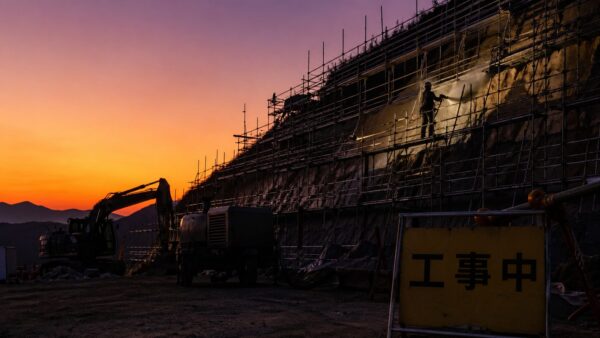
① "There are way too many"—I totally feel that lol
According to the Ministry of Land, Infrastructure, Transport and Tourism’s “Survey on the Number of Licensed Construction Companies” (published in May Reiwa 7), the number of licensed construction companies as of the end of fiscal year Reiwa 6 was483,700 businesses。
According to the 2024 White Paper on Small and Medium-Sized Enterprises, there are approximately 430,000 companies in the construction industry and approximately 340,000 in the manufacturing industry (number of companies by industry).
There are far more companies in the construction industry than in the manufacturing industry.
This includes both prime contractors and subcontractors, but most of them are subcontractors.
There are plenty of slope contractors, too—no exception.
Even though people say there’s a labor shortage and the numbers are down, I still get the impression there are quite a lot of them.
Well, when one goes out of business, it just splits up into independent operations, so it’s kind of like when one goes under, two or three more pop up lol.
So that's why dumping is on the rise?
Lately, there’s been more talk about business succession. It’s become quite common for me to hear from company presidents over 65, through my personal network, asking, “Would you take over my company?”
We’re starting to hear occasional reports from small companies that are on the verge of collapse due to soaring material costs.
From the perspective of those on the inside, natural selection isn't something that "might happen"—"It's already started."That's it.
But it's splitting up again lol
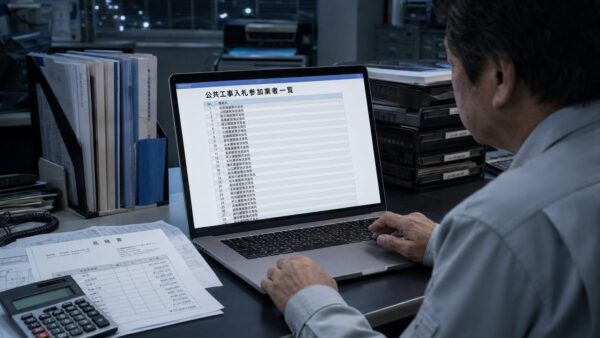
② From the perspective of someone who has gone into business for themselves, “industries that aren’t suited for self-employment” are...
Since I’m self-employed, this is a bit hard to hear, but you’re absolutely right.
Specialized trades such as slope construction, in particular,Industries Where It's Difficult to Achieve Economies of ScaleThat's it.
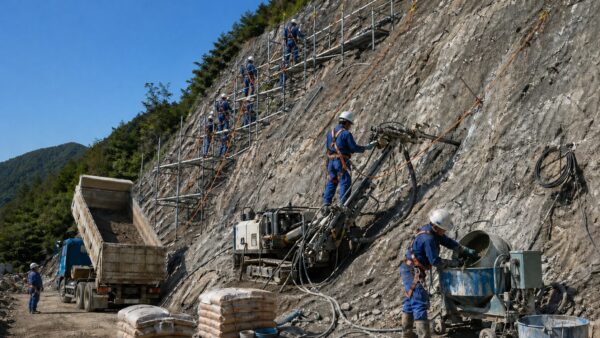
Spray-on concrete plant, drilling rig, rock bolt machine, scaffolding materials, storage yard, dump truck, 4-metric-ton Unick crane. All of them are really expensive.
For example, a single spray-coating plant currently costs between 5 million and over 10 million, while anchor work costs at least 15 million to 80 million (including crawler equipment, etc.).
The unit prices for rebar, prestressed concrete steel, cement, and sand are also quite high.
The days when a one- or two-person crew from a small private company could get the job done with just a generator and a hammer drill are over; most of them are now employed by companies and enrolled in social insurance.
In areas without machinery, the work is generally handled by teams employed by major companies, so there’s a sense of security, but it’s hard to make a big profit.
Even if you have the machinery, the challenge is whether you can recoup the cost...
Even if you work twice as hard, your take-home pay is only half. Since there’s no economies of scale after you go independent, this kind of situation happens all the time.
Even so, the number of people who go into business for themselves doesn't seem to be decreasing—perhaps because of the belief that "a true craftsman is only fully realized when working independently," or the idea that going into business for yourself means making more money!
I guess that’s because Showa-era values are still alive and well in the industry, huh!?
However, slope stabilization and civil engineering work,A true team sportThat's it.
You need at least three people to do slope stabilization work!
We'd really need at least five people to handle one job site properly.
Even to drill a single anchor hole, you need at least four people—a drilling operator, plant staff, and two on-site workers—plus the machinery.
The scope of what a sole proprietor can do is truly limited.
So independence doesn't mean freedom—it means doing everything yourself, huh? lol
③ “The industry lacks a foundation in business administration”
In Germany, in addition to journeymen (Geselle), there are requirements for setting up an independent business, such as"Meister" CertificationApparently, there is one.
Major occupations in the construction sector fall under Annex A (regulated occupations) of the German Crafts and Trades Act, and
In principle, the system is set up so that you cannot establish a company under your own name without a Meister certification.
The certification curriculum includes courses in business administration, accounting, and laws and regulations.
*I have not personally verified the text of the German Crafts Act (Handwerksordnung) down to the specific provisions. This is written as an overview of the system.
So, what are the licensing requirements for the construction industry in Japan?
As the person in charge of managing business operations, “at least five years of experience as an executive or in a similar capacity”; as a full-time technical specialist, a national certification or relevant work experience.
In short, as long as the required number of years has passed and the registration on paper is in order, the permit will be granted.
There is absolutely no need for any evidence of having studied business management.That's right.
Even an idiot can get a license if they've been doing business-like things for five years!
I worked as a salaryman for 10 years before going out on my own, but after I did, I was surprised to realize, “I have no choice but to figure everything out on my own,” lol.
I really struggled with the legal stuff in particular, lol.
In my case, I started out as a site supervisor and already had a general understanding of cost management and other aspects, so I was able to manage, but it would probably be much harder for someone starting out as a craftsman.
Driven by the thought that “I’ll make more money if I go into business for myself!” or the feeling that “I hate working for someone else,”
This scenario—"going independent, taking on work without even knowing if the rate is low, and then suddenly going under due to cash flow problems"—is happening on a massive scale.
This isn't a matter of a lack of personal effort, but rather,Isn't this an industry-wide issue?I guess so, but aren't there very few people in the construction industry who'll just blindly go along with everything? lol

There are plenty of companies out there, going independent isn't worth the effort, and I'm teaching myself how to run a business.
I can't help but laugh as I'm writing this lol
But that’s just the reality of working in civil engineering and slope stabilization, isn’t it?
However, while people around them tend to assume, “They’re spending so much money—they must be making a killing!” the reality is that for most companies, that’s not actually the case.
Anyway, the construction business is expensive!
After all, the profit margin under those circumstances is pretty obvious.
Especially the more you outsource.
It's a tough topic, but we can't move forward unless we face the reality of the situation head-on.
So, what should you do to make a profit?
I'm going to try to think about that.
See you later.
Which Is Better: Being a Salaried Employee or Going Independent?