Hello, everyone.
This is Enta.
We're right in the middle of Golden Week, but I'm here on patrol at a company in Nagano lol (I'm bored)
Everyone, make sure to savor and enjoy Golden Week to the fullest lol
But that's beside the point.
I've always wondered—don't they often use boulders for root reinforcement work?
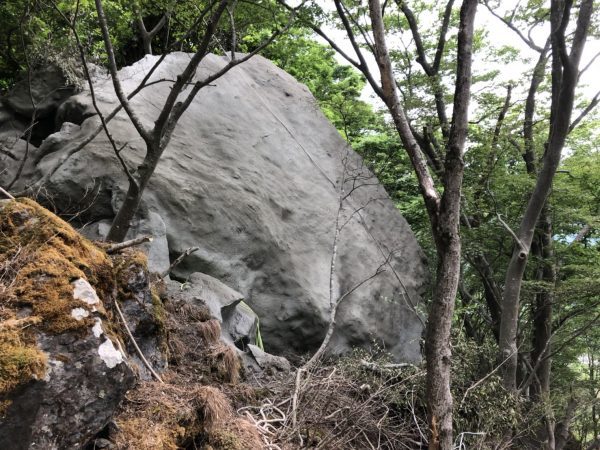
I know it might sound a little weird for me to write this, but I can’t help wondering, “Does that rock really move?” lol
These aren't 1-ton or 2-ton rocks! They're rocks weighing tens of tons, you know?
Do you think it'll work??
Well, if it's a rock weighing a few hundred kilograms, there's a chance it might move.
When performing root reinforcement, first clean the root area slightly and dig a little.
It turns out the roots go quite deep (the depth to which the stones are embedded).
Spray fiber-reinforced mortar or similar material onto that surface. (Assemble rebar as needed, depending on the size.)
Naturally, since it blows in the surrounding stones and other debris, it also helps prevent weathering.
Sure, it’s showing some signs of wear and tear, but I always find myself thinking, “I can’t believe this thing still works…”
In the long run, if this were to shift and fall due to an earthquake, for example, it would likely cause extensive damage to the structures below.
If you're saying it's something meant to prevent that, I can kind of see where you're coming from...
Actually, there are quite a few construction projects where you find yourself wondering, “Why are they even doing this here?”
I get the impression that, especially in some government offices, there are a lot of people with backgrounds in agriculture and forestry. (Or is that just my imagination?)
Around 2003, I worked on slope stabilization as part of a road improvement project for the Ministry of Agriculture, Forestry and Fisheries for several years.
After that, the road led nowhere; it collapsed due to heavy rain and was left as is.
It's still just the same. (I went to see it before, didn't I? lol)
I can't help but wonder, "Wasn't this supposed to connect to something?"
It’s undeniable that some of the construction work is unnecessary, but since it’s not up to us to decide, there’s no point in complaining.
Besides, that's what we slope contractors do.
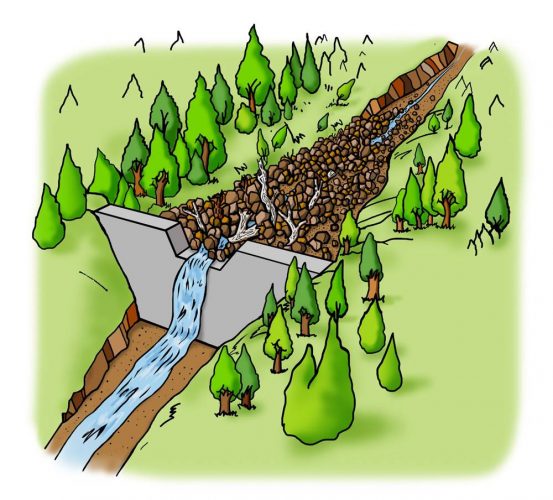
With all the natural disasters we’ve had lately, there are moments when I find myself wondering, “Maybe that construction project wasn’t a waste after all?”
Flash floods from erosion control dams are another example, aren't they?
When constructing a erosion control dam, the slope contractor typically builds the left and right abutments.
What condition are the slopes in after a flash flood? You’re probably wondering if they’re actually serving a purpose, aren’t you?

By observing slopes (at the site) after a disaster, we can probably learn a little more and come up with some new ideas.
That kind of mindset is important to ensure the construction work isn't a waste of time, isn't it?
Since you’ll hardly ever look at it once it’s done, you should check on its progress (for your own sake, too).
As a slope contractor.
See you later.