Hello, everyone.
This is Enta.
This is a continuation of the previous post.
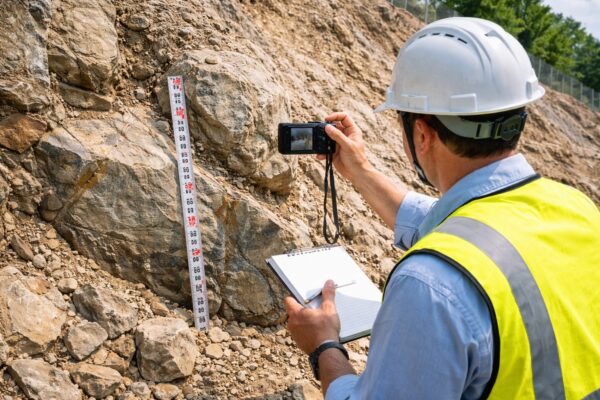
⑤ The basic rule is to “always document” any discrepancies between the drawings and the site.
This is really important.
There are almost no construction projects where the blueprints and the actual site match exactly.
In particular, when it comes to slope construction, it’s best to assume that the actual ground conditions will never match the 100% design specifications exactly.
Just go with the flow there, lol (which is kind of easy, in a way)
A common scenario is,
・When we tried drilling, the bedrock turned out to be much harder than expected...
・When I cut into the slope, spring water started flowing out...
・There is an existing structure at the designed anchor location, making it impossible to pour concrete there.
・The length is shorter (or longer) than the design value.
When such discrepancies arise, immediately take photos, document the issue, and contact the general contractor and the client. (Evidence is crucial!)
As a craftsman, you tend to just plow ahead thinking, “Well, it’ll work out somehow,” but if a construction manager did that, they wouldn’t make any money.
The reason is that “records” serve as the basis for design changes and quantity changes.
If there is no record, the change will not be approved.
Design changes are where you can make the most money ^^
In other words, even if our company does a good job, it doesn't bring in any money.
This is directly linked to management issues as well.
Be sure to record everything.
This is the absolute basics.
⑥ Prepare in advance for as-built inspection (specification values) to ensure accurate “measurement and recording”
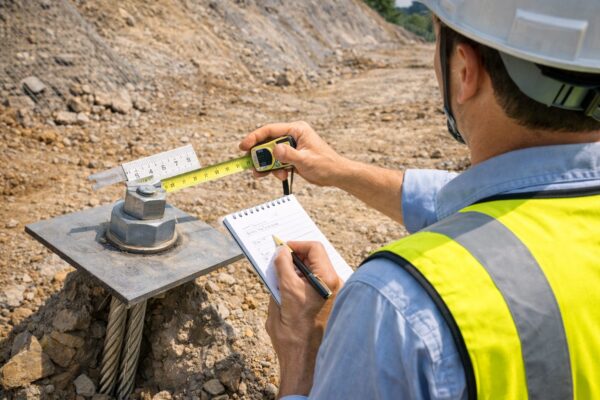
As-built inspection is a process for verifying and documenting whether a completed structure conforms to the design specifications.
The Ministry of Land, Infrastructure, Transport and Tourism’s “Standards for Construction Management of Civil Engineering Works (March Reiwa 5)” specifies standard values for each type of work.
For example, here are a few examples from slope stabilization work:
Mortar and Concrete Spraying Worker
Thickness: 2 cm less than the design value (in other words, if the design specifies 10 cm, at least 8 cm is required, but in practice, a greater thickness is the minimum)
Ground Anchor Construction
Drilling location: Within ±10 cm of the designed location
Drill hole length: Must be at least the design length, with a tolerance of -0 cm (if shorter, it is a failure)
Drilling angle: Within ±2.5° of the design angle
Measure this, take a photo, record it on the as-built control chart, and submit it to the client.
The three-step process of actual measurement, recording, and submission is the foundation of quality control.
Since the finished product is the absolute basics, whether you're a craftsman or someone sent to oversee the work, you'd understand just by watching what the foreman does on site all the time, right?
Let's take a good look at what the director was doing. (Let's try to remember.)
However, if you miss anything, it will cause problems later on, so please make sure to prepare thoroughly!
What am I going to photograph? Am I going to measure something? What's the key point here?

⑦ Quality control involves learning “what to test, when to test it, and how much to test.”
Quality control, along with work-in-progress control, is a critically important part of construction management.
Quality control refers to testing and verifying whether materials and workmanship meet the quality standards specified in the design.
Here are some examples of quality control tests commonly performed in slope construction.
Compressive Strength Test of Grout (Cement Slurry, Mortar)
→ Test Method: In accordance with JIS A 1108 (Test Method for Compressive Strength of Concrete)
→ Test specimen: φ50 × 100 mm (for grout) or φ100 × 200 mm
→ Control value: At least the design strength (24 N/mm² or higher)
→ Test frequency: As specified in the construction specifications (once per day when concrete is poured—morning and afternoon)
When it comes to quality control, be sure to memorize the following as a set: “What to test,” “When to test,” “How many samples or how many times to test,” and “What the acceptance criteria are.”
Since you do it over and over again, you’ll get used to it quickly, but experience is important because sometimes you won’t be able to generate enough power, and other times you’ll be like, “Whoa!”
In the end, forget about the order—just memorize everything at once!
It's just the same routine day in and day out, but the key is to be clear about what needs to be done so I definitely don't forget, lol.
Since all the items listed here must be carried out, it is essential to carefully plan the sequence of operations (construction sequence).
Especially if you're switching careers from a trade, think of it as building on the workflow to incorporate construction management.
It’s true that there are some challenges involved in transitioning from a craftsman to a construction manager.
Still, having firsthand experience on the front lines is an overwhelming advantage.
You can definitely catch up on paperwork and administrative tasks later.
The more you do it, the better you get at it, and there are so many ways to get creative that you’ll end up getting totally hooked lol.
What I'm trying to say is, "It's the best-case scenario when someone who knows the day-to-day operations also takes on a management role."
Just start by writing down the order of the steps on a piece of paper, and then learn them one by one.
There's no need to rush.
If you have any questions, please contact us through the blog's contact form!
I'll answer every question to the best of my ability—down to the very last detail.
I get about 30 emails every month lol
I've answered all of them.
I want to support people who manage and construct slopes, so I’ll do whatever I can to help!
See you later.