Hello, everyone.
This is Enta.
Things have been pretty hectic lately.
And so, the vicious cycle of falling behind on my blog.
I'm sorry. I'll do my best to post updates a little sooner!

But that's beside the point.
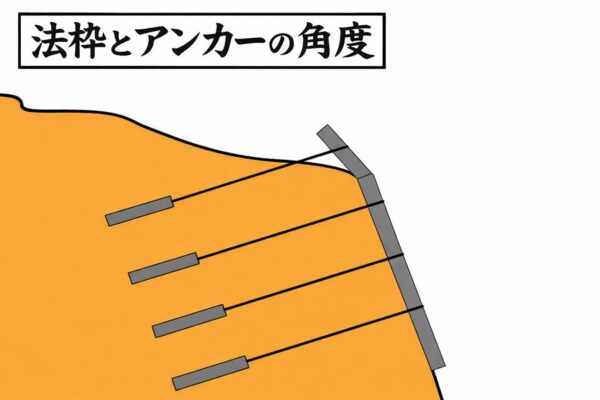
Rock bolts'The borehole length is 3.0 mThat's it.
For example, if the legal limit is 300□, then,Rope Material Lengthは
Projection + Formwork Thickness + Drilling Length = 0.1 m + 0.3 m + 3.0 m = 3.4 m
So, what about this?
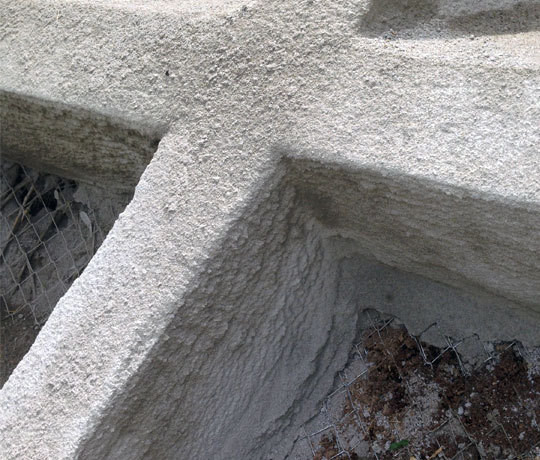
This is clearly a legal frame that is over 300 mm.
If the actual measurement is 500 mm, doesn't that mean the drilling depth will be 200 mm shorter?!?!
That's what someone told me a long time ago.
Well, it's a pretty common sight, isn't it?
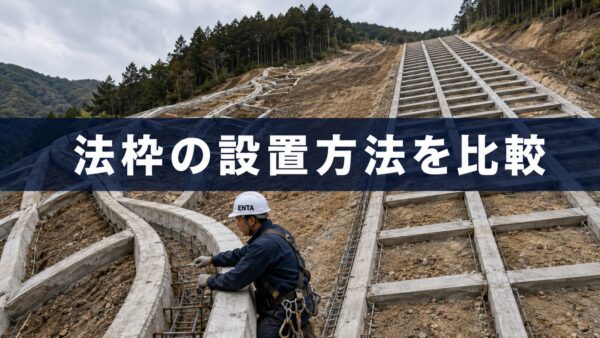
This is what happens when you install the frame along the mountain without adhering to the legal guidelines, opting instead for an appearance-focused design.
I guess this is fine in its own way, but personally, I think it's a waste of money.
Ground netting + mortar + effort = a waste of money lol
That’s a different story if the rebar is thick and the terrain is very rugged.
Well, putting that aside, there are often issues with drill hole length in rock bolting work, and that’s a point that tends to come up a lot.
Conclusion: The drilling depth remains the same!
That's all!
I can't just say that, so here's an explanation lol
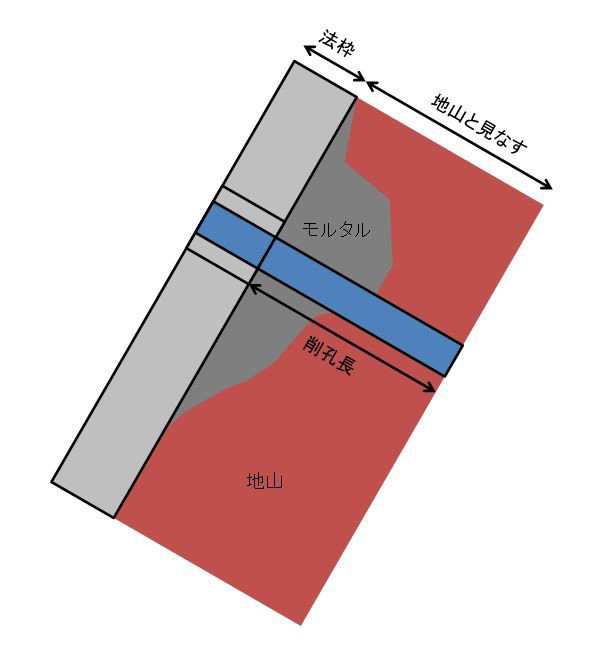
The 200-mm section is considered to be the soil section (natural ground).
No, no! It's mortar!I bet that's what they'll say lol
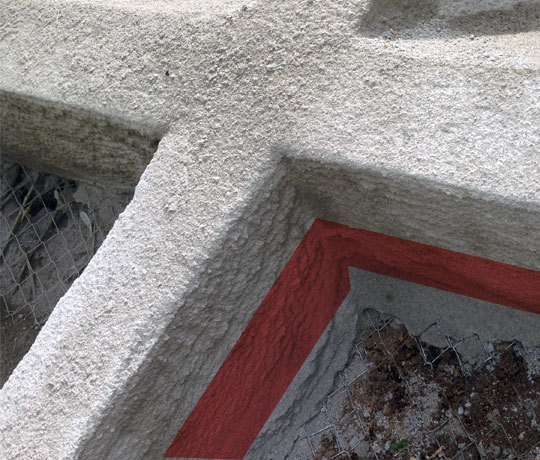 The red part is definitely mortar.
In cases where the natural terrain is highly uneven, it is sometimes necessary to spray a low-strength mortar and then install formwork on top of it.
Alternatively, after backfilling and grading the natural ground, install formwork.
I think you’ll understand that, from a design perspective, it’s better to have something more solid than the original natural ground to support the structure.
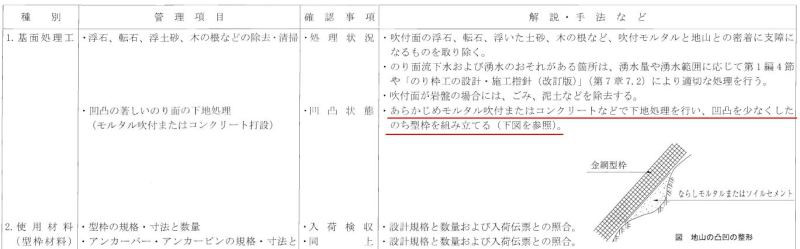
"If the material used to fill in unevenness is of the same quality as or better than the natural ground, it shall be considered natural ground."
The following is stated in the Slope Protection Association’s *Textbook on Construction Management Techniques for Slope Protection Works, Heisei 19, p. 189*.
So, if we interpret the lower portion of the formwork—which became thicker than specified due to the sprayed concrete—as "natural ground," then,
This means that the drilling length remains the same.
If people start nitpicking over every little detail, it’ll make it impossible to do the work on-site, but I think it can’t hurt to know these things.
To put it simply, the legal framework is...
"The weight of the legal framework is holding down a mountain that looks like it might slide (or collapse)."
If you spray mortar over the uneven surface, it'll get even heavier—that's great, isn't it!!!
That's the deal, lol
See you later.