Hello, everyone.
This is Enta.
It looks like this summer is going to be crazy, too!
As I mentioned before, the Ministry of Land, Infrastructure, Transport and Tourism issued on December 23, Reiwa 7,"Support Package for Coping with Extreme Heat During Construction Projects"
I’m going to give a candid explanation of this document from a slope engineer’s perspective.
If you're thinking, "Government documents are so hard to read...," don't worry.
I'll try to extract just the key points and write them out in a way that makes sense to me, lol (though my reading comprehension might be a little off too).
It's not all good news—there are parts that make you think, "Wait a minute."
To begin with, what was the purpose of releasing this package?
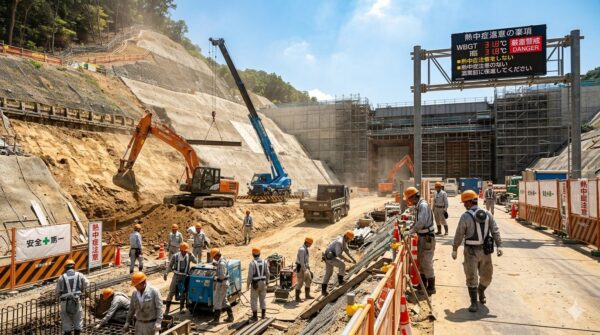
The reason the Ministry of Land, Infrastructure, Transport and Tourism released this package is simple.
"Summers are getting crazier every year."It feels like I finally got off my butt to do it, lol.
Data shows that the number of heatstroke-related deaths and injuries is on the rise every year, with cases particularly concentrated around 3:00 p.m.
Since we're the "guardians of social infrastructure," we can't really take a break. (To be honest, they won't let us take one, lol.)
But if things keep going like this, people are going to be dropping like flies on the job site.
Have the voices from the field finally been heard? The Ministry of Land, Infrastructure, Transport and Tourism has..."Looking Ahead to Next Season (Summer of Reiwa 8)"I guess they've put together a specific package of measures, lol.
In short,Let’s change the way we work during the summer across the entire construction industry.That is the government's policy.
① Avoiding Work During Periods and Times of Extreme Heat: What Specifically Should Be Done?
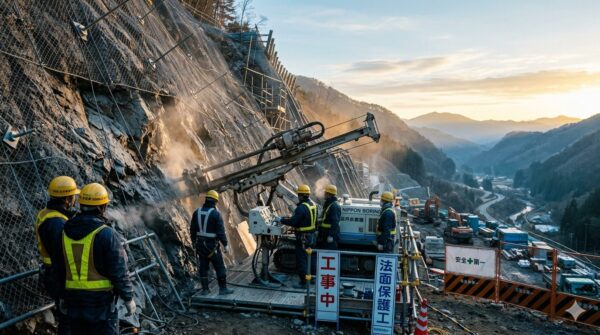
This is the most substantial part.
Specifically, the following four elements serve as the pillars.
(1) Using WBGT Values to Set Construction Schedules
The WBGT (wet-bulb globe temperature) value isConvert 31 or more hours to daysFurthermore, in March of Reiwa 5, the construction schedule guidelines were revised to adopt a method that incorporates the five-year average as the “number of days with extreme heat” into the construction schedule.
But I do think these numbers aren't very useful in the field, though... lol
If there are more days of extreme heat than initially anticipated, forcing us to suspend operations,Payment can be settled based on the number of days the construction period is extendedI try to do that.
This is a relief for the general contractor.
We're still getting our butts kicked lol (true)
(2) Pilot Construction Project Allowing for Work Suspensions During Periods of Extreme Heat
At the contractor's discretion, during periods of extreme heat,Can suspend work for a certain periodThey said they would conduct a pilot project and examine methods for calculating additional costs.
However, this is still in the "trial" phase.
It doesn't apply to all construction projects yet.
I'm not saying subcontractors benefit from this, lol.
(3) Introduction of Early Morning Construction and Cool Work Hours
As an actual example, weed removal work accounts for the highest number of heat-related deaths and injuriesChange work hours to 6:00 a.m. to 3:00 p.m., avoiding the 3:00 p.m. hourExamples of this are presented.
Also, regarding prefectural construction projects,"Cool Work Time": No outdoor work between 11:00 a.m. and 2:00 p.m.There are also examples where it has been set up this way.
It was also suggested that the contracting authority would provide support regarding police coordination and consultations with local communities for early morning and nighttime construction work, wasn't it!?
(4) Flexible Work Hours System on an Annual Basis
A system in which employees work fewer hours during the summer in exchange for working more hours during other seasons. However, this requires provisions in the company’s work rules, the conclusion of a labor-management agreement, and notification to the Labor Standards Office.
This presents quite a high hurdle for small and medium-sized slope construction companies.
So that means there’s a very high chance that work will pile up during a certain period... Yeah...
② Efficiency and Work Environment Improvements: Can i-Construction 2.0 Be Used on Slopes?
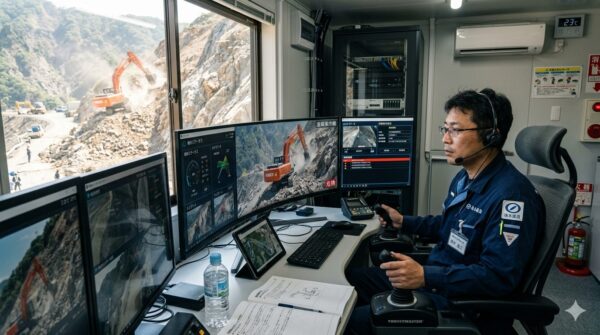
As one of the pillars of the package,i-Construction 2.0...will appear.
By fiscal year 2040At least a 30% reduction in labor at construction sites and a 1.5-fold increase in productivityThis is the government's policy aimed at achieving that goal.
Specifically,
・Remote Construction: Operating construction machinery from an air-conditioned room
・Tilt Rotator: Labor-saving heavy machinery that can reach the cutting surface without facing it directly
・ICT Installation Stage II: Optimize production processes by aggregating machine location data and operational status
That's the gist of it.
You’re probably thinking, “Whoa, that’s so cool!”
But from a slope engineer's perspective,Drilling, grout injection, and installation of pressure-bearing plates on slopes and scaffolding on steeply sloping terrainThere are still many areas where it is not yet practical to apply remote construction.
I think the direction of ICT adoption is the right one, but when it comes to implementing it on slope construction sites...There is still plenty of room for developmentThat's the honest truth, I guess.
I mean, isn't that slope a bit too much?? lol
Isn't that a real robot?
Or maybe there's a simpler construction method?
For example, eliminating legal restrictions.
If we were to focus solely on drilling, I feel like it could be mechanized.
However, it might depend on the height...
③ Securing Funding for Heatwave Countermeasures: Will the Money Actually Be Allocated?
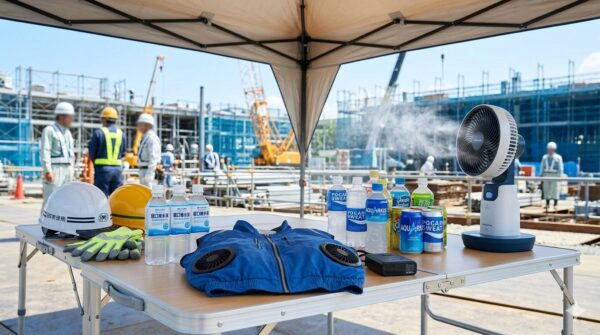
The issue of expenses is the most important one for the field staff.
Here is how the current system works.
[Supplies, etc. (Measures for Individuals)]
Adjustment of on-site management fees based on the number of days with high summer temperatures. Currently being piloted since fiscal year Reiwa 1.
Can be used for salt candy, oral rehydration solutions, air-conditioned clothing, heatstroke prevention kits, and more.
[Facility Support (On-Site Environment Improvement)]
Starting in Reiwa 7,Common temporary facility expenses may be accrued and recorded up to a maximum of 50%, corresponding to the rate allocated for site environment improvement expenses.Apply the cost estimation guidelines.
Can be used with shade nets, large fans, ice makers, sunshade tents, mist fans, and more.
This, in itself, is a step forward.
However,Directly Administered Civil Engineering ProjectsAbout...
Whether the same accounting treatment can be applied to construction projects by local governments or private-sector projects depends on the client.
And the point is that we subcontractors have nothing to do with it, lol.
It simply means that the government will now cover the costs of heatstroke prevention measures—something that prime contractors have been handling on their own up until now.
Perhaps the air-conditioned clothing and portable refrigerators we use on a daily basis are the result of corporate innovation...
To be continued.
See you later.