Hello, everyone.
This is Enta.
I'm going to try writing about the measures mentioned in my recent article.
Let's Consider a Slope Collapse Accident
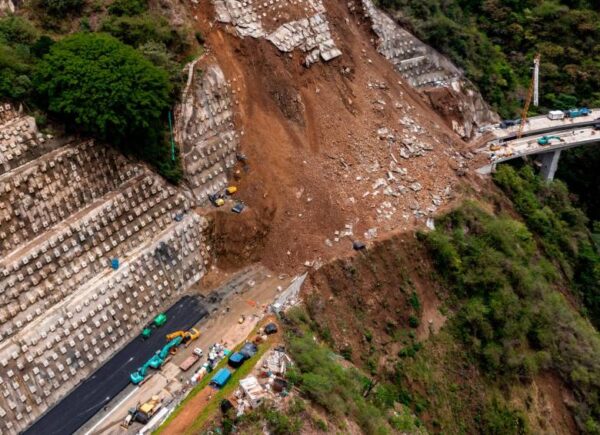
When it comes to measures to prevent secondary disasters at disaster sites, there’s actually not much to do.
That's because the mountain is already sliding as a result of the disaster, so it's unlikely to slide any further.
But when people say, “Aren’t you slipping, just like this time!?”—well, they’re right, but,
In this case, it simply means that these are remnants that didn't slide all the way down and were left behind (remnants that got caught).
There's no way to know how much debris is left, and sometimes you slip, and sometimes you don't.
The solution is to install the reinforcing mesh quickly and apply the temporary spray coating as soon as possible.
In fact, simply installing wire mesh can help minimize the damage.
Even if it doesn't act as a deterrent, connecting them with a net will create some resistance.
If you apply a temporary spray coating on top of that, you can prevent erosion caused by rain and wind for the time being.
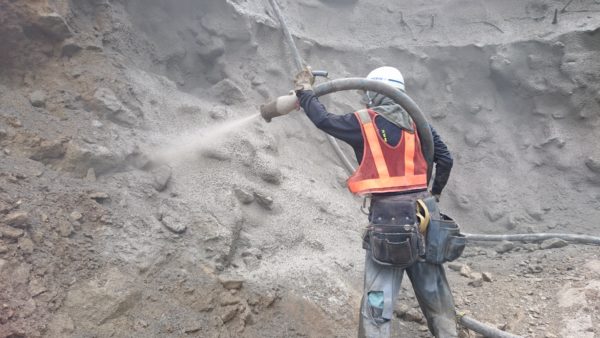
If the location is extremely dangerous, it's fine to go without a net.
If this is going to be left as is for the time being due to budget or design constraints, this is the most effective safety measure.
It's 3 centimeters thick, and it doesn't really matter whether it has wire mesh or not, but
If you want to ensure greater safety, you can install wire mesh, or
Please add fiber to improve the continuity of the mortar itself.
At sites like this, people often use blue tarps as a quick, makeshift solution, but,
Since this is a measure to prevent surface erosion caused by rainfall, it’s not very effective. (But it’s better than nothing.)
Temporary mortar does, of course, cost money, but it makes the next phase of construction much safer.
Rockfalls will decrease, and landslides will virtually disappear. (Although this depends on the mountain.)
Once construction begins, there will be no issues as long as you proceed with either formwork or shotcrete.
After all, there aren't that many safety measures in place on slopes, so,
| Item | Remedial Work | Large or Small | Remedial Work |
| Strength | Blue Tarp | < | 3 cm of temporary sprayed mortar |
| Money | Blue Tarp | < | 3 cm of temporary sprayed mortar |
| Convenience | Blue Tarp | > | 3 cm of temporary sprayed mortar |
Or, as a slightly bold strategy, just leave the bare ground as is.
If you do that, there’s a good chance that any residue not washed away by the rain will be removed.
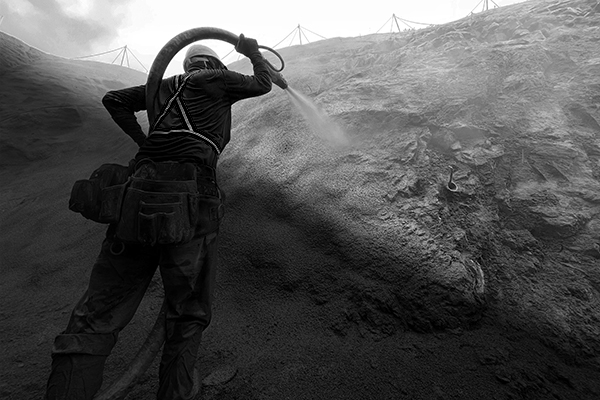
In the future, if we find ourselves in a situation where there’s simply no other option due to labor shortages or a lack of contractors, it’s possible we might just close the road to traffic and leave it as is.
If it's a place where it's okay to shut everything down, it seems better to take action after the situation has fully deteriorated.
If that's the case, I think it would be fine to just use rebar reinforcement, a 10 cm layer of sprayed mortar, and drainage boreholes. (Since there's nothing that could cause slipping.)
I get the feeling that installing retaining wall structures on a slope that has already collapsed might be a bit nonsensical—but what do you think?
It really got me thinking about a lot of things.
See you later