Hello, everyone.
This is Enta.
The other day, I went to Joetsu City—where it hasn’t rained much—to check on a few things.
Me, the one and only "rain man."
I just stopped by on my way from Nagano to Ishikawa.
But as soon as we entered Niigata, it started pouring—just a little bit!!
I guess I really am a rain magnet, lol.
But that's beside the point.
Why do you conduct material inspections?
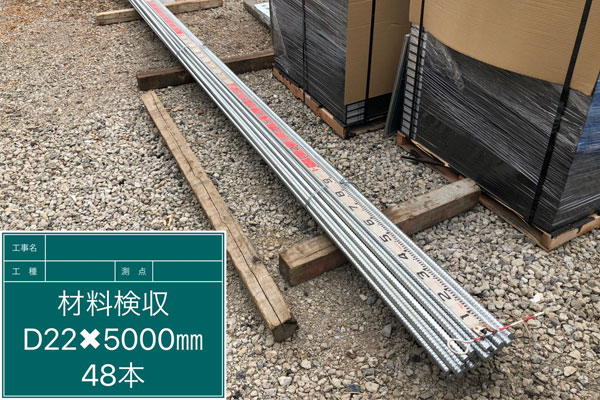
As a craftsman, you probably wonder why I’m taking so many pictures of the materials, don’t you?
Like, "Let me use the ingredients already!" (lol)
From the director's perspective, it's just a hassle!
Ugh—what a hassle!
That's kind of how it is, isn't it? Especially when there are a lot of different ingredients.
The more types of work there are, the more...
There was a time when I, too, was sick and tired of taking the same photo over and over again.
However, inspecting materials upon receipt is extremely important.
Although craftsmen don’t often see these documents, the first one is the construction plan.
The construction plan includes material planning, scheduling, as-built management, quality control, safety management, and recycling planning
And so on.
The materials used in that process are from a specific manufacturer and meet the 〇〇 standard, and they are used to make 〇〇.
That's the general idea—we specify it to some extent in advance.

So, based on that, the purpose of inspecting materials on-site is to verify that the project is being carried out using the materials specified in the plan.
If, for some reason, that material is not available, we will revise the construction plan and seek approval for the changes.
In particular, ground anchor work for critical structures is absolutely essential.
While there are no issues with rebar mesh or formwork frames from any manufacturer, compliance with JIS standards is fundamentally important.
This means there's no particular problem as long as the product has a clear source.
These product specifications are also quite complicated—which steel rolls to use, which steel wire to use,
It's a lot of work—figuring out how to apply XX grams of plating and so on.
You can verify this by checking the manufacturer's quality certificate (commonly known as a mill sheet), and
We will verify this using a shipping certificate that proves the product was shipped.

It’s surprising how materials that seem so simple to use on site actually go through quite a lot before they get there (lol).
And when taking photos of specific subjects, I make sure to capture the parts that won’t be visible in the final image.
That's the part that's not visible, isn't it?
In particular, with rebar insertion work, the rebar becomes invisible after installation.
You can see about 10 centimeters of the head, but you can't see anything else, right?
The most important part of material inspection is to take clear photos of the shape before it becomes invisible.
Please have the craftsmen wait until the material inspection is complete—as long as the supervisor isn't slacking off.
It's really tough for the people who handle material inspections, too.
It's the supervisor's job to ensure consistency in the craftsmen's work, after all!
See you later.