Hello, everyone.
This is Enta.
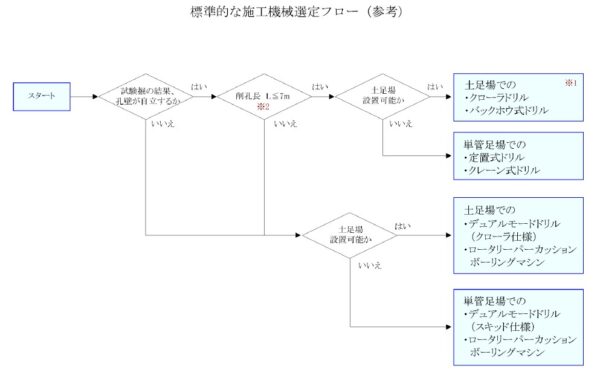
I'm sure you've seen something like this before.
You often see them attached to design specifications, don't you?
And I think designers use this as a reference when they're designing.
But isn't it actually quite common for machines to be unsuitable for the job site?
First of all, you’re probably thinking, “What on earth is this ‘dual-mode drill’ they’re talking about here?!” lol
When I search for this online, there are no images.
Since the text appeared, I'll just copy and paste it.
| Types | Features, Suitable Soil Conditions | Scope of Work | Drill Hole Diameter (mm) | |
| Leg Drill | This method is used only for temporary structures.
Since drilling is performed manually, the maximum drilling depth is approximately 3 meters. Drilling is possible in soil conditions ranging up to weathered rock. Note that the borehole walls are prone to collapse in natural rock.*1*When used in this application, self-drilling reinforcement can be used in place of standard reinforcement. |
1 m high, pointing downward from the horizontal
Up to about 45° |
42–46
42–52*2* |
|
| Crawler Drill | This is a self-propelled, crawler-driven drilling rig that uses pneumatic and hydraulic systems. Due to its heavy weight, it is typically used on soil surfaces. While standard models can drill holes up to approximately 4 meters in length, depending on the model, it is possible to drill longer holes of up to approximately 7 meters by using high-performance drifters or longer guide sleeves. It can drill through soil conditions up to hard rock. Additionally, for temporary applications, it can be used in rock formations prone to borehole wall collapse.*1*When used in this application, self-drilling reinforcement can be used in place of standard reinforcement. | Up to 5 meters in height, depending on the model
Can be poured horizontally. The angle of placement is horizontal to vertical. |
65
42–52*2* |
|
| Stationary Drill | This is a pneumatic or hydraulic drilling machine without a drive unit. Because it is lightweight, it can be operated on single-tube scaffolding. While standard models are limited to drilling depths of approximately 4 meters, depending on the model, it is possible to drill to depths of approximately 7 meters by using high-performance drifters or longer guide sleeves. It can drill through soil conditions up to hard rock. Additionally, for temporary construction purposes, it can be used in ground conditions where the borehole walls are prone to collapse.*1*When used in this application, self-drilling reinforcement can be used in place of standard reinforcement. | Height during horizontal placement varies by model
Can be installed over a length of approximately 1 meter. The angle of placement ranges from horizontal to vertical. |
65
42–52*2* |
|
| Crane-mounted drill | The drilling rig is suspended from a crane or mounted directly onto it for operation. Since scaffolding on the slope face is not required, the maximum working height depends on the crane’s lifting capacity but is typically around 30 meters. Although the typical drilling length is up to about 5 m, depending on the model, high-performance drifters or longer guide sleeves can be used to achieve long-hole drilling of up to about 7 m. Drilling is possible in soil conditions ranging up to hard rock. Note that for temporary purposes, in rock masses prone to borehole wall collapse*1*When used in this application, self-drilling reinforcement can be used in place of standard reinforcement. | Depends on the crane, but typically 20–30 meters in height. Construction is possible at a downward pour angle of 10°–60°. | 65
42–52*2* |
|
| Dual-Mode Drill | This hydraulic-powered machine, designed for the air grout drilling method (cement slurry drilling with air), is capable of drilling holes up to 10 meters deep. It can be used in both crawler and skid configurations; the skid configuration allows for construction in a minimum working width of 1.5 m. The crawler configuration is capable of rotating, enabling construction at both ends of a slope. It can drill through soil conditions up to hard rock. Note: For rock masses prone to borehole wall collapse*1*When used in this manner, it can be employed as an air-assisted cement slurry drilling method; however, in rock formations where the borehole walls are stable enough to stand on their own, it can be used as a standard air drilling method. | The placement height is approximately 3.5 meters, depending on the placement angle. For skid-mounted models, the height is approximately 20 meters, though this varies depending on the crane. The placement angle ranges from horizontal to vertical. The machine can rotate, allowing construction at both ends of the slope. | 65 | |
| Automatic Bolt Setter | By mounting an automatic grouting system on a self-propelled base machine—a modified backhoe—the entire process, from drilling and grouting to the insertion of reinforcing materials, can be mechanized. Once the placement angle is set, continuous placement in the vertical direction is possible. Drilling depths of up to approximately 5 m are possible, and a minimum working width of 6 m must be secured. Drilling is possible in soil conditions ranging up to hard rock. Note that for temporary purposes, this system is suitable for unstable ground where the borehole walls are prone to collapse.*1*When used in this application, self-drilling reinforcement can be used in place of standard reinforcement. | A placement height of approximately 11 meters, depending on the placement angle. The placement angle is
Horizontal to 1:1.5. |
65
42–52*2* |
|
| Rotary Percussion Drilling Machine | Fixed-type | Primarily for long-hole drilling of 7 meters or more and rock masses with permanent hole-wall collapse*1*Used for drilling. The hydraulic rotary percussion system enables rapid drilling in all types of soil. The drill unit and power unit are separate, allowing operation even in areas with limited space. It is capable of long-reach drilling, and both the drilling depth and angle are adjustable. Suitable for all types of soil. | The pouring height ranges from 0 to approximately 1.5 meters, depending on the pouring angle. The pouring angle ranges from horizontal to vertical. Drilling is possible only from the front of the drill rig. | 90 |
| Crawler-type | Primarily for long-hole drilling of 7 meters or more and rock masses with permanent hole-wall collapse*1*Used for drilling. The hydraulic rotary percussion system enables rapid drilling in all types of soil and allows for faster operation and drilling positioning than crawler-mounted units. Due to its heavy weight, it must be operated on a soil foundation or a temporary platform. It is capable of long-hole drilling and is suitable for all types of soil. | Depending on the angle of placement, the drilling range extends from approximately 0 to 2.5 meters in height, from horizontal to vertical. Drilling is possible at the front and sides of the machine. | 90 | |
| Rotary Drilling Machine | Primarily for long-hole drilling of 7 meters or more and rock masses with permanent hole-wall collapse*1*Used for drilling holes. Available in a variety of sizes, from small to large diameters, and includes a long-reach type for horizontal drilling. Generally, these are fixed-type units and are often used on single-tube scaffolding. They can be used on most types of soil, but are somewhat unsuitable for cobblestone, soft rock, and hard rock. | The placement height is approximately 0 to 0.5 m, depending on the placement angle. The placement angle is 360° for the spindle drill type and horizontal for the long-field type.
(No adjustment mechanism on the machine itself) |
90 | |
*1 Collapsible borehole wall: Refers to ground conditions—such as collapsible soil or soil mixed with gravel—where it is difficult to ensure the stability of the borehole wall; after drilling, the borehole wall may collapse, making it difficult to insert reinforcement materials afterward.
*2: When using self-drilling reinforcement
"Design and Construction Guidelines for Cut-and-Fill Reinforcement Methods: East, Central, and West Japan Expressway Co., Ltd., pp. 70–71"
The machine called the "Auto Bolt Setter" appears here!
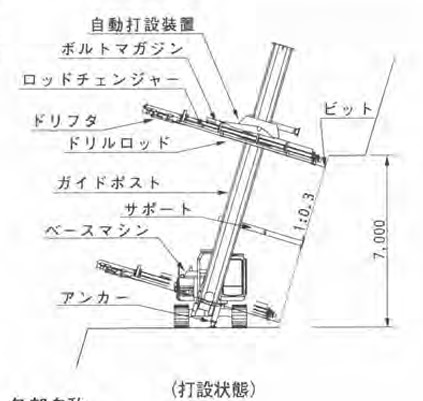
I've never seen one before, so I guess they're probably gone...
The concept—or rather, the approach—to selecting machinery for this drilling job is something only the contractor really understands, isn't it?
In the past, equipment was selected by consulting major companies, and to some extent, the selection was influenced by a desire to accommodate those companies. (Well, that’s still the case for specialized construction projects.)
I don't know if it's because we're now using market prices and don't really take that into account anymore, but the machines really aren't suited for the job site, lol.
A prime example of this is the rotary drilling machine.
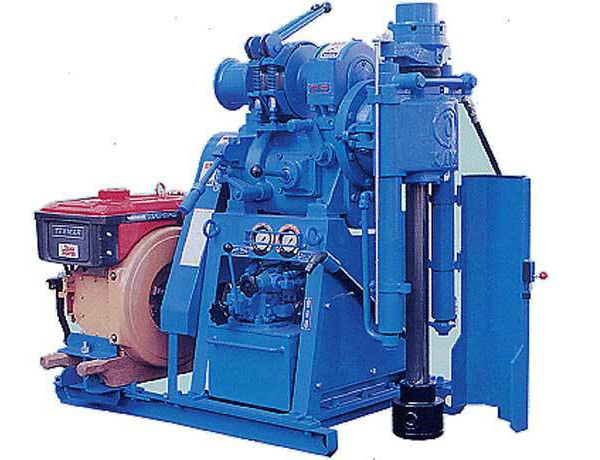
This is it, huh? lol
So, with a borehole diameter of φ90, we're drilling a 60-meter-deep drainage borehole...
"Direct drilling at φ135, 80 meters deep, and install an extensometer? Haha."
That's impossible.
I wonder how many months they plan to spend on just one episode??
That's what I think, lol
Well, it’s not impossible, but to drill a single 60-meter hole with a rotary drilling machine, I’m guessing that—
Under good conditions, I think it's at least one week per piece.
And since this is a dual-borehole drilling operation, we’ll need to install casing—what do you think?
It'll take a little longer.
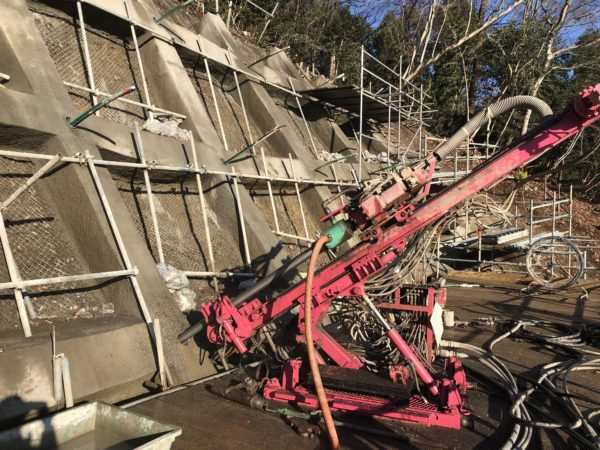
With the rotary percussion drill we use, drilling 60 meters takes about 1.5 days (assuming good mountain conditions).
Since it comes with a hammer, you can just hammer away to drill holes—of course it’s fast.
That’s how off the machine selection is in some places.
I'm thinking of creating a workflow for machine selection next.
Otherwise, it'd be a hassle for us to make design changes, lol.
If the right machine had been chosen from the start, it would have saved a lot of effort, wouldn't it?
See you later.
This Is What Happens with Standard Spacers | Product Comparison