Hello, everyone.
This is Enta.
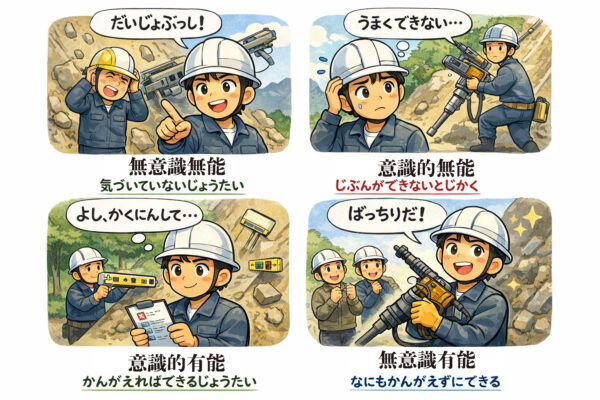
When it comes to learning something, have you heard of the four-stage model of learning?
By knowing this, I can figure out where I stand and what I should do next.
I think you'll understand that.
It is said that people go through the stages of “unconscious incompetence,” “conscious incompetence,” “conscious competence,” and “unconscious competence.”
The Four-Stage Model of Learning
By understanding what stage you're currently at, you can alleviate the anxiety of wondering, "Why isn't this working?" and
You can study (or work) more efficiently.
I think you’ll feel incredibly anxious, especially when you’re working on a project (or type of work) for the first time.
Let's think about how to resolve this issue so that we can ensure proper construction management.
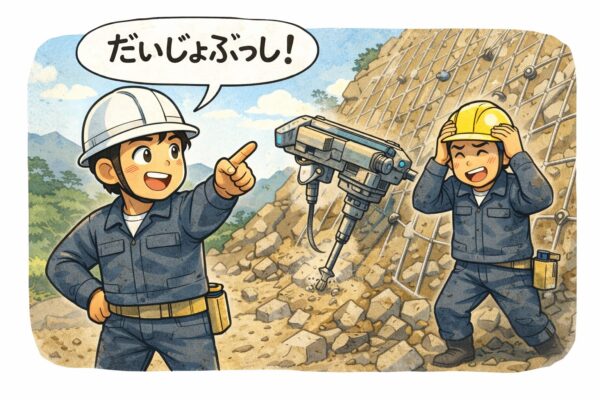
① Unconscious Incompetence
The stage where the person is not yet aware that they "aren't doing it"
Common Conditions at Slope Construction Sites
- Even though the spray thickness isn't sufficient, "It's pretty much OK, right?"
- Even if the number of anchors installed for the lath is insufficient or the lath overlap is insufficient—and thus does not meet specifications—it does not look out of place.
- I'm not aware that the drilling angle is off.
- Even if the safety harness isn't fastened properly, "That's just how it's always been."
Hazardous Areas
- He thinks he's taking it seriously.
- This is where the “seeds” of accidents and construction defects are sown
- The highest accident rate and rework rate
When giving instruction,
- ❌ Don't just snap, "That's not right!" and scold them without listening!
- ⭕ Illustrated with photos, diagrams, and figures—all from books, past projects, and actual construction sites to demonstrate and teach
- Comparison photos of the person's incorrect installation and the correct installation
- Display angles, lengths, and other measurements as numerical values.
👉 It’s extremely important to “make people realize”!
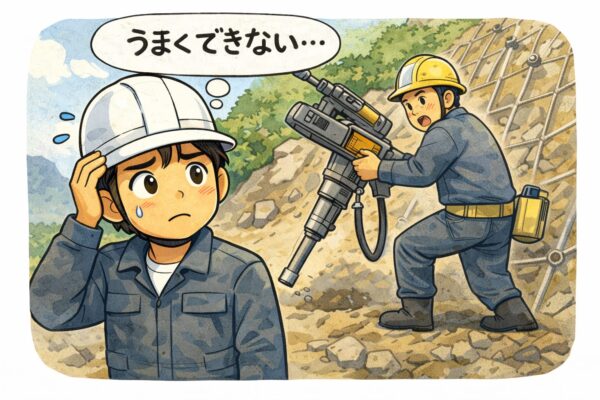
② Conscious Incompetence
The stage where you're aware of what you haven't been able to do
Conditions on Site
- "I'm scared to measure the finished product..."
- "I'm not sure if I gave clear instructions on the drilling angle and drilling depth."
- "I'm doing exactly what I was told, but it's taking too long."
- Watching my senior colleague work, I feel, “It’s completely different…”
- To feel anxious
- I lose confidence
- I want to hide my mistakes
When giving instruction,
❌ “How many times do I have to tell you?” Cutting people off like that is just workplace harassment.
⭕ “It’s only natural that you can’t do it right now” (If you try it enough times, you’ll be able to do it)
Specific Measures:
- Break the task down into small steps
- Prepare → Verify → Execute → Check
- If you set one theme per day, you're less likely to make mistakes.
- "Today, let's make sure to double-check the drilling angle and drilling depth, at the very least."
👉 Don’t blame yourself for “not being able to”(Nobody could do it at first, after all!)
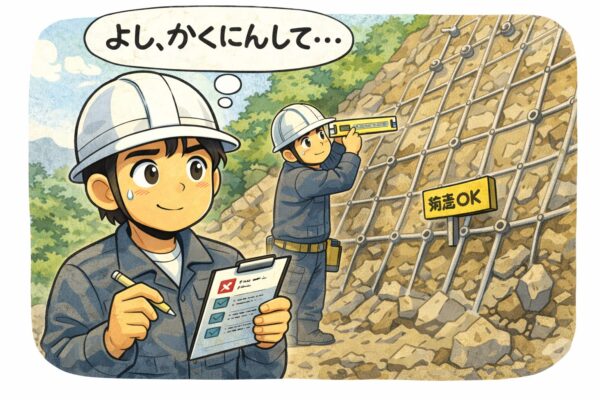
③ Conscious Competence
The stage where, with a little effort, you can follow the rules
Conditions at the Slope Construction Site
- We can perform the work as long as we check as we go.
- You can measure the dimensional deviations yourself and instruct the craftsmen to make adjustments.
- Perform the work while checking the drilling angle and drilling depth each time
- Carry out the procedure with a focus on reattaching the safety harness
Areas that are still unstable
- When I'm rushed, I make mistakes (I get thrown off by something unexpected).
- It tends to fall apart when conditions change.
- Multitasking can lead to a decline in concentration
When giving instruction,
- Don't focus on speed
- Define the procedure as a "template"
- Explain why that standard was chosen
- Why is that angle necessary?
- Why is this location important?
👉 Through repetition“Reproducibility”The stage of enhancing
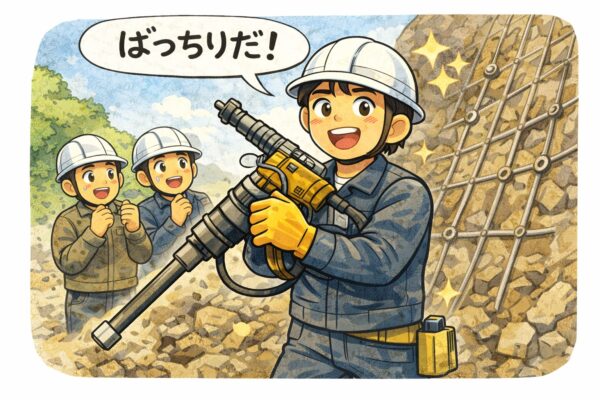
④ Unconscious Competence
The stage where your body moves on its own without having to think about it (master craftsman)
- Construction Management at a Slope Construction Company: The Pinnacle of a Craftsman’s Career
- I can intuitively tell when something isn't quite right or looks suspicious
- Instantly identify errors or accuracy issues in drilling angles
- The finish of the last layer is beautiful
- My eyes are drawn unconsciously to hazardous areas and critical points on the job site.
Pitfalls (Common Experiences for Veterans)
- "You can tell just by looking, can't you?"
- "Learn by feel."
- My teaching becomes sloppy
Key Considerations for the Company Going Forward
- “Visualizing” This Person's Skills
- Creating a Checklist
- Videos and Photos
- Articulating Numerical Criteria
👉 Turning Tacit Knowledge into Explicit Knowledge(If this isn't documented or explicitly stated, it's just a matter of intuition.)
Where do I stand?
Where do the subordinates and junior colleagues I’m mentoring stand?
By thoroughly understanding this, you can improve the accuracy of construction and construction management.
I actually think this works surprisingly well as a self-assessment, too.
I put together the table below, so where do I stand?
Let's think about it.
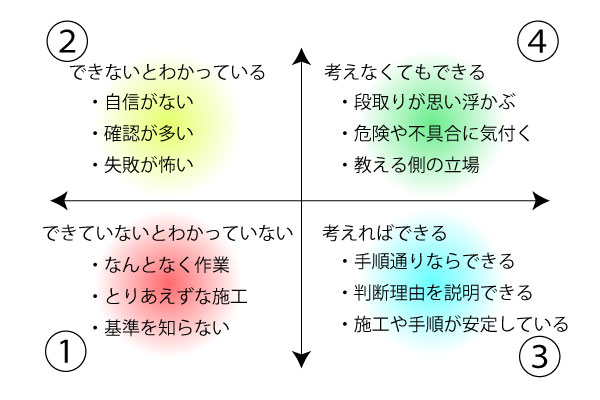
The coach will be at position ⑤ lol (even though it's not written there).
The Growth of Slope Construction Companies
① → ② → ③ → ④ Apparently, you must follow this order!
✔ It's normal to struggle with ②
✔ Once you reach step ③, the situation will stabilize
✔ Point ④ is the culmination of “skill + judgment + experience”
There are all sorts of possible items depending on your perspective, but it might be a good idea to get creative and try making some.
See you later.