Hello, everyone.
This is Enta.
I went to South Korea the other day for a meeting.
We have entered an era where we are manufacturing overseas the things that can no longer be produced in Japan.
As we were discussing this, it became clear that this trend is really taking off in South Korea as well—and there are actually things that even South Korea can’t produce!?

And at the same time, the serious issue is, of course, the labor shortage!
There are no young people, so we can't make anything!
In industries such as construction, nursing care, and transportation, the pattern of “young people aren’t coming, so foreign workers are keeping things going” is a common one!
It seems that South Korea, like Japan, is actively accepting immigrants from Vietnam, Nepal, and Indonesia.
The construction industry, in particular, has reached a point where “construction would grind to a halt without foreign workers,” making the situation extremely critical.
Why Has South Korea's Birth Rate Declined?
South Korea's declining birth rate is not simply a result of "young people losing interest in romance," but rather the outcome of a complex interplay of social structures and culture.
The following is a summary of the main factors I heard about.
(1) Men’s Military Service and the Prolonged Competition for Educational Attainment
In South Korea, men are required to serve in the military (for about two years).
As a result, many people enlist while still in college, and
Furthermore, South Korea is an extremely meritocratic society where students aim to get into “prestigious universities,” to the point where parents will even go into debt to send their children to study abroad while they’re still in school.
As a result, it’s generally said that people tend to graduate from college around the age of 28!!
This structure is causing people across society to delay marriage and childbearing.
② The Rising Age of First Marriage and the Lack of a “Age-Gap Marriage Culture”
In this country, very few people get married in their 20s, and it’s not uncommon for people to marry for the first time in their late 30s (especially women around age 37).
Furthermore, since marriages with a significant age gap are not as common as they are in Japan, both men and women tend to strongly prefer marrying someone of a similar age, and
Apparently, this is making it even harder to find the right time to get married.
That means I might have to postpone giving birth—or even choose not to have a baby at all!
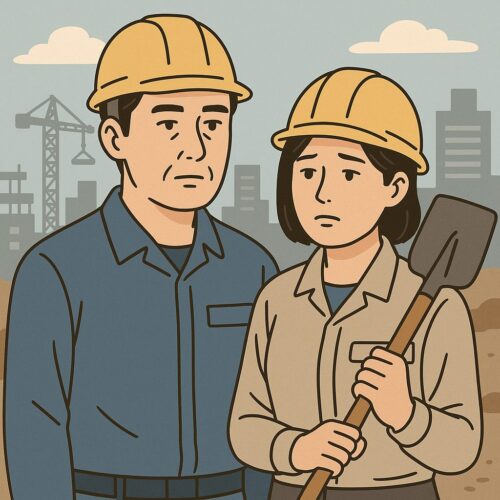
③ The Burden of Education Costs on Household Finances
In South Korea, there’s a strong tendency to “focus educational resources on a single child,” and apparently there’s a culture where families allocate a large portion of their household budget to cram schools and private tutoring...
As a result, more families have come to believe that “having many children is financially unfeasible,” and a trend of hesitating to have children has taken hold.
④ Changing Attitudes Toward Marriage and Childbirth
Another characteristic of South Korea is that many couples and young people openly declare that they “won’t get married” or “won’t have children.”
There is a growing social climate that does not reject this view, and it seems that the idea that “marriage is a burden” and “it robs you of your freedom in life” has also taken hold,
That tech girl said so too, lol (I asked her all sorts of things).
Marriage itselfA Difficult ChoiceThat means it is in that state.
The result is the world's lowest birth rate!
Let's take a look at the 20 countries with the lowest birth rates in the world.
| Rank | Country/Region Names | Birth Rate (Total Fertility Rate: The average number of children a woman gives birth to in her lifetime) | Key Background and Features |
|---|---|---|---|
| 1 | Taiwan | 1.09 | Education and housing costs are high, and there is a strong tendency to avoid having children. |
| 2 | South Korea | 1.11 | The lowest in the world. Late marriage, choosing not to marry, and the burden of education costs. |
| 3 | Singapore | 1.17 | The cost of urban living is high in high-income countries. |
| 4 | Ukraine | 1.20 | War and economic uncertainty are having a severe impact. |
| 5 | Hong Kong (Special Administrative Region of China) | 1.20 | Cramped living conditions, educational competition, and later marriage. |
| 6 | Macau (Special Administrative Region of China) | 1.20 | Even with financial stability, it’s difficult to start a family. |
| 7 | Moldova | 1.30 | Brain drain and economic instability in Eastern Europe. |
| 8 | Italy | 1.30 | A Southern European-style decline in the birth rate. Young people remaining unmarried and facing long-term unemployment. |
| 9 | Spain | 1.30 | Job insecurity, soaring housing costs, and women entering the workforce. |
| 10 | Poland | 1.30 | The Gap Between Traditional Values and Modern Life. |
| 11 | Japan | 1.31 | The trend toward later marriage, the rise in single-person households, and the financial burden of childcare and education. |
| 12 | Greece | 1.32 | Delays in Starting Families Following the Economic Crisis. |
| 13 | Hungary | 1.33 | Even with increased government support, the effects are limited. |
| 14 | Romania | 1.34 | The exodus of young people overseas and the growing number of people living in poverty in Japan. |
| 15 | Slovakia | 1.35 | The trend is downward compared to the European average. |
| 16 | Croatia | 1.36 | The outflow of immigrants continues. People are starting families later. |
| 17 | Portugal | 1.37 | A social structure that makes it difficult to balance work and family life. |
| 18 | Mainland China | 1.38 | The lingering impact of the one-child policy and the trend of young people avoiding marriage. |
| 19 | Czech Republic | 1.39 | Amid social security reforms, family support systems are still in the early stages of development. |
| 20 | Thailand | 1.40 | Urbanization, a focus on education, and changing attitudes toward marriage. |
The labor shortage—which is also occurring outside Japan—is set to accelerate even further!
Is there really no choice but to welcome not only us Japanese but also people from overseas?
There are things you might surprisingly overlook if you only focus on your own country, but traveling to other countries or working with people from other countries allows you to see them from various perspectives.
In every country, society has become one where the younger generation cannot live with peace of mind.
Is it true that only “people with plenty of leeway” can get married and raise children!?
The president of that company also said that construction projects, such as infrastructure, are shrinking rapidly to an unimaginable extent.
To that end, I hear they’re also doing business with countries overseas that are expected to prosper in the future....

While business succession is certainly a top priority, this experience really made me realize that there are so many other urgent matters that need to be addressed as well!
What does the future hold for us small, local slope-construction companies?
Is this a timeline where only the big players survive?
It seems to me that construction companies are facing a sudden and growing need to accelerate their hiring of foreign workers.
For now, that's the only way!
That's already the norm in South Korea, too.
Because that's the only option.
There are many people in Japan who oppose the arrival of immigrants and trainees.
However, they are already taking care of that person's daily life.
These are the technical interns that we Japanese employ.
Despite that, it still draws criticism.
I can sort of see where you're coming from, but politically speaking, it's already too late for that...
I feel like we're facing a difficult situation!
Personally, I’d like to focus my efforts on initiatives that not only hire foreign workers but also completely transform the slope stabilization industry going forward.
I believe that might be the path that keeps us alive, lol
These are tough times, but let’s live strongly in the present without making excuses about the times we’re in!
See you later.