

Hello, everyone.
This is Enta.
The other day, I came across an article online that said you should be careful with place names containing this word, so I thought I’d share it with you.
I suppose it was probably published in a magazine somewhere.
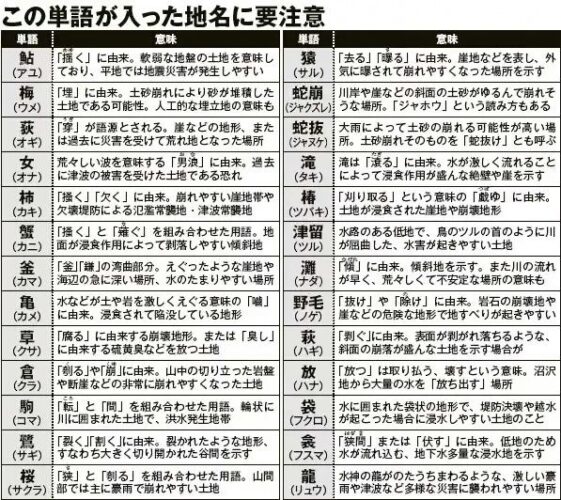
I thought this was hard to read, so I transcribed it.
鮎
(Ayu)
Derived from the word “yuku.” It refers to land with weak subsoil, where soil-related disasters are likely to occur on flat terrain.
猿(Monkey)
Derived from the words “to leave” and “to expose.” Refers to cliff faces and similar terrain, indicating areas that have been exposed to the elements and have become prone to collapse.
梅(Ume)
Derived from the character “埋” (buried). This may refer to land where sand has accumulated due to a landslide. It can also mean an artificial landfill.
Jakuzure
A place where the soil on a slope—such as a riverbank or cliff—has become loose and is in danger of collapsing. It is also pronounced "Jahou."
荻(Ogi)
It is believed to derive from the word “uga.” It refers to terrain such as cliffs, or areas that have become wasteland due to past disasters.
Snake Extraction(Januke)
Areas where there is a high risk of landslides due to heavy rain. Landslides themselves are also called “januke.”
女(Masturbation)
Derived from "Ona," which means "raging waves." There is a concern that this area may have suffered tsunami damage in the past.
滝(Taki)
"The word 'waterfall' derives from the verb 'to boil' (tagiru). It refers to sheer cliffs and precipices where erosion is intense due to the force of the rushing water."
柿(Oyster)
Derived from the words “to scrape” and “to chip away.” Areas prone to frequent flooding or tsunamis due to unstable cliffs or breached levees.
椿(Camellia)
Derived from “sobau,” which means “to harvest.” Cliffs and landslide-prone terrain where the land has been eroded.
蟹(Crab)
A term combining “kaku” (to scratch) and “chigu” (to sweep). Sloped terrain where the ground is prone to erosion and collapse.
Tsuru(Crane)
A low-lying area with waterways, where the river winds like a crane’s neck, making it prone to flooding
釜(Kama)
The curved parts of the characters “kama” and “kama.” Cliffs that appear to have been carved out, areas along the coast that drop off steeply, and places where water tends to pool.
灘(Nada)
Derived from "kashige" (incline). Refers to a sloping area. It also refers to a place where the river flows rapidly and is turbulent and unstable.
Turtle
Derived from the word “kamu” (to bite), which refers to the violent gouging of soil and rock by water or other forces. A landform that has been eroded and collapsed.
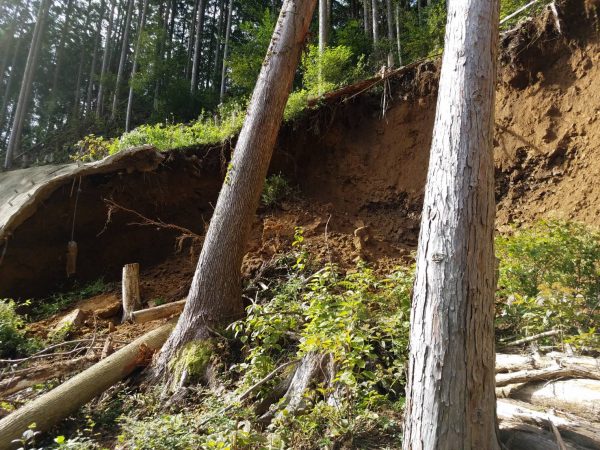
Noge(Noge)
Derived from the terms “nuke” and “yoke.” Landslides are likely to occur in dangerous terrain such as areas of rockfall and cliffs.
Grass (Kusa)
A type of landform resulting from decay, or land that emits a sulfuric odor, derived from the word “rot.”
萩(Hagi)
Derived from the verb “to peel off.” It is sometimes used to describe areas prone to landslides, where the surface appears to peel away.
倉(Kura)
Derived from the words “kuru” (to hollow out) and “kuzure” (to crumble). Land in mountainous areas—such as steep bedrock and cliffs—that has become extremely prone to collapse.
放(Hana)
"Release" means to remove or destroy. A place where large amounts of water are "released" from the marshland.
駒(Panel)
A term combining "koro" (roll) and "to" (question). A piece of land surrounded by a river in a circular pattern, located in a flood-prone area.
Bag (Fukuro)
A bag-shaped area of land surrounded by water that is prone to flooding in the event of a levee breach or overtopping.
Heron
Derived from the verbs “to tear” (saku) and “to split” (saku). Refers to terrain that appears to have been torn apart—that is, a valley that has been deeply carved out.
Fusuma
Derived from “hazama” or “fusu.” Refers to a low-lying area prone to flooding due to water flowing in, characterized by high groundwater levels.
Cherry Blossoms (Sakura)
A term combining "narrow" (sa) and "to hollow out" (kuru). In mountainous (Sakura) areas, it refers primarily to land prone to landslides caused by heavy rain.
Ryū (Dragon)
A place prone to a variety of disasters, such as torrential rains and tsunamis that seem as if the Water God’s dragon were writhing about
How about you all?
Are kanji like the ones listed above used in any areas you're familiar with?
So, these kinds of traditional oral traditions are represented by the names of the regions, aren't they?
That's very interesting.
See you later.