Hello, everyone.
This is Enta.
I often receive inquiries from individuals regarding erosion prevention.
We were talking about that very thing the other day, too.
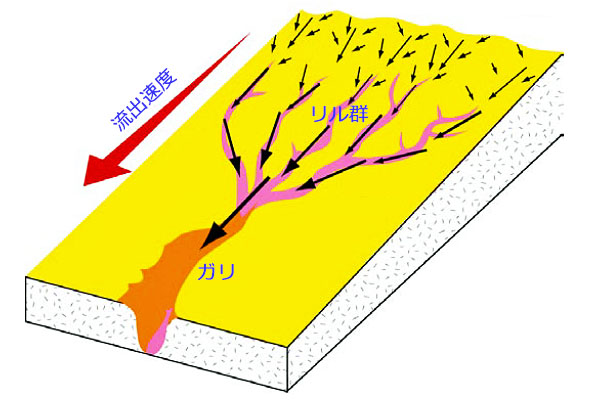
I think most of the erosion commonly seen on private land is gully erosion.
For some reason, the grass disappears, leaving bare ground that is then eroded away by the rain.
If it rains before the grass has a chance to grow in properly, the ruts will get deeper and deeper.
When that happens, surprisingly few weeds grow.
And it keeps getting whittled away.
I'm going to try writing down some measures to address that.
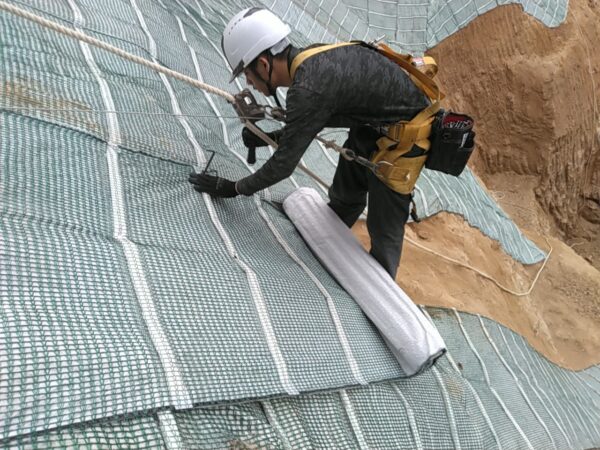
To be honest, the easiest option is a vegetation mat.
Since it contains seeds and fertilizer, it provides reliable protection for both even during heavy rain.
And over time, grass will grow, providing solid protection against erosion. (This does not prevent collapse or similar issues.)
However, even if you do the installation yourself, I think it will cost around 1,500 yen per square meter (including nails and anchors).
Of course, please understand that our unit prices are different from yours.
Cheaper!
If that's the case, I think you can do it yourself using the following method.
1. Prevent water (rainwater) from flowing in from the top of the slope.
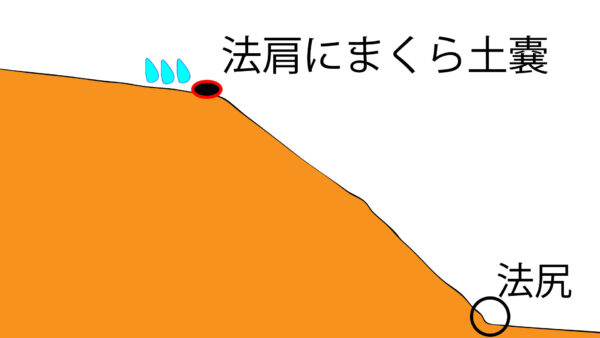
Please lay weather-resistant sandbags along the shoulder of the slope (the shoulder of the slope) to prevent water from flowing down the slope.
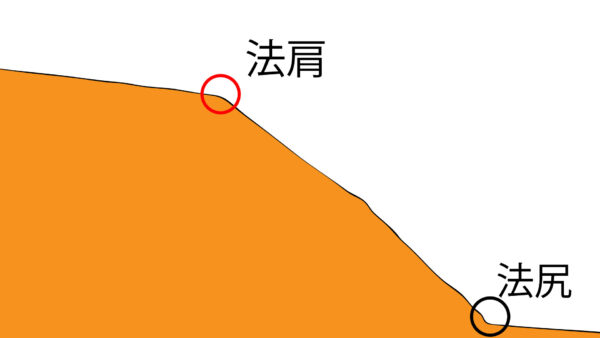
The area circled in red is the shoulder line.
It’s important to line up sandbags here to slow down the water flow as much as possible while preventing the water from flowing away.
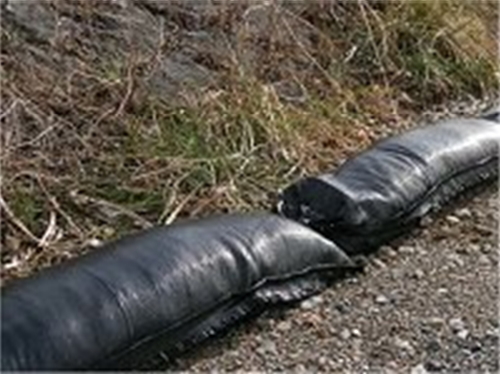
If possible, stacking them in two layers and arranging them in a staggered pattern would be even better.
Then, mix the seeds with fertilizer and spread them at the best possible time.
From September through November and from March through July, add water, weed seeds (rhizomes are recommended), and fertilizer (high-grade compound fertilizer) to a 20-liter bucket.
Apply fertilizer in moderation—just enough to spread it evenly. If you use too much, the plants will die. (About two handfuls.)
You don't have to be exact with the amount of seeds. (It's fine whether it's three or four handfuls.)
Sprinkle it while stirring with a ladle.
If there doesn't seem to be much rain, sow the seeds about once every three days to encourage early germination.
I think it should be fine for now as long as I trim the sprouts.
It will grow to some extent in about a week. In about a month, it will be quite lush.
As long as the roots are well-established and the plants are thriving, they’ll be fine to some extent even if it rains.
However, it offers absolutely no protection against heavy rain.
It's really just minor erosion, so don't get your hopes up about the vegetation, lol.
For your reference
See you later.
Weather-Resistant Sandbags
Vegetation Mat Installer
Advanced Chemical Fertilizer
White Clover
The deadline is Friday, October 18, 2024.