Hello, everyone.
This is Enta.
This is a continuation of my previous post.
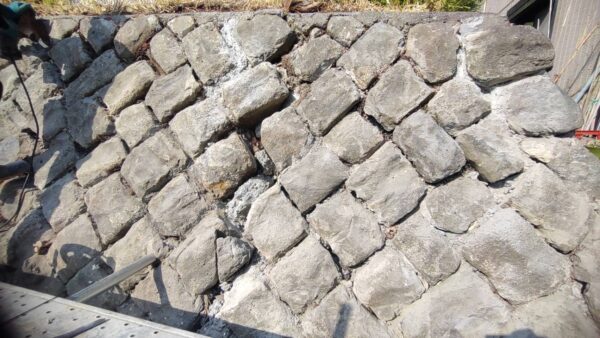
Today, I’ll be writing about how to deal with situations where stone masonry is bulging out.
The fact that it’s oozing harami means it’s already in a state of internal collapse or on the verge of collapse.
If you leave it as is, it might collapse eventually.
The reason it is on the verge of collapsing is that the rocks are being pushed out due to rising internal pressure.
Water is the cause of the increase in internal pressure.
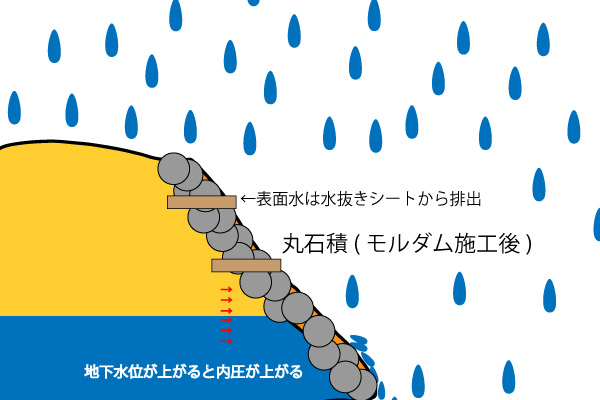
It's going to rain.
The mountains are soaking up the rain drop by drop.
As a result, the groundwater level in the mountains will rise.
If there is no outlet for the water to escape, the internal pressure will continue to rise, eventually pushing against the masonry and other structures in an attempt to break through.
This means that when the strength of the stone masonry is overcome, it will collapse all at once.
As I mentioned the other day, that’s precisely why you shouldn’t cover it with sprayed mortar.
If you cover it up, you'll hide everything and erase the situation, so that won't work.
As a countermeasure in this case, reduce the internal pressure.
This is the most important thing.
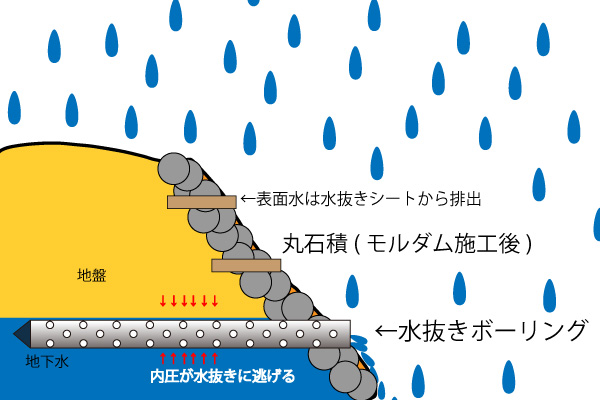
One of the construction methods we often use is,
We connect the stone masonry using the Moldam method.
(While connecting the deteriorating stone walls would improve their overall stability,
(Since the individual units do not move when the structure shakes, this could make the structure vulnerable to earthquakes, so a combined construction method is used as a countermeasure.)
After that, we will drain the water from the inside using a dewatering drilling method.
Just doing this can significantly reduce the risk of collapse.
This means that since the internal pressure doesn't increase due to water pressure, there's no way it could collapse.
The same measures are taken as collapse prevention measures in slope stabilization work for public works projects.
Next time: If you absolutely don't want your stone wall to collapse, this is the way to go!
I'll be writing about that.
See you later.