Hello, everyone.
This is Enta.
I just found out recently that even construction workers seem to be reading this blog!!
I'm surprised.
That’s because it seems the earthwork crew at the same job site noticed me and came over to say hello!
Actually, I thought that probably only slope engineers were looking at it, but,
It's a little embarrassing knowing the construction workers are watching, lol.
Since I'm the one reaching out, I won't know about any of you unless you contact me.
Well, if we happen to run into each other somewhere, please say hi. Just work up the courage, lol.
But that's beside the point.
Cement Slurry Formulation
When it's this hot, the cement slurry sets super fast!
I was mixing it using the usual recipe, but quite a few lumps were forming on the edge of the mixer.
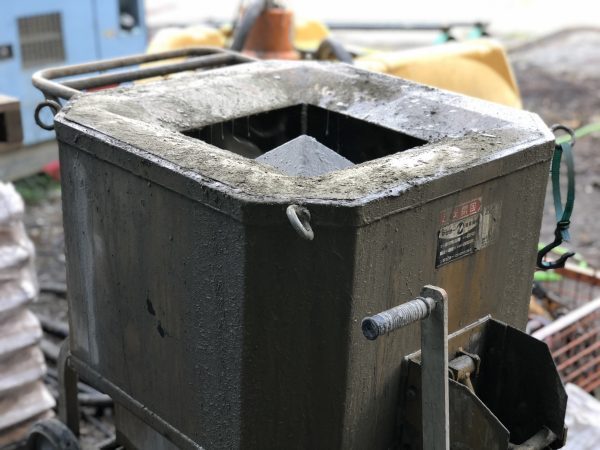
In the past, this was often included in design documents as a standard mix, but nowadays, for rebar insertion work—which is now priced based on market rates—it’s rarely specified at all.
The following is a traditional formulation that has been around for a long time. These days, it’s mostly just listed as an example by materials manufacturers.
| Ingredients | Cement | 水 | Admixture |
| Mixing Ratios | 1,230 kg | 50–55% | 2% or more |
Generally speaking, the water-to-cement ratio is set at 50%, right?
In fact, even at 55% during the summer, the strength is sufficient.
But I'm still worried, so honestly, I don't really want to post this here, lol.
Now, I’ll explain how to make it so that it has good fluidity and high strength during the summer.
Well, I guess that makes sense, but first of all...
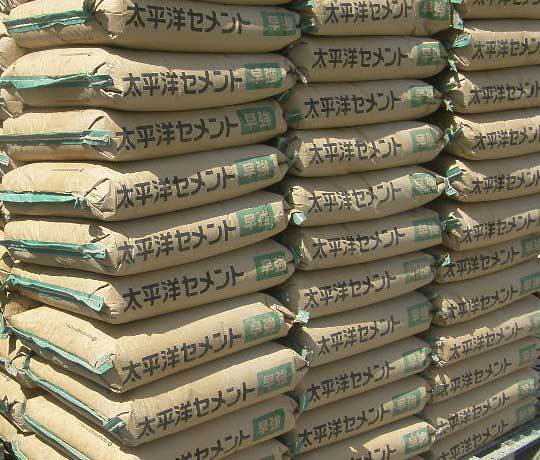
Use ordinary cement instead of fast-setting cement.
During the summer, even ordinary cement will reliably reach θ = 24 kN within seven days.
On the other hand, depending on the region, there might even be people who’ve only ever used regular cement! lol
The Tokai region actually uses quite a bit of fast-setting cement. It’s just common practice to use fast-setting cement there. (I don’t know why.)
If there is enough time in the construction schedule, regular cement is sufficient.
When using ordinary cement, the mixture becomes runnier than when using high-early-strength cement, so its workability is quite high.
Also, since it takes quite a while to cure, it makes the work easier.
Increase the amount of admixture
I think people generally only add about 2%, but it’s actually effective up to about 4%!
That said, according to the instructions in the LeoBuild 4000 catalog,
The standard dosage is 2,000 mL of undiluted solution per 100 kg of cement, but depending on the intended use,
Please use the undiluted solution in the range of 1,000 to 4,000 mL.
That's what it says.
So, that means you can invest up to 4%.
If you find that the fast-setting cement is too hard, do not dilute it with water.
It's better to loosen it with a mixing agent.
If diluted with water, there will be a significant decrease in strength.
When diluting, use a mixing agent!
Craftsmen don't really know much about that, so they tend to try to dilute it with water right away.
Please absolutely do not do that.

If possible, please explain this to them—that way, once they have this knowledge, they won’t have to worry about insufficient strength in the future.
Cement gains strength when less water is used.Please tell me about that.

However, there is a downside: if you add too much admixture...
The salt concentration increases quite a bit.
That said, since the rebar insertion fittings are already hot-dip galvanized, it shouldn’t really be a concern, but,
This is a bit of a problem from an administrative standpoint... Please be careful when using Kantab.
Some interesting results have emerged from research on salt concentration and carbonation, so I thought I'd share them for your reference.
Understanding the Effect of Salt Content in Hardened Cement on Neutralization The Japan Society of Civil Engineers
There's one more, so I'll save that for tomorrow!
See you later.