Hello, everyone.
This is Enta.
Have you ever thought about the balance between workability and quality in quality control?
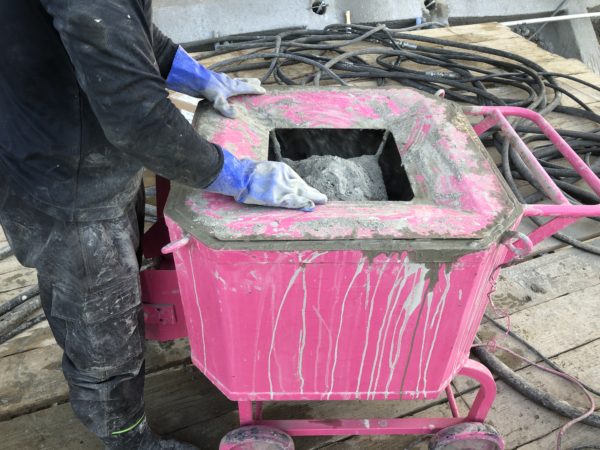
This is the cement slurry we use most often.
In the flow test, it takes 10 to 18 seconds, with a maximum of 22 seconds (for railways), right?
How long does it usually take everyone to complete the installation?
Well, generally speaking, it's around 14 seconds, right?
That's about how often I do it, too.
But recently, I started wondering: wouldn’t it actually improve work efficiency if we drastically reduced the workability of the cement slurry?
That's because the pumps used in ground anchor construction and similar projects push the slurry out with considerable force.
We use an MG10 or a squeeze-type pump to transfer the material, and it can handle materials that are fairly thick.
Well, there are standard values, so I’d like the supervisor to use their discretion in that regard, but if we look at it from an extreme perspective, the most important aspect of cement slurry is its strength, isn’t it?
As long as it maintains its strength while still being fluid, there's no problem.
And this fluidity translates into ease of use.
Based on my experience, I think it should be fine as long as you can send it within about 25 to 30 seconds. (Personal opinion)
Just be careful, though—if it’s too hard, it’ll get stuck halfway through and things will get really messy lol.
Actually, it takes about 25 seconds,
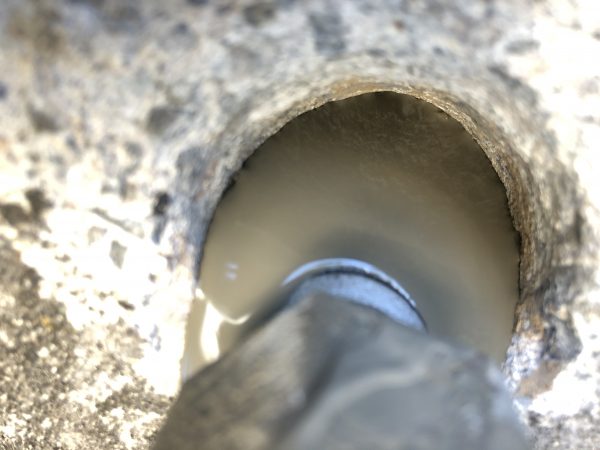
As for the reason for making it stiffer, I feel it would be better to lower the W/C (water-to-cement ratio) to reduce bleeding and minimize settlement after grouting, even if only slightly.
Depending on the contractor, they might perform follow-up grouting over and over again, but each time they do that, they’re essentially creating cold joints inside the structure, and I can’t help but wonder, “Is that really okay?”
In that case, wouldn't using a slightly thicker cement slurry improve workability since it would only require one additional pour?
Some of you might think, “That can’t be that much trouble, can it?” But when the distance is far, the height is significant, or the job requires a thorough cleaning, it actually becomes quite a bit more work. (From a contractor’s perspective)
However, since I believe that top-up injections should be performed, this is a way to save even a little time.
When applied using 50% water-to-cement ratio, 2% admixture, and 200 kg of cement
Cement: 8 bags, admixture: 4 L, water: 96 L
Reduce the amount of water by about 2 to 4 liters at this point.
If you do that, you'll end up with a nice, thick cement slurry.
Please be very careful, as there is a possibility that messages containing terms like "Pekopon" may not be sent.
Naturally, there are also opinions that if it’s too hard, it will affect the adhesion to the subgrade.
But think about it carefully.
In ground anchor construction, the borehole depth is 7 meters or more, and the internal pressure when cement slurry is injected is immense.
The same applies to rebar installers.
When internal pressure is high, the pressure tends to spread outward from the interior, causing it to seep into the surrounding rock mass.
I believe there are absolutely no issues with the anchored section (the undisturbed soil section). (Both strength and workability are satisfactory.)
(Although this is off the record, government officials usually understand once we explain it to them.)
However, since the standard values and mix ratios are up to the supervisor’s discretion, I’ll leave that up to you lol.
In flow tests, lower workability of the cement slurry actually results in better workability.
In the case of NEXCO, since work standards and construction standards are tested on-site, this kind of thing is sometimes possible.
See you later