Hello, everyone.
This is Enta.
I've had a slight cold for the past few days.

I hadn’t had a cold in about three years. So when my nose started running the day before yesterday, I thought, “Maybe it’s pollen?” Then the other day, I woke up with a fever and couldn’t even move (lol). It’s so rare for me that it was really tough. I did my usual tea gargle and went to my regular doctor, where I got one of those shots—the kind where I never know what’s actually in it. This shot works like a charm, so I’ll be back to normal by tomorrow. Please be sure to take good care of your health during this time of year.
But that's beside the point.
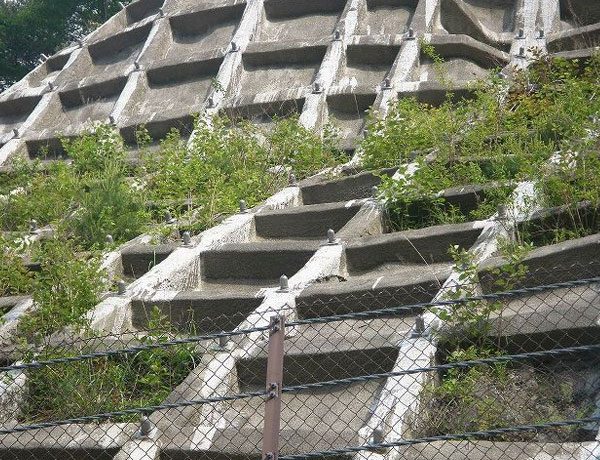
Have you ever seen an overflow like this?
Have you ever seen construction work like this? (lol)
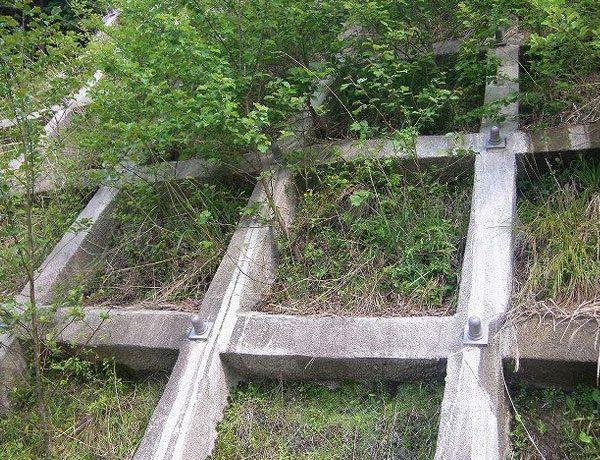
That's pretty bad, isn't it? I mean, this is...Instructions from the government officeThat's what I've heard, anyway.
It seems they're checking to see if an overflow is occurring.
So, that's what this mark is.
It ruined the whole look!
It is true that grout injection for rebar insertion and ground anchor work is described in documents such as the Toyama Prefecture Rebar Insertion Manual (Draft) as “After starting the injection, continue injecting without interruption until cement slurry begins to flow out of the borehole opening." is stipulated.
In other wordsDischarge (overflow) from the orifice is itself a requirement specified in the specifications.So, I have no objection to that.
However, nowhere in the specifications does it say that the water should be allowed to drip so profusely—as shown in the photo—that it soils the formwork or the mortar surface.
「It would be fine if we could confirm the discharge."That's what it says," but it doesn't say, "Let it overflow in large quantities."
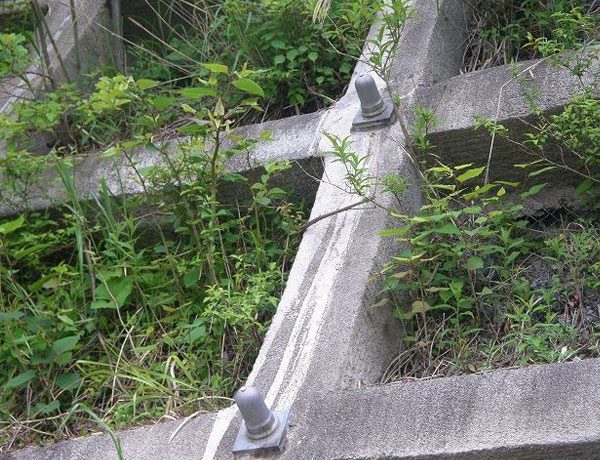
Bottom-up pouring and rich milk keep the mold clean
Personally, from the very beginning,I want to feed the concentrated milk from the bottom so that it flows as little as possible.That's right lol
It'll get dirty, won't it? Like the frame and the mortar surface.
If you think about how much work it is to clean it when it gets dirty, it’s better not to spill it in the first place.
To begin with, bottom injection (the push-up method from the bottom of the borehole) is described in the Toyama Prefecture manual as “Injection must be carried out promptly from the bottom of the borehole."This is the standard procedure, as clearly stated."
It’s like replacing the contents inside the hole with milk while allowing the air and bleeding water to escape upward.
If the water-to-cement ratio (W/C) is set slightly lower here, the amount of bleeding will decrease, making it less likely for voids to remain within the pores.
The cement slurry used in rebar insertion and ground anchor work is generallyW/C = 45–50%That's the general range, but,
If you adjust the mixture to be slightly thicker based on the on-site ground conditions and the injection pump’s capacity, runoff will decrease, and there will be a noticeable reduction in dirt on the slope formwork.
Although injection resistance increases as viscosity rises, modern grout pumps should have ample discharge capacity.
Actually, we don't need any photos to confirm the overflow.
I don't need it.
Quite a few people take photos, but even if you don’t, the inspectors won’t say anything about it (this is just based on my experience; depending on the client or the special specifications, photos may be required in some cases).
What really matters in testing is,The entire borehole is filled with grout of the same composition.That's the point.
Whether this is guaranteed or not is the essence of quality; photos that are overflowing from the viewfinder do not equate to that guarantee.
So, while there’s not much we can do if there’s water inside the casing, we’ll try not to get it dirty as much as possible.
That way, it'll be easier to clean up later on.
The quality of the finished product directly affects how the project is evaluated on-site.
After all, it’s always better when the work site looks neat and tidy.
If it looks like this photo, even if the frame itself turned out beautifully...My impression of it took a nosedive at the very end,It will happen.
When clients or supervisors visit a job site, I feel that the visual impression they get plays just as big a role in their evaluation as the actual performance metrics.
There may not be an item labeled “aesthetics” in the inspection guidelines.
However, in reality, it’s also true that sites with less debris are more likely to be chosen for the next project.
Develop an injection procedure that meets the quality requirements specified in the specifications while preventing unnecessary contamination.
I think this is ultimately a way to avoid reducing both the effort and the trust involved.
See you later.
Cement Slurry Is Pumped Up from the Bottom | The Key to Anchor Grouting